

Buying a Small Business vs. Index Funds: What a Laundromat's Cash Flow Actually Pays
A listing's 34% cash yield includes your wages. For one modeled $500,000 purchase, the return on cash ran from -6% to 27% as earnings moved 20% either way.
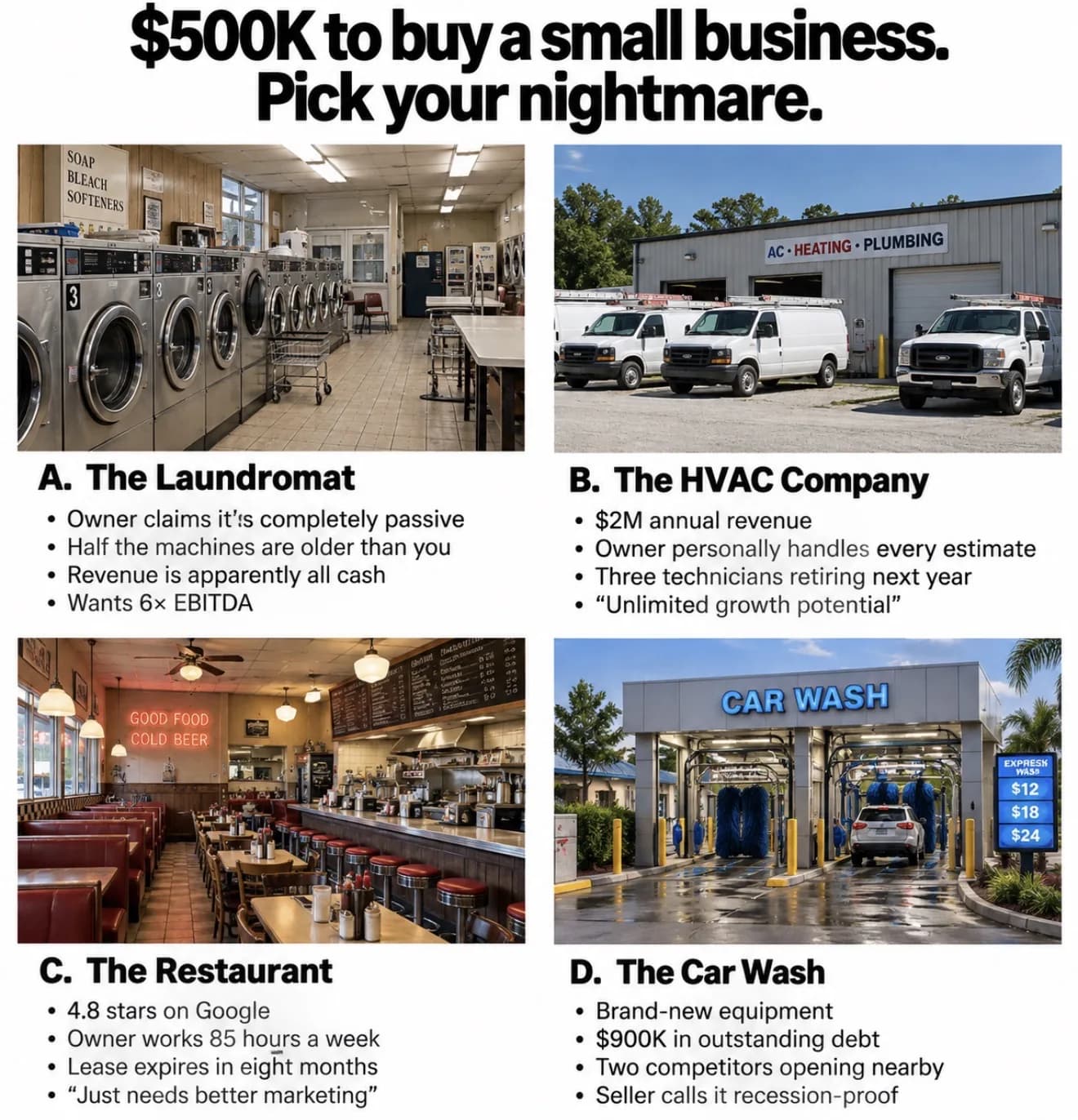
Source: @financedystop on X, October 24, 2026. The photos are illustrations, not real listings.
The graphic is a joke, and a useful one. Every option has a fatal-sounding flaw, and each flaw belongs to a different part of the math that decides whether buying a business beats leaving the same money in an index fund. The question behind it is a real one: should a DIY investor with a few hundred thousand dollars buy a laundromat, an HVAC company, a car wash, a storage facility or a restaurant instead of buying more stocks and bonds?
Quick answer
For someone who wants passive, diversified growth, index funds remain the better default. Buying a small business means buying a job together with a concentrated, borrowed-against, usually personally guaranteed investment, and a listing’s “cash flow” mixes your future wages with the return on your money. It can be the better path for a buyer who knows the industry, pays a price the business can carry after paying someone to run it, keeps cash outside the deal, and can survive a 20% drop in earnings. Industry expertise is not legally required, but the price you pay assumes the seller’s skill, and you have to replace it.
Each card hides a different line of the math
Small businesses are priced on seller’s discretionary earnings (SDE): pre-tax profit with one owner’s pay, interest, depreciation and one-time costs added back. BizBuySell, the largest marketplace for these sales, reports its “cash flow” figures on this basis. SDE is the money available to pay three different claims: whoever runs the business, the equipment that wears out, and the lender. The four cards each point at one of those claims.
| Closed sales, full-year 2025 | Reported sales | Median sale price | Median cash flow (SDE) | Average price / cash flow |
|---|---|---|---|---|
| Laundromats and coin laundries | 169 | $287,000 | $77,104 | 4.12x |
| HVAC businesses | 123 | $800,000 | $315,225 | 2.80x |
| Restaurants | 1,774 | $225,000 | $126,500 | 2.26x |
| Car washes | 32 | $700,000 | $230,000 | 4.73x |
| Storage facilities and warehouses | 8 | $697,500 | $201,019 | 4.60x |
Source: BizBuySell Insight Report data tables, closed transactions by sector, full-year 2025, read October 25, 2026. Brokers report these sales voluntarily, so they are not a random sample of all small business sales. The multiple is an average of deal-level ratios, so dividing the two medians does not reproduce it.
The multiples already tell you something. Buyers paid about 4x cash flow for laundromats and car washes and about 2.3x for restaurants. One likely reason: in a restaurant or contracting business, more of the SDE is the owner’s own labor, and more of it can walk out the door when the owner does, so buyers pay less for each dollar of it.
A. The laundromat: the cost is in the machines
“Completely passive” usually means the owner does the collecting, repairs, vendor calls and bookkeeping without counting them as work. Machines older than the buyer mean the seller has been skipping replacement spending, which inflates recent SDE: money that should have gone to new washers showed up as profit. Treat a replacement schedule as a yearly cost before you value the business.
All-cash revenue cannot be verified, and anything you cannot verify should be left out of the price. Lenders now require the same thing on larger deals: SBA’s current lending rules require an independent quality-of-earnings review, including a cash proof that reconciles bank deposits to the income statement and tax return, on any acquisition priced at $3 million or more.
“6x EBITDA” sounds expensive next to the 4.12x average, but it uses a different denominator. EBITDA is supposed to be after paying someone to run the place. For a laundromat with $100,000 of SDE that needs $30,000 a year of hired help, EBITDA is $70,000 and 6x is $420,000, or 4.2x SDE. What matters is whether that EBITDA charges for the labor and the machine replacement, not the multiple itself.
B. The HVAC company: the revenue belongs to the owner
$2 million of revenue says little about value; the 2025 median HVAC sale on BizBuySell had $1.27 million of revenue and $315,225 of cash flow. The serious problem is that the owner prices every job. In a contracting business the estimator is the sales department, and customers who called the owner for 20 years may not call the new one. Three retiring technicians are a hiring problem in a tight market: the Bureau of Labor Statistics projects HVAC mechanic jobs to grow 11% from 2025 to 2035, with a May 2025 median wage of $61,010, so replacements will cost more than the people leaving. The low 2.80x average multiple is consistent with buyers discounting that dependence on the owner. “Unlimited growth potential” is something the buyer would have to build, and a buyer should not pay the seller for it.
C. The restaurant: the owner’s hours are the profit
Eighty-five hours a week is 4,420 hours a year, a little over two full-time jobs. At the May 2025 median wage for food service managers of $69,390, replacing that labor would cost about $147,000 a year. If this restaurant earned the 2025 median reported restaurant cash flow of $126,500, it would not cover the cost of hiring people to do what the owner does. The 4.8-star rating describes the food; the lease describes whether there is a business to buy. A restaurant whose lease expires in eight months is worth what the landlord says it is worth.
D. The car wash: the debt sets the risk
New equipment is the opposite of the laundromat’s problem: no deferred spending. The $900,000 of debt is the issue, and whether it comes with the business depends on how the deal is structured (asset purchase, stock purchase or assumed loan). At 10% over ten years, $900,000 of debt costs about $142,700 a year to service, which is 62% of the $230,000 median car-wash cash flow in 2025, before two new competitors take any customers. “Recession-proof” describes demand. It does not cover a loan payment that stays fixed while volume and price both fall.
So which nightmare? Any of them can be a good purchase at a price that accounts for its flaw: the laundromat with a capex reserve in the valuation, the HVAC company with an earned-in seller transition and a lead technician, the restaurant only with a new long-term lease. The graphic leaves out the one number that decides each case, the price after paying for the flaw.
A $500,000 purchase, worked through
Here is one modeled deal, with every input stated. These are illustrative assumptions, not a listing, a lender quote or a forecast.
- Purchase price $500,000; verified SDE $170,000 a year.
- 20% down ($100,000) plus $50,000 of closing costs and reserves, so $150,000 of cash goes in.
- A $400,000 loan at 10% for ten years, monthly payments. Prime was 7.00% in October 2026, and SBA caps variable 7(a) rates on loans over $350,000 at prime plus 3%, so 10% is the highest rate an SBA lender could charge on this loan.
- $90,000 a year to pay someone to run it. That is below the BLS May 2025 median of $105,770 for general and operations managers, which favors the deal.
- $20,000 a year of maintenance capital spending.
| Year 1, this modeled deal | Amount |
|---|---|
| SDE in the listing | $170,000 |
| Less: market pay for running it | −$90,000 |
| Less: maintenance capex | −$20,000 |
| Cash available for the loan | $60,000 |
| Loan payments ($5,286 a month) | −$63,432 |
| Left over | −$3,432 |
The listing implies a 34% yield ($170,000 on $500,000). After paying for the work and the equipment, the business yields 12% on its price before financing. After loan payments, it is about $3,400 a year short. The debt coverage ratio, cash available divided by loan payments, is 0.95x. SBA lenders require at least 1.15x, though most do not subtract capex the way this table does.
If the buyer runs it personally, about $86,600 a year lands in their account. That is a salary for a full-time job, about $3,400 less than the job pays on the market. Owning the business adds no investment income on the $150,000 in year one.
Where the return comes from: paying down the loan
The first-year shortfall leaves out debt paydown. Each loan payment buys back part of the business from the lender, and by year ten the loan is gone. The table below follows the same modeled deal for ten years, charging $90,000 of labor every year whoever does the work, and selling at the end for the same multiple of SDE paid going in, less 10% in selling costs. SDE, wages and capex are held flat in each row.
| This modeled deal, 10 years | Debt coverage | Return on the $150,000 (IRR) | Wealth at year 10 |
|---|---|---|---|
| SDE 20% lower ($136,000) | 0.41x | −6.4% | −$157,000 |
| SDE as listed ($170,000) | 0.95x | 10.2% | $403,000 |
| SDE 20% higher ($204,000) | 1.48x | 27.3% | $962,000 |
| Same $150,000 in an index fund at an assumed 7% | n/a | 7.0% | $295,000 |
Pre-tax. Wealth counts the net sale proceeds plus each year’s surplus or shortfall carried at 7%. The 7% index return is an assumption for illustration, not a forecast. Calculated with the calculator below.
At the listed SDE, this modeled deal beats the assumed index return, 10.2% against 7%, because debt paydown turns into equity at the sale. A 20% drop in SDE, held for ten years, turns it into a loss: the owner would have to put in about $37,400 a year to keep the loan current, $374,000 over the decade, on top of the $150,000 at the start. In practice the business would more likely default first, and the personal guarantee would put the owner’s other assets behind the loan. A 20% rise lifts the return to 27%. With no loan at all, the same deal returns 9.8%, so most of the spread between outcomes comes from the borrowing.
Two more numbers from the same model. The year-1 SDE needed just to cover the loan after labor and capex is about $173,400. The highest price that $170,000 of SDE supports at SBA’s 1.15x coverage, with the same down payment and loan, is about $411,000, roughly 18% below the asking price.
What the research says about returns to owning a business
The evidence answers several different questions, and it is easy to mix them up.
Owners are wealthier on average, and the average is misleading. In the Federal Reserve’s 2025 Survey of Consumer Finances, 15.4% of families owned a privately held business. Among them, the median business was worth $75,400 and the mean $1,566,600. Ownership is concentrated at the top: about 8% of families in the bottom half of the income distribution owned one, against 40% in the top tenth. These are snapshots of wealth, not investment returns, and they mix founders, buyers and heirs.
The typical self-employed person earns less. Barton Hamilton (2000) found that people who had been in business for ten years had median earnings 35% below what they would have been predicted to earn in paid work. Hurst and Pugsley (2011) found that more than half of new small-business owners gave non-financial reasons such as being their own boss for starting, against about a third who cited income, and that most had no plan to grow much. Lower pay can be a rational trade for autonomy. It is still lower pay.
Concentrated private equity has not reliably earned a premium. Moskowitz and Vissing-Jørgensen (2002) found that about 75% of all private business equity was held by households with at least half their net worth in it, and that its returns were no higher than those of public equity, despite the far greater risk of holding one company. Kartashova (2014) revisited the data and found that the result depended on the 1990s bull market: from 1999 to 2007, private business returns ran well ahead of public stocks. Her windows start at the dot-com peak, a weak stretch for public stocks, so neither paper settles the question. Korteweg and Sørensen (2010) showed, for venture-backed firms, that correcting for the fact that private companies are valued only when something happens lowers their measured returns and raises their measured risk.
Startups fail often; acquisitions are a different case. From 1994 to 2022, 49.2% of new employer establishments survived five years and 33.9% survived ten, according to SBA’s Office of Advocacy. Those figures describe new locations, not purchases of businesses that have already survived. They do not mean a buyer has even odds of failing.
The strongest case for buying: search funds
Search funds are a version of buying a small company with published long-run returns. An MBA-trained searcher raises money from investors, spends a median of about 20 months finding one business, buys it and runs it. Stanford Graduate School of Business’s 2026 study, covering funds formed in the U.S. and Canada since 1984 with data through 2025, reports an aggregate pre-tax IRR of 33.9% and a 4.75x return on invested capital. Its public market equivalent of 2.88 means investors ended with about 2.9 times what the same cash flows would have earned in the S&P 500.
The same study shows why this is a poor base rate for an individual:
- Only 58% of finished searches ended in a purchase, and 48% for searches launched from 2021 to 2024.
- Of the funds that bought a company, 26% did not report a gain, and 39% of the losses were total.
- Excluding the top 10% of funds cuts the return to 2.1x and a 20% IRR. A few big winners produce most of the gains.
- The median purchase in 2024 and 2025 cost $16.0 million at 6.2x EBITDA, a different market from a $500,000 laundromat.
- The figures are investor returns, calculated from data the searchers supplied. The searcher’s own result, after a search on a modest salary, is a separate question.
How often SBA loans to these businesses went bad
No public dataset tracks what buyers earn on small businesses. The closest public record of outcomes is SBA’s loan-level 7(a) file, which lists every guaranteed loan with its industry code and whether it was repaid or charged off. We tabulated loans approved from fiscal 2010 to 2016, which have had nine to sixteen years to resolve.
| SBA 7(a) loans approved FY2010–2016 | Disbursed loans | Charged off | Still active | Share of dollars charged off |
|---|---|---|---|---|
| All 7(a) loans | 323,018 | 7.0% | 4.7% | 3.1% |
| Full-service restaurants | 16,413 | 9.0% | 5.3% | 4.6% |
| HVAC and plumbing contractors | 4,179 | 6.2% | 3.7% | 4.5% |
| Car washes | 1,394 | 6.1% | 9.8% | 2.1% |
| Laundromats | 1,193 | 4.4% | 5.2% | 1.6% |
| Self-storage lessors | 574 | 0.7% | 9.8% | 0.1% |
Source: SBA 7(a) FOIA loan data as of June 30, 2026; Summitward tabulation. Industries by NAICS code (812310, 238220, 722110/722511, 811192, 531130). Cancelled loans excluded. Script and output: summitward-research.
Restaurants had the highest charge-off rate of the five, about one loan in eleven. Restricting to loans with terms of ten years or less, which drops most real estate loans, raises every rate: 10.6% for restaurants, 10.8% for car washes, 6.8% for HVAC and plumbing, and 5.5% for laundromats. Self-storage loans are mostly secured by the property, which is why so few were charged off.
SBA labels a loan as financing a change of ownership only for fiscal 2018 and 2019 approvals. Across all industries, 4.6% of those acquisition loans had been charged off by mid-2026, against 8.1% for startups and 7.3% for existing businesses borrowing for other reasons. That supports the view that buying a going concern is less risky than starting one. It is an early reading: 36% of the acquisition loans are still being repaid, and SBA made payments on many 7(a) loans in 2020 and 2021 under the CARES Act, which delayed defaults.
Read these as lower bounds on owner losses. A charge-off is what the lender lost after seizing collateral and collecting on guarantees. An owner can lose their entire down payment on a loan that was repaid in full, by selling for less than they paid or by repaying it from personal savings.
What an SBA loan does and does not protect
Many small acquisitions are financed with SBA 7(a) loans, which go up to $5 million. The SBA guarantee protects the lender. Under 13 CFR 120.160, anyone owning 20% or more of the borrower generally must personally guarantee the loan, so a failed business can cost more than the down payment. An unleveraged index fund investor cannot lose more than they put in.
Under SBA’s lending rules (SOP 50 10 8.1, effective October 1, 2026):
- A buyer acquiring a business must put in at least 10% of total project cost, and lenders cannot reduce it.
- A seller note counts toward that equity only if it is on full standby, with no principal or interest paid for the life of the SBA loan.
- Seller earnouts are prohibited.
- Cash flow must cover debt payments at least 1.15 times, and on deals of $3 million or more the lender must use earnings from an independent quality-of-earnings review.
Taxes help less than the pitch suggests
Owning a business opens tax treatment an index fund does not get, and much of it defers tax rather than eliminating it.
- Qualified business income deduction. The 20% section 199A deduction for pass-through income was made permanent in 2025, with wider income phase-in ranges. Wage and income limits still apply, so it is not a flat 20% cut for every owner.
- Bonus depreciation. Qualifying equipment acquired after January 19, 2025, can be deducted in full in the first year, including some used equipment bought with a business.
- Goodwill is slow. The part of the price allocated to goodwill and other section 197 intangibles is deducted over 15 years. Buyer and seller report how the price is split among asset classes on Form 8594.
- Recapture on the way out. When depreciated equipment is sold, the gain up to the depreciation taken is taxed as ordinary income under section 1245.
For example, if $150,000 of a purchase price is allocated to equipment and expensed in year one, a buyer in the 32% bracket saves about $48,000 of tax that year. If that equipment is later sold as part of the business for $100,000, the $100,000 is ordinary income in the year of sale. The deduction was worth the time value of deferring tax, plus any difference between the two tax rates. Payroll or self-employment tax on the owner’s wages is an extra cost an index investor does not face.
Self-storage is mostly a real estate purchase
A storage facility that comes with its land and buildings is valued like other commercial property: stabilized net operating income divided by a capitalization rate. For an illustrative $100,000 of net operating income, the property is worth $2 million at a 5% cap rate and about $1.43 million at 7%. That two-point move costs nearly 30% of the value without any change in the business. BizBuySell recorded only eight storage-and-warehouse sales in 2025, too few to say much about pricing.
SBA’s 504 program excludes passive real estate investment, so financing a storage facility you will not operate works differently from buying an operating business. For passive exposure, publicly traded REITs own storage facilities at scale; see Should You Hold REITs? and Rental Property vs. Global Index Funds for the property side of the comparison.
Who should buy a business, and who should not
| Profile | Fit | Why |
|---|---|---|
| Experienced operator in the same industry | Strong | Can replace the seller, keep staff and customers, and spot deferred costs a generalist would miss. |
| Experienced manager entering a related industry | Conditional | Management skills transfer; technical gaps need a hired lead with a stake in the result. |
| Investor with a proven operating partner | Possible | Works when the operator owns equity and the contract spells out pay, decisions and exit. |
| High earner considering a career change | Conditional | The forgone salary is a real cost of the deal and belongs in the comparison. |
| Saver who wants passive income | Poor | The business needs management, and the money is concentrated in one illiquid asset. |
| Household with thin savings or high-interest debt | Poor | No cushion for a bad year, and a personal guarantee reaches the household’s other assets. |
What kind of expertise matters
No law requires a laundromat owner to repair washers or an HVAC owner to hold a mechanical license, though state or local rules can require a licensed contractor at the company. Three kinds of skill decide the outcome:
- Industry knowledge: what the work costs, where it goes wrong, and what the regulators require.
- Management: hiring, pay, scheduling, controls and keeping customers.
- Deal skill: valuing earnings, structuring the purchase and loan, and reading a lease.
You can hire for the first two, but hiring costs money (that is the $90,000 line in the example), and someone has to choose and supervise the hires. The price a seller asks assumes their own experience keeps working after they leave. A buyer without it is paying for skill they will have to rebuild.
Can anyone get rich this way?
Some people do, and their stories are easy to find. The outcomes are skewed: the 2025 SCF mean business is worth about 20 times the median, and Stanford’s search fund returns depend on their top tenth. A buyer who builds a group of HVAC companies shows the strategy can work. It says little about what a first-time buyer should expect. What decides a first-time buyer’s result is whether they can run this particular business better than the market assumes, at this price, after paying for the labor, the equipment and the loan.
When to walk away
| Check | Walk away if |
|---|---|
| Revenue | Tax returns, bank deposits and card processor statements do not reconcile to reported sales. |
| Add-backs | SDE adds back costs that will recur, or values the owner’s work below what you would pay to replace it. |
| Equipment | Replacement is due within the loan term and is not in the price or the reserve. |
| Key people | The seller or one employee holds the customers, the license or the pricing, with no transition plan. |
| Lease | The remaining term with renewal options is shorter than the loan, or the landlord has not consented to assignment. |
| Coverage | Debt coverage after market-rate labor and capex falls below 1.0x with SDE down 20%. |
| Your balance sheet | A year of losses would require selling retirement assets or missing household bills. |
Business purchase vs. index fund calculator
Enter a listing’s numbers to see the year-1 cash waterfall, debt coverage, and the return on your cash compared with putting the same money in an index fund. Defaults are the $500,000 example above. Toggle who runs the business to see how your own wages change the cash you receive without changing the return on the cash invested.
Frequently Asked Questions
Is buying a small business better than investing in index funds?
For most people, no. A business can return more, but the return comes with a full-time job, concentration in one company, and usually a personally guaranteed loan. For one modeled $500,000 purchase, the 10-year return on cash ranged from −6.4% to 27.3% as earnings moved 20% either way, against an assumed 7% for an index fund.
What is SDE, and why is it not the same as profit?
Seller’s discretionary earnings is pre-tax profit plus one owner’s pay, interest, depreciation and one-time costs. It is the pool that pays the person running the business, the equipment and the lender. Investment profit is what is left after all three.
Is a laundromat passive income?
Usually not. Laundromats need fewer staff than restaurants, but someone still collects revenue, maintains machines, handles the landlord and keeps the books. Pricing the business as if that work is free overstates its return.
How much do I need to buy a business with an SBA loan?
SBA requires at least 10% of total project cost in equity for an acquisition, which includes closing costs and working capital as well as the price. Lenders often ask for more, and the buyer also needs cash reserves outside the deal. Owners of 20% or more generally guarantee the loan personally.
Do I need experience in the industry?
It is not legally required, though some trades require a licensed person on staff. Without it, you have to hire that knowledge, and its cost has to come out of the earnings before you decide what the business is worth.
What happens if the business fails?
With an SBA loan, the lender collects from business assets first and then from personal guarantors. You can lose your down payment and be liable for the remaining loan balance. Loans to full-service restaurants approved from 2010 to 2016 were charged off at a 9.0% rate, a lower bound on how often owners lost money.
Key Takeaways
- A listing’s cash flow pays three claims. The person running the business, equipment replacement and the lender come before any return on your money.
- Borrowing sets the range of outcomes. In one modeled $500,000 deal, the return on cash went from −6.4% to 27.3% as earnings moved 20% either way; with no loan it was 9.8%.
- Research does not show a reliable premium. Median self-employment pay trails paid work, and concentrated private equity has matched public equity in some periods and beaten it in others.
- Search funds are the strongest counterexample. Stanford reports a 33.9% aggregate IRR, driven by a few big winners, on companies bought for a median $16 million.
- Buy only with an edge, a cushion and a margin. Know the industry, keep reserves outside the deal, and pay a price that survives a 20% drop in earnings.
Related Guides
- Rental Property vs. Global Index Funds: the same comparison for a leveraged rental.
- Concentration Risk: why one large position raises risk without raising expected return.
- Human Capital Risk for Tech Workers: what happens when your paycheck and your portfolio depend on the same thing.
- You Have One Household Portfolio: counting a business, its loan and your labor on one balance sheet.
- Personal Leverage: how borrowing changes the range of outcomes.
- Portfolio Risk Is More Than Volatility: drawdowns and time underwater, which matter more for an illiquid asset.
- What a Rental Write-Off Is Actually Worth: depreciation as deferral, worked through for a rental.
Sources
- BizBuySell, Insight Report data tables, closed small business transactions by sector, full-year 2025. bizbuysell.com.
- Board of Governors of the Federal Reserve System, “Changes in U.S. Family Finances from 2022 to 2025: Evidence from the Survey of Consumer Finances,” October 2026, including Box 3, “Public and Private Business Equity.” federalreserve.gov.
- Hamilton, B. H. (2000), “Does Entrepreneurship Pay? An Empirical Analysis of the Returns to Self-Employment,” Journal of Political Economy 108(3), 604–631. doi.org/10.1086/262131.
- Hurst, E. and Pugsley, B. W. (2011), “What Do Small Businesses Do?” Brookings Papers on Economic Activity, Fall 2011, 73–118. brookings.edu.
- Moskowitz, T. J. and Vissing-Jørgensen, A. (2002), “The Returns to Entrepreneurial Investment: A Private Equity Premium Puzzle?” American Economic Review 92(4), 745–778. NBER working paper 8876.
- Kartashova, K. (2014), “Private Equity Premium Puzzle Revisited,” American Economic Review 104(10), 3297–3334. doi.org/10.1257/aer.104.10.3297.
- Korteweg, A. and Sørensen, M. (2010), “Risk and Return Characteristics of Venture Capital-Backed Entrepreneurial Companies,” Review of Financial Studies 23(10), 3738–3772. doi.org/10.1093/rfs/hhq050.
- U.S. Small Business Administration, Office of Advocacy, “Frequently Asked Questions About Small Business,” February 2026. advocacy.sba.gov.
- Kelly, P., Zenios, S. and Ng, D., “2026 Search Fund Study: Selected Observations,” Stanford Graduate School of Business, Case E967. gsb.stanford.edu.
- U.S. Small Business Administration, 7(a) and 504 FOIA loan data, as of June 30, 2026. data.sba.gov.
- U.S. Small Business Administration, SOP 50 10 8.1, “Lender and Development Company Loan Programs,” effective October 1, 2026. sba.gov; 7(a) loan terms and rate caps, sba.gov.
- 13 CFR 120.160, Loan conditions (personal guarantees). ecfr.gov.
- Board of Governors of the Federal Reserve System, H.15 Selected Interest Rates (bank prime loan rate). federalreserve.gov.
- Bureau of Labor Statistics, Occupational Outlook Handbook: Top Executives; Food Service Managers; Heating, Air Conditioning, and Refrigeration Mechanics and Installers (May 2025 wages, 2025–35 projections). bls.gov, bls.gov, bls.gov.
- Internal Revenue Service: business tax provisions of the 2025 tax law (QBI deduction); irs.gov; guidance on 100% additional first-year depreciation, irs.gov; intangibles and section 197 amortization, irs.gov; Publication 544, Sales and Other Dispositions of Assets, irs.gov; Instructions for Form 8594, irs.gov.
More in Investing & Portfolio
Browse all investing & portfolio guidesGet new guides by email
Evidence-based, no jargon. At most two emails a month. Unsubscribe any time.
Try it in Summitward
See portfolio factor analysis in action with your own financial data. Free to start, no credit card required.