

VOO + QQQ + SCHD: The Reddit Portfolio That Isn't Diversified
Equal thirds in VOO, QQQ, and SCHD looks like three different bets. It is actually one: U.S. large-cap stocks with a growth/dividend barbell and zero international exposure. Here is what the data shows.
The Reddit Three-Fund Portfolio
If you spend any time on r/investing, r/dividends, or YouTube finance channels, you have seen this portfolio: VOO for "the market," QQQ for "growth," SCHD for "dividends and safety." Equal thirds. Three tickers. It sounds balanced.
As @egr_investor noted: "In honor of the Bogleheads three-fund portfolio, I'm going to coin the Reddit three-fund port consisting of VOO, SCHD, and QQQ in equal parts. Add JEPI to make it a four-fund. Can't go wrong with dividends and growth, right?"
The irony is intentional. The Bogleheads three-fund portfolio holds U.S. equity, international equity, and bonds. The Reddit version swaps international for QQQ and bonds for SCHD, leaving a concentrated U.S. large-cap barbell dressed up as diversification.
This portfolio shows up on r/ETFs constantly:
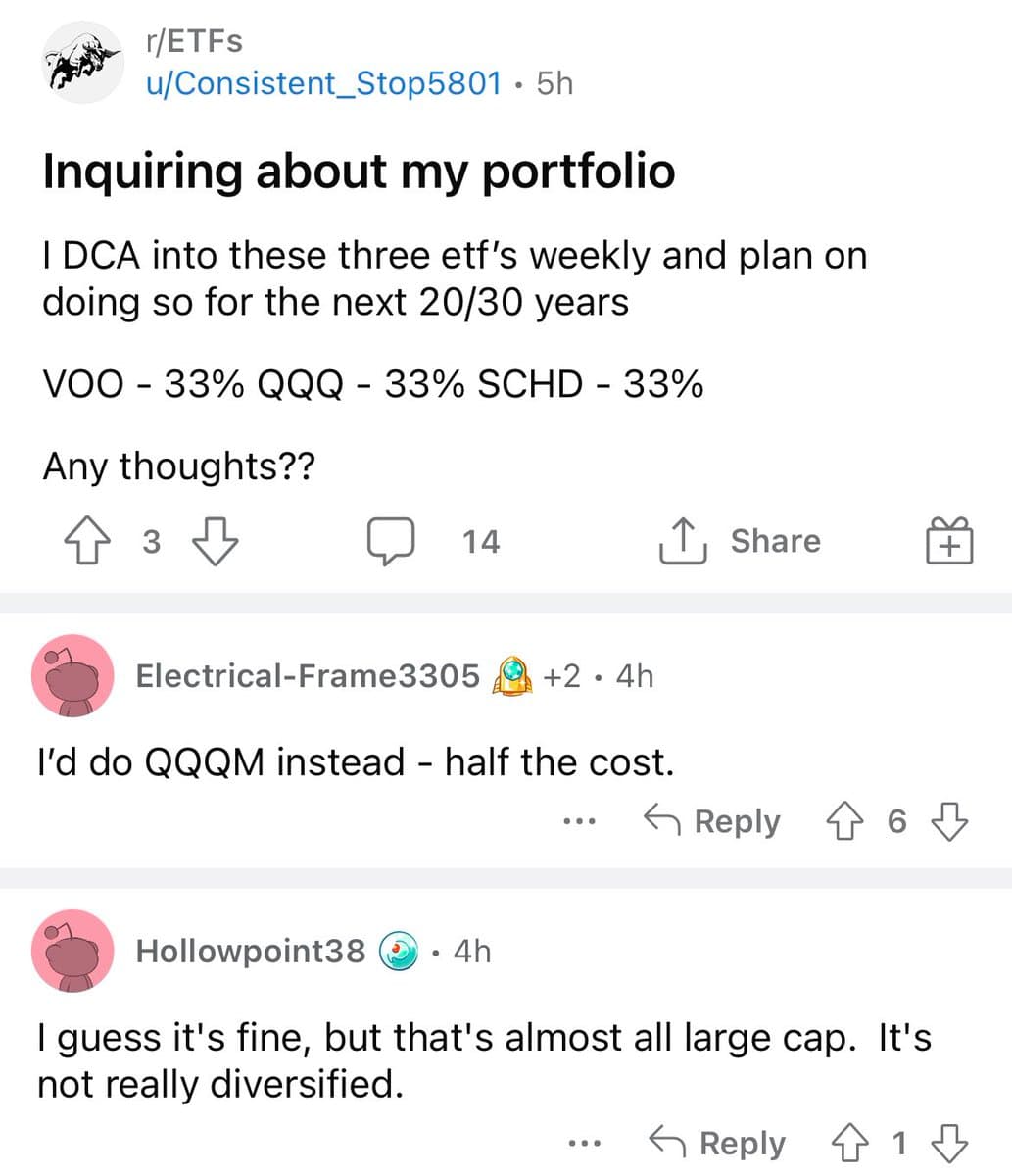
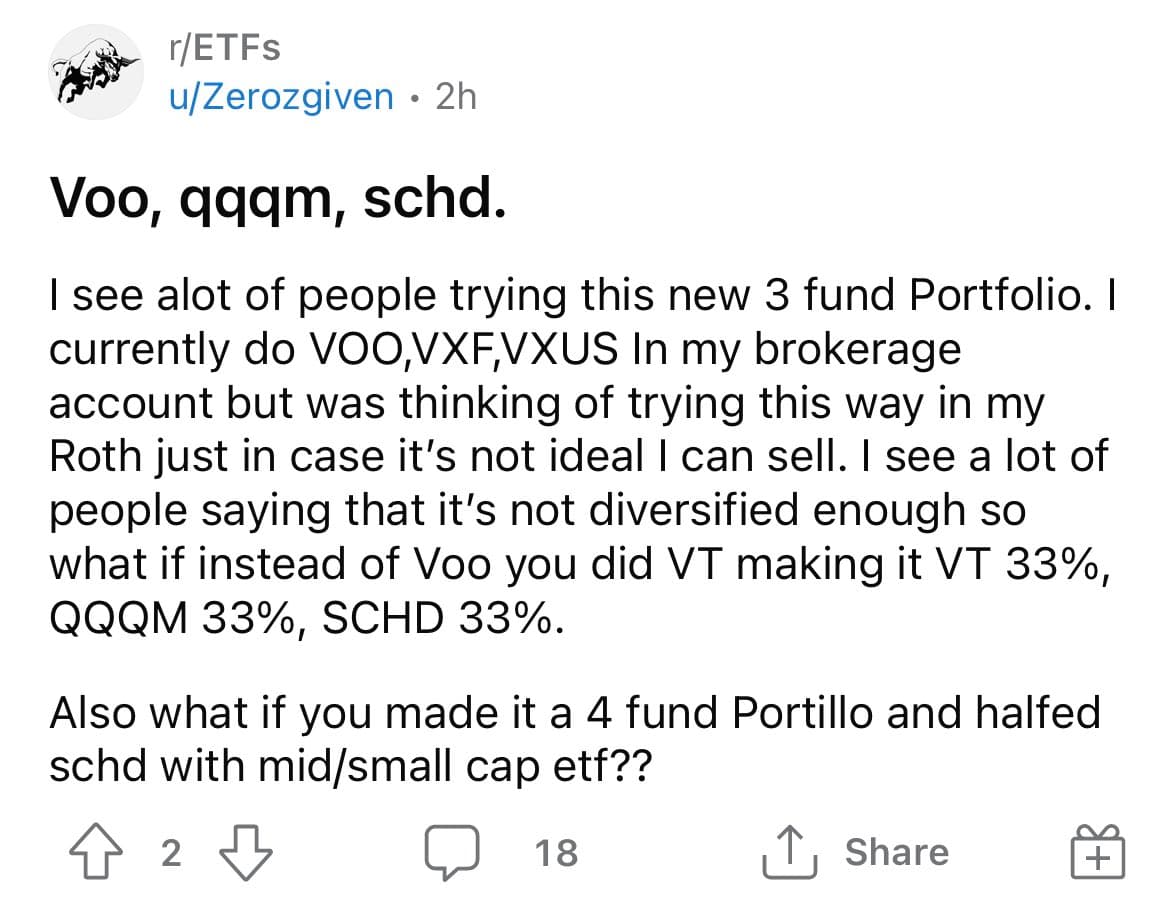
The replies are revealing: "I guess it's fine, but that's almost all large cap. It's not really diversified." Another poster asks about substituting VT for VOO to fix the diversification problem, which at least shows awareness that something is missing. But adding VT while keeping QQQ and SCHD still creates an incoherent style barbell.
What Each Fund Actually Is
| Fund | What It Tracks | Holdings | Top 10 % | P/E | ER |
|---|---|---|---|---|---|
| VOO | S&P 500 | 504 | 40.7% | 28.4x | 0.03% |
| QQQ | Nasdaq-100 (non-financial) | 100 | ~48% | 36.5x | 0.18% |
| SCHD | DJ U.S. Dividend 100 | 104 | ~40% | 20.1x | 0.06% |
Data from Vanguard fund docs, Invesco, and Schwab (late 2025 / early 2026). QQQ P/E based on QQQM proxy.
All three funds are U.S. large-cap equities. VOO is the S&P 500. QQQ is the 100 largest Nasdaq-listed non-financial companies. SCHD is 104 large-cap stocks screened for dividend consistency, free cash flow, ROE, and yield. Three tickers, one asset class.
The Style Barbell Problem
The equal-third mix creates an ad hoc style barbell: expensive mega-cap growth on one end (QQQ at 36.5x P/E), cheaper dividend/value on the other (SCHD at 20.1x P/E), with the S&P 500 in the middle (VOO at 28.4x P/E). The equal-third mix is an active style bet, whether the investor realizes it or not.
The sector exposures make the barbell visible. SCHD is 19.9% Energy, 18.5% Consumer Staples, and only 8.2% Information Technology. QQQ is approximately 58% tech and communication services. VOO is 34.4% Information Technology. These are two opposing style bets jammed together with a broad index in between.
The Overlap Is Still Massive
Despite the style barbell, the overlap at the top is significant. VOO and QQQ share most of QQQ's largest holdings, because the biggest Nasdaq-100 companies are also the biggest S&P 500 companies. Apple, Microsoft, NVIDIA, Amazon, and Meta appear in both. Adding QQQ to VOO overweights the mega-caps that already dominate VOO, rather than broadening exposure.
An equal-third blend costs approximately 0.09% in expense ratio (VOO 0.03% + QQQ 0.18% + SCHD 0.06%, divided by 3). That is triple the cost of VOO alone or VTI (0.03%), and you are paying more for a portfolio that is less coherent as a default core.
What Is Actually Missing
The two forms of diversification that matter most for a stock portfolio are almost entirely absent:
International stocks: 0%
VOO is 0% international. SCHD is explicitly a U.S. dividend strategy. QQQ is 97% U.S. The portfolio completely ignores the 38% of global equity market capitalization that exists outside the United States. For why this matters, see the Case for Global Diversification guide.
Small-cap stocks: near 0%
Nearly 59% of SCHD is in companies above $70 billion market cap. QQQ is giant-cap growth. VOO is large-cap. There is effectively no dedicated small-cap exposure, which means no exposure to the small-cap value premium that has the strongest academic support of any equity factor.
Why QQQ Is a Stranger Fund Than You Think
QQQ is marketed as "innovation" and "growth," but its methodology is much more idiosyncratic. The Nasdaq-100 selects the 100 largest Nasdaq-listed non-financial companies. Inclusion is driven partly by exchange listing venue (Nasdaq, not NYSE) and partly by a non-financials exclusion, not by any clean academic factor like market, size, value, profitability, or investment.
Invesco explicitly classifies QQQ as "non-diversified" and warns that sector-focused investments can be more volatile than diversified ones. QQQ is a rules-based slice of one exchange that happened to be a great bet in a tech-led era, not a curated list of "the best companies."
Why SCHD Is Not "Safe"
SCHD screens for 10+ consecutive years of dividend payments, then ranks by free cash flow to total debt, ROE, yield, and 5-year dividend growth. It caps at 4% per stock and 25% per sector. This is a quality and value screen, not a "safety" mechanism.
Dividends are not free money. When a company pays a dividend, the share price drops by the dividend amount. The total return is the same; the packaging is different. SCHD's 3.5%+ yield feels like income, but it is economically equivalent to selling 3.5% of a non-dividend fund each year.
The Actual Bogleheads Three-Fund Portfolio
The real three-fund portfolio, the one the Bogleheads community actually recommends, is:
| Sleeve | Fund | Purpose |
|---|---|---|
| U.S. total market | VTI (or VOO as substitute) | Broad U.S. equity exposure |
| International | VXUS (or VTIAX) | The other 38% of global equity |
| Bonds | BND (or BNDX) | Stability and deflation protection |
Notice what is different: the Bogleheads version includes international stocks and bonds. It covers the whole world, not just U.S. large-caps. It uses total market funds, not style tilts. And it serves as a neutral starting point that can be adjusted, not an active bet disguised as a passive portfolio.
An even simpler option: VT (Vanguard Total World Stock) holds approximately 10,000 stocks across 47+ countries at market-cap weight. One fund, global diversification, 0.07% expense ratio. Add BND for bonds if desired.
The Right Framing
VOO + QQQ + SCHD is active portfolio construction by internet meme. It overweights what has recently looked attractive in charts and narratives: S&P 500 "safety," Nasdaq "innovation," and dividend "income." It is not the disaster some critics make it out to be, and it is also not the diversified plan it is marketed as. Underneath the labels, it is still mostly the same U.S. large-cap ecosystem with arbitrary tilts, overlap, and zero international exposure.
If you own this portfolio knowingly as an active bet on U.S. large-cap equities, that is a legitimate choice. But if you believe it is a diversified, balanced core portfolio, the evidence says otherwise.
You can check your actual portfolio overlap, sector concentration, and factor exposures in Summitward's portfolio analysis. The factor regression will show whether your "three-fund" portfolio is actually three independent bets or one bet in three wrappers.
Frequently Asked Questions
Is VOO + QQQ + SCHD the Bogleheads three-fund portfolio?
No. The Bogleheads three-fund portfolio is U.S. total market (VTI), international (VXUS), and bonds (BND). VOO + QQQ + SCHD replaces international and bonds with growth and dividend tilts, which is a fundamentally different portfolio with different risk characteristics.
Is SCHD safe?
SCHD is a large-cap U.S. dividend and quality screen, not a safety mechanism. Dividends do not protect against price declines; the share price drops by the dividend amount on the ex-date. SCHD has significant sector concentration (20% energy, 18% consumer staples) that creates its own risks.
Does adding QQQ to VOO improve diversification?
No. QQQ's largest holdings are already the largest positions in VOO. Adding QQQ overweights tech and mega-cap growth relative to the broad market. The top-10 overlap is substantial.
What is wrong with 100% U.S. stocks?
The U.S. is approximately 62% of global equity market cap (Vanguard Total World Stock ETF data, December 2025). A 100% U.S. portfolio ignores 38% of the world's investable equity. International stocks have lower correlation with U.S. markets, provide currency diversification, and currently trade at significantly lower valuations (CAPE 18-28 vs. U.S. 39.9).
What would a better portfolio look like?
VTI + VXUS (or VT alone) gives you the whole world at 0.03-0.07% cost. For factor tilts with academic support, add AVUV (U.S. small-cap value) and AVDV (international small-cap value). Add BND for bonds based on your risk tolerance.
Key Takeaways
- VOO + QQQ + SCHD is three flavors of U.S. large-cap, not three independent asset classes. All three funds are overwhelmingly U.S., overwhelmingly large-cap, and have significant overlap at the top.
- It creates an ad hoc style barbell: expensive tech growth (QQQ at 36.5x P/E) + cheap dividend value (SCHD at 20.1x P/E). This is active construction, not passive diversification.
- International exposure: 0%. The portfolio ignores 38% of global equity market cap and all of the diversification benefits that come with foreign-domiciled stocks.
- Small-cap exposure: near 0%. The small-cap value premium, the most academically supported factor premium, is completely absent.
- QQQ tracks the 100 largest Nasdaq-listed non-financial companies, not "innovation." Invesco classifies it as non-diversified.
- SCHD is not "safe." Dividends are not free money. The fund has heavy sector concentration in energy and consumer staples.
- The Bogleheads three-fund is VTI + VXUS + BND. The Reddit version replaces international and bonds with growth and dividend tilts. These are fundamentally different portfolios.
Related Guides
- The Tech Bro Portfolio is the companion guide on VOO + QQQ + VGT concentration.
- Dividends Are Not Free Money covers why SCHD’s yield is not the advantage it appears to be.
- Why I Avoid SCHD is the full SCHD deep dive: what the Dividend 100 screen selects, the taxable-account math, and the systematic value alternative.
- Why I Avoid QQQ is the full QQQ deep dive: why indexing one exchange’s listings is arbitrary, and how to exit a large position tax-aware.
- The Case for Global Diversification covers why 100% U.S. is a concentrated bet.
- The Case for Small-Cap Value covers the factor premium this portfolio completely misses.
- Concentration Risk covers the math behind why overlap matters.
More in Investing & Portfolio
Browse all investing & portfolio guidesGet new guides by email
Evidence-based, no jargon. At most two emails a month. Unsubscribe any time.
Try it in Summitward
See portfolio factor analysis in action with your own financial data. Free to start, no credit card required.