

Dividends Are Not Free Money: What Every Investor Should Know
When a company pays a dividend, its stock price drops by the dividend amount. You are not richer. The mechanics, the tax trap, why dividend capture fails, and why dividends still exist anyway.
The Misconception
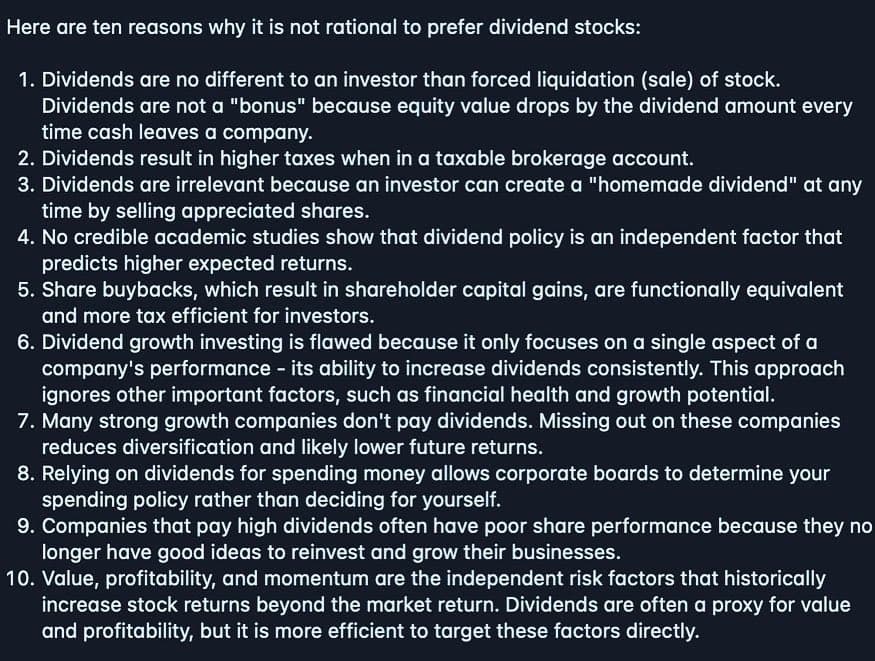
"I got a $2 dividend from my stock. That is $2 of profit." This is one of the most common misunderstandings in investing. It feels like free money. It is not. When a company pays a cash dividend, its stock price drops by the dividend amount on the ex-dividend date. You receive cash, but your shares are worth less by the same amount. Your total wealth has not changed. It has just been repackaged.
This guide explains the mechanics, walks through a concrete example, shows why dividend-capture strategies fail after taxes, and addresses the question most dividend critics avoid: if dividends are not free money, why do companies pay them at all?
What Actually Happens When a Dividend Is Paid
A cash dividend is a transfer of cash from the company to its shareholders. After the payment, the company has less cash on its balance sheet. As Fidelity explains, "money paid to shareholders is no longer part of the asset base of the corporation." That reduction in corporate value must be reflected in the stock price.
This is not a theoretical claim. FINRA Rule 5330 requires that open order prices be reduced by the cash dividend amount on the ex-dividend date. The exchange literally adjusts prices downward to reflect the dividend leaving the company.
A $100 Stock Pays a $2 Dividend
Suppose you own one share of a stock trading at $100. The company declares a $2 cash dividend. On the ex-dividend date, the stock price is adjusted downward by $2. You now hold:
| Before Dividend | After Dividend | |
|---|---|---|
| Stock value | $100 | $98 |
| Cash received | $0 | $2 |
| Total wealth | $100 | $100 |
Same wealth, different packaging. This is the basic intuition behind the Miller-Modigliani "dividend irrelevance" framework: a dividend does not create value, it distributes it.
An important nuance: the observed market price does not always drop by exactly the dividend amount on the ex-date. Fidelity notes that the adjustment "can be hard to observe because of normal day-to-day price fluctuations." A Kellogg School study found that even in Hong Kong during a period with no dividend or capital gains taxes, observed price drops were less than the dividend amount, suggesting market microstructure effects play a role. The stock is worth less by roughly the dividend amount, but the real-world price path around the ex-date is noisy.
Source: @egr_investor
The Dividend Capture Mirage
A common idea: buy a stock right before the ex-dividend date, collect the dividend, sell right after. Free money, right?
No. If the stock drops by the dividend amount, your gain from the cash is offset by the loss in share price. Before taxes and transaction costs, the strategy is roughly a wash. After taxes, it is often worse.
The IRS requires that you hold a stock for more than 60 days during the 121-day window around the ex-dividend date for the dividend to qualify for the lower qualified dividend tax rate (15-20% instead of ordinary income rates up to 37%). If you buy and sell quickly to "capture" the dividend, it may be taxed at your ordinary income rate, making the after-tax result negative.
Even reinvesting the dividend does not avoid the tax. IRS Publication 550 is clear: dividends received through a reinvestment plan must still be reported as income in the year they are paid. Reinvestment defers nothing.
Yield Is Not the Same Thing as Return
One of the most persistent errors in dividend investing is confusing dividend yield with investment performance. FINRA's guidance on calculating investment returns says you should include both dividend payouts and price appreciation. A stock with a 5% dividend yield and a 6% price decline has a negative total return of -1%. The "income" feels good, but the shareholder is poorer.
This is why total return is the only metric that matters. A dividend is one component of total return, not a bonus layered on top of it. A company that pays no dividend and returns 10% through price appreciation is economically equivalent to a company that pays a 3% dividend and returns 7% through price appreciation. Same total return, different packaging.
The Tax Problem No One Mentions
In taxable brokerage accounts, dividends create a tax liability you did not choose. The company decided to pay, and you owe taxes on the distribution regardless of whether you wanted the income.
Capital gains, by contrast, offer timing control. You choose when to sell, which means you choose when to realize the gain. This allows for tax-loss harvesting, deferral until a lower-income year, and potentially stepping up the basis at death. Qualified dividends and long-term capital gains are taxed at the same rates (0%, 15%, or 20%), but capital gains let you decide when to pay.
In tax-advantaged accounts (401(k), IRA, HSA), this distinction disappears. Dividends are not taxed until withdrawal (traditional) or never (Roth). The tax drag argument against dividends only applies to taxable accounts.
If Dividends Are Not Free Money, Why Do Companies Pay Them?
This is the question that prevents the analysis from becoming a straw man. Dividends are not free money, but they can still be rational. Three reasons:
- Capital allocation discipline. Michael Jensen's 1986 free cash flow paper argues that paying out excess cash reduces the money available for managers to waste on low-return projects. A company that commits to a dividend forces itself to be disciplined about capital allocation. This is a real governance benefit.
- Signaling. Dividend increases are often interpreted as a signal that management is confident about future earnings. Dividend cuts are interpreted as bad news. Aswath Damodaran notes that this signaling value is real even if the dividend itself does not create wealth.
- Investor clientele. Some investors, particularly retirees and tax-exempt institutions, prefer regular cash distributions over selling shares. This is a preference, not an economic advantage, but it is a legitimate reason for companies to pay dividends.
Berkshire Hathaway is the classic counterexample. Warren Buffett has never paid a regular dividend because he believes each retained dollar creates more than one dollar of market value through reinvestment. That logic only holds when management has genuinely attractive reinvestment opportunities. When they do not, paying a dividend is the responsible choice.
The right takeaway is not "dividends are bad." It is "dividends are a payout decision, not a source of free wealth."
Source: Alpha Architect, "Do Dividends Impact Stock Returns?"
What Actually Explains Dividend Stock Returns
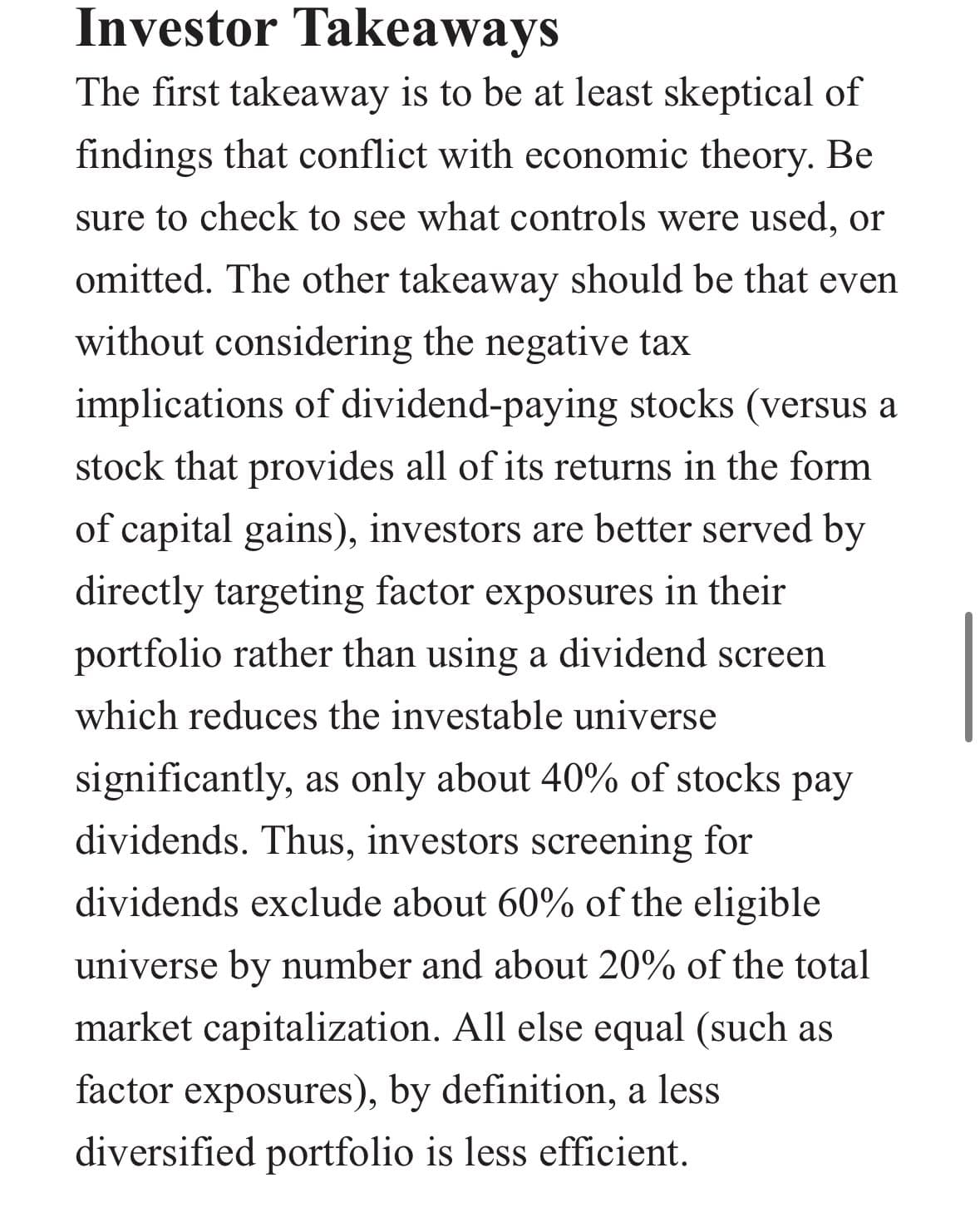
High-dividend stocks have historically outperformed low-dividend stocks. The outperformance is explained by the fact that dividend-paying stocks tend to be value stocks (cheap relative to earnings) with high profitability, not by the dividends themselves. These are independent risk factors (HML and RMW in the Fama-French model) that have their own return premiums.
As Meb Faber's analysis shows, once you control for value and profitability factors, dividend policy itself has no predictive power for future returns. The dividend is a proxy for the real drivers, not a driver itself.
This means that screening for high dividends is an indirect and inefficient way to get factor exposure. Only about 40% of US stocks pay dividends. By screening for dividends, you exclude roughly 60% of companies by count and about 20% of total market capitalization. All else equal, a less diversified portfolio is a less efficient portfolio. It is more direct to target value and profitability through factor funds that do not restrict themselves to dividend-payers.
You can see your portfolio's actual factor loadings by running a Carhart 4-factor regression in Summitward. If your "dividend strategy" is really just a value + profitability tilt, the factor analysis will show it.
Key Takeaways
- A cash dividend does not create wealth. It transfers cash from the company to the shareholder, and the stock price drops by roughly the dividend amount on the ex-date.
- Total return is what matters, not yield. A 5% yield with a 6% price decline is a loss, not income.
- Dividend capture strategies are usually a wash before taxes and negative after. The holding period rules for qualified dividend rates make quick trades especially unattractive.
- Dividends create involuntary taxable events in taxable accounts. Capital gains offer timing control that dividends do not.
- High-dividend outperformance is explained by value and profitability factors, not by dividends themselves. Targeting these factors directly is more efficient.
- Dividends are not bad. They serve real purposes: capital discipline, signaling, and meeting investor preferences. They are just not free money.
- Screening for dividends excludes ~60% of stocks. A less diversified portfolio is a less efficient portfolio.
Frequently Asked Questions
Are dividends free money?
No. When a company pays a dividend, its stock price drops by the dividend amount on the ex-dividend date. You receive cash, but your shares are worth less. Your total wealth is unchanged. The dividend is a transfer of value, not value created from nothing.
Do dividends provide downside protection in a falling market?
No. Because the stock price adjusts downward by the dividend amount, receiving a dividend in a falling market is economically equivalent to selling a portion of your shares. The dividend does not cushion the decline.
Do dividend-paying stocks outperform non-dividend-paying stocks?
Historically, high-dividend portfolios have outperformed low-dividend portfolios. However, this outperformance is largely explained by their exposure to value and profitability factors, not by the dividends themselves. When you control for these factors, dividend policy has no independent predictive power for returns.
Is a dividend capture strategy profitable?
Usually not. The stock price drops by the dividend amount on the ex-date, offsetting the cash received. After taxes and trading costs, the strategy is typically a net loss. The IRS also requires a 60-day holding period for dividends to qualify for the lower qualified dividend tax rate.
Are dividends taxed even if I reinvest them?
Yes. IRS Publication 550 states that dividends received through a reinvestment plan must be reported as income in the year they are paid. Reinvesting does not defer or eliminate the tax obligation.
Is there a better way to invest than focusing on dividends?
Yes. Rather than screening for dividends (which excludes ~60% of stocks), target the underlying factors that drive returns: value, profitability, and size. Factor-based strategies provide the same exposures that make dividend stocks outperform, without reducing your investable universe.
Are dividends a good way to fund retirement spending?
Not necessarily. Spending only dividends means letting corporate boards determine your spending policy. A total-return spending strategy, where you withdraw a percentage of your total portfolio value, gives you more control and is often more tax-efficient.
Related Guides
- SCHD vs JEPI applies the yield-versus-total-return test to two popular income ETFs.
- Why I Avoid SCHD applies these mechanics to the most popular dividend ETF: the tax drag of a forced 3.2% yield and the factor-fund alternative.
- Do Most S&P 500 Returns Really Come From Dividends? debunks the “75% from dividends” chart and separates the compounding effect from the actual return attribution.
- How Financial Sales Pitches Hide the Real Cost of Investing is the hub on marketing tactics; the dividend pitch is its example of transference.
- Fama-French Factor Analysis is the framework that decomposes dividend stock returns into value and profitability factors.
- Growth Stocks vs. Systematic Momentum is another case where similar holdings serve completely different investment theses.
- Tax-Loss Harvesting covers how to actively manage the tax drag that dividends create passively.
- Safe Withdrawal Rate covers why total-return spending is more efficient than dividend-only spending in retirement.
- Covered Calls Are Not Free Income applies the same “cash flow is not income” logic to options premiums (XYLD, QYLD, JEPI, JEPQ), with a calculator that visualizes principal erosion when distributions are withdrawn.
- Structured Notes: Who Is on the Other Side of Your 15% Coupon? takes the same logic to its extreme, where a double-digit “coupon” is option premium and the buyer is the one writing the insurance.
More in Investing & Portfolio
Browse all investing & portfolio guidesGet new guides by email
Evidence-based, no jargon. At most two emails a month. Unsubscribe any time.
Try it in Summitward
See portfolio factor analysis in action with your own financial data. Free to start, no credit card required.