

The Hungry Caterpillar Portfolio: A Silly Name for a Serious All-Weather Idea
A bedtime-story joke portfolio that eats small-cap value, bonds, gold, T-bills, and trend. Over 10 years it earned less than 60/40, with half the drawdown.

It started as a bedtime joke. After reading The Very Hungry Caterpillar to a toddler, the investing writer Engineer Investor (@egr_investor) posted the “Hungry Caterpillar Portfolio”: a fund that munches U.S. and international small-cap value, then snacks on bonds, bills, gold, and trend, so it never goes hungry across regimes. Rebalance after the food coma. The hashtag was #sarcasm.1
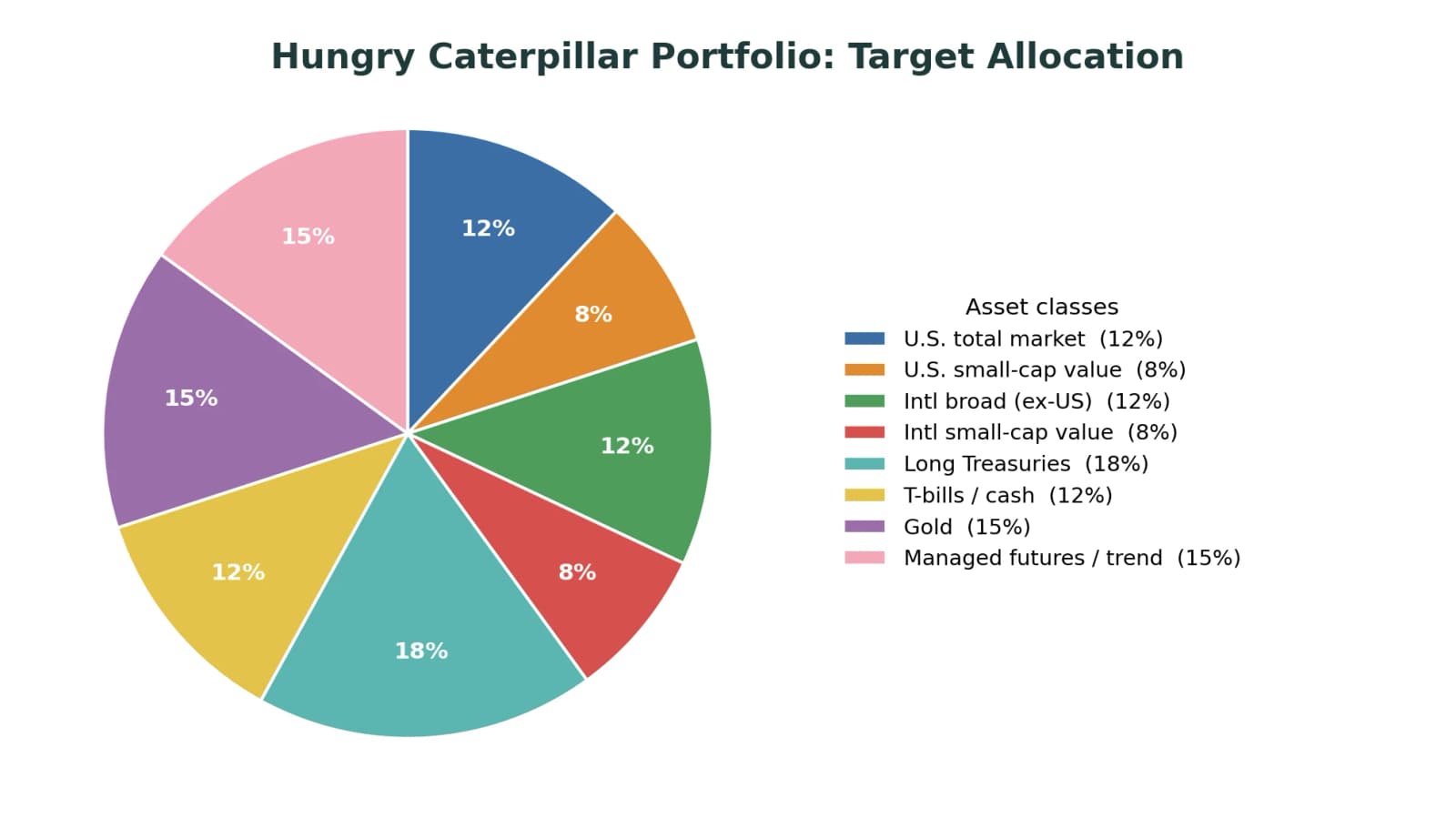
The name is a joke. The allocation is not. Strip the caterpillar costume off and you are looking at a global, factor-tilted blend of the Permanent Portfolio, the Golden Butterfly, and the Cockroach: own several different sources of return that tend to respond differently to growth shocks, inflation shocks, rate shocks, and market trends, instead of betting almost everything on one (equity beta).
| Sleeve | Weight | Job |
|---|---|---|
| U.S. total market | 12% | Broad growth engine |
| U.S. small-cap value | 8% | Size / value / profitability tilt |
| International broad (ex-US) | 12% | Global equity diversification |
| International small-cap value | 8% | Global factor diversification |
| Long Treasuries | 18% | Recession / deflation ballast |
| T-bills / cash | 12% | Stability, dry powder, rebalancing fuel |
| Gold | 15% | Inflation / currency-stress diversifier |
| Managed futures / trend | 15% | Crisis alpha / trend across asset classes |
The one-line verdict: this is a defensible sleep-well portfolio for an investor who accepts tracking error, more moving parts, and lower expected returns than an all-equity portfolio during long bull markets, in exchange for smaller drawdowns and less dependence on any single regime. It is not the right tool for someone chasing maximum long-run wealth, minimal complexity, or a pure cap-weighted index. It is a close cousin of the simplified Engineer Investor portfolio from the same author, with the bonds, gold, and trend the all-equity version leaves out.
How it descends from older bug portfolios
The Hungry Caterpillar sits at the end of a well-documented family tree of “own a little of everything” portfolios.
The Permanent Portfolio is the ancestor. Harry Browne’s 1980s design splits a portfolio into four equal 25% sleeves: stocks for prosperity, long-term Treasuries for deflation, gold for inflation, and cash for recession.2 A 2014 study by Anderson, Marshall, and Miao found that the Permanent Portfolio did not consistently beat a buy-and-hold stock portfolio or stock-bond portfolios on raw return, but it delivered better risk-adjusted performance and smaller downside losses.3 That tradeoff, lower or similar raw return for a smoother ride, runs through every portfolio in this family.
The Golden Butterfly, designed by Tyler of Portfolio Charts, modifies the Permanent Portfolio by raising equities to 40% and splitting them between a total U.S. market fund and small-cap value. It holds 20% U.S. total market, 20% small-cap value, 20% long-term Treasuries, 20% short-term Treasuries, and 20% gold.4 The Hungry Caterpillar borrows its equity structure almost directly: broad market plus a small-cap value tilt.
The Cockroach adds the “keep surviving weird worlds” layer. Mutiny Fund’s version is a diversified ensemble of global stocks, global bonds, long volatility, commodity trend, and fiat hedges (gold plus a small crypto-futures slice). Its sleeves are sized by risk rather than by dollars: Mutiny publishes a risk budget of 23% each to stocks, income, long volatility, and commodity trend and 8% to the fiat hedge, and levers each sector between 1x and 4x to reach it, so total notional exposure runs well above 100%.5 The Hungry Caterpillar keeps the trend sleeve but drops the long volatility and the leverage in its base 100% version. The Permanent Portfolio, Golden Butterfly, and Cockroach comparison backtests the first two from 1972 and reviews the Cockroach fund’s terms.
Put together, the Hungry Caterpillar is closest to a Golden Butterfly with global equities, global small-cap value, and a managed-futures sleeve grafted on, with slightly less weight in gold, cash, and bonds than a pure Permanent Portfolio. It is the spot where factor investors, Bogleheads, and all-weather diversifiers overlap.
What theory it is rooted in
1. Diversify return drivers
A 60/40 portfolio looks diversified by capital weight, but its risk is usually dominated by equities, because stocks are several times more volatile than bonds. AQR’s risk-parity research makes the point bluntly: in a traditional 60/40, the large majority of portfolio risk comes from the equity sleeve even though it is only 60% of the dollars.6 Owning 500 stocks does not fix this. They mostly rise and fall together.
The Hungry Caterpillar instead tries to spread exposure across several different return drivers: equity market beta, the size and value and profitability premia, term and duration exposure, cash and liquidity, gold and currency-stress exposure, and trend-following. That is a more serious form of diversification than counting holdings, and it is the idea the modern portfolio theory guide develops: total portfolio risk depends on covariances between holdings, not just on each holding’s own risk.
2. Economic regime balance
Bridgewater’s All Weather framework is built around a simple grid: markets respond to surprises in growth and inflation, so a portfolio should hold something that does well in each of four environments, rising growth, falling growth, rising inflation, and falling inflation, without needing to predict which comes next.7 The Hungry Caterpillar maps onto that grid like this:
| Regime | Sleeve that should help |
|---|---|
| Strong growth / disinflation | Global equities, small-cap value |
| Recession / deflation | Long Treasuries, T-bills |
| Inflation shock | Gold, managed futures |
| Rate shock / stock-bond correlation flips positive | Trend, cash, gold |
That last row matters more than it looks. A plain 60/40 leans on bonds to rise when stocks fall, but that hedge can fail. AQR documents that stocks and bonds have opposite-sign sensitivities to growth news but same-sign sensitivities to inflation news, so when inflation uncertainty dominates, the stock-bond correlation can turn positive and both fall together, exactly what happened in 2022.8 Gold and trend are in the portfolio partly to cover that failure mode.
3. Factor investing
The small-cap value sleeves are not decoration. Fama and French’s 1993 model identified market, size, and book-to-market (value) factors in stock returns, plus maturity and default factors in bonds.9 Their 2015 five-factor model added profitability and investment, which improved the explanation of average returns.10 The international sleeve has support too: Fama and French found value premiums across North America, Europe, Japan, and Asia Pacific, and outside Japan the value premium was generally larger among small stocks.11 Factor premia are real in the long historical record, but they are not guaranteed, they can underperform for a decade at a time, and they are sensitive to implementation. The case for small-cap value guide covers both the evidence and the years of pain.
4. Trend following
The 15% managed-futures sleeve is the most Cockroach-like part of the portfolio. Moskowitz, Ooi, and Pedersen documented significant time-series momentum across equity index, currency, commodity, and bond futures, with one-to-twelve-month return persistence and especially strong performance in extreme markets.12 Hurst, Ooi, and Pedersen extended the evidence back to 1880 and found positive average returns in every decade, low correlation to traditional assets, and positive performance in 8 of the 10 largest 60/40 drawdowns.13 It is also the sleeve most exposed to manager and process risk, higher fees, whipsaw, and investor impatience. The managed futures guide is the deep dive, including how the sleeve behaves inside the Cockroach and other all-weather frameworks.
Build it and see the structure
The exact weights are less important than the shape. Use the builder to compare the Hungry Caterpillar against the Permanent Portfolio, the Golden Butterfly, a 60/40, and an all-equity portfolio. Watch three things: how the capital spreads across return drivers, how much of the portfolio is still equity-driven, and whether any macro regime is left with thin coverage. The blended expense ratio uses real low-cost ETF fees, so you can see what the trend and small-value sleeves actually cost.
The Hungry Caterpillar scores high on driver diversification because no single driver dominates. An all-equity portfolio scores zero on that same metric: one driver, full exposure. Neither score is “better.” They describe different bets. The builder shows the structure of each; it does not, and cannot, tell you which will compound more over your lifetime.
What a 10-year backtest actually shows
Engineer Investor published a Portfolio Visualizer backtest of the portfolio. Run over June 2016 to May 2026, using index and mutual-fund proxies with long histories (Vanguard total market and DFA small-cap value funds, VXUS, TLT for long Treasuries, the 3-month T-bill rate, GLD for gold, and the AQR Managed Futures Strategy fund), against a Vanguard Balanced Index (a 60/40 fund) benchmark, the results look like this:14
| Metric (2016–2026) | Caterpillar 100% | Caterpillar 150% | Permanent | 60/40 |
|---|---|---|---|---|
| Annualized return (CAGR) | 8.22% | 10.91% | 7.82% | 9.74% |
| Volatility (std dev) | 7.48% | 11.11% | 7.61% | 10.47% |
| Worst calendar year | -7.13% | -11.59% | -12.48% | -16.97% |
| Maximum drawdown | -10.03% | -15.38% | -15.91% | -20.85% |
| Sharpe ratio | 0.79 | 0.79 | 0.73 | 0.72 |
| Sortino ratio | 1.28 | 1.27 | 1.18 | 1.10 |
Read the first and last columns together, because they tell the real story. Over this window the unlevered Hungry Caterpillar earned less than a plain 60/40 (8.22% vs 9.74% a year) while taking on about half the drawdown (10% vs 21%). Its Sharpe and Sortino ratios were higher, and its worst year was a mild -7% against the 60/40’s -17%. That is the entire thesis in one row: this is a downside and risk-adjusted trade, not a way to earn more. Its maximum drawdown landed in the 2022 stock-and-bond selloff and recovered in about nine months, while the 60/40 fell more than twice as far.
The 150% version is the only one that beat the 60/40 on return, at 10.91% a year, and it did so by adding leverage. In the backtest that leverage is modeled as borrowing at the 3-month T-bill rate, which is cheaper and smoother than real margin or fund borrowing costs, so the levered line flatters the strategy. Leverage is covered separately below.
Why a good backtest can still fool you
A clean 10-year table is exactly the kind of thing that should make you more careful, not less. Four reasons to discount it.
- Start dates decide rankings. Risk-parity research by Anderson, Bianchi, and Goldberg shows that even over multi-decade windows, the choice of start and end dates can materially change which strategy looks best, transaction costs can reverse rankings, and a statistically significant premium still need not show up over a normal investor’s horizon.15 Begin the same backtest in a different year and the bug looks more, or less, beautiful.
- The funds are proxies. The backtest uses DFA small-cap value funds and the AQR Managed Futures fund because they have long histories. The ETFs you would actually buy (AVUV, AVDV, DBMF, KMLM) are newer, charge different fees, and run different models, so live results will not match the proxy line.
- Leverage is not free. The 150% line assumes borrowing at the T-bill rate. Real leverage, through margin or return-stacked funds, costs more, adds path risk, and behaves worst in exactly the stress periods the portfolio is meant to survive.
- Simple can beat optimized, which cuts both ways. DeMiguel, Garlappi, and Uppal found that across seven datasets, none of 14 optimizing portfolio models reliably beat a naive 1/N rule out of sample, because estimation error swamps the theoretical gains.16 That is a point in favor of a simple, evenly spread portfolio, and a warning against believing any specific optimized weighting is the right one.
See Your Own Portfolio's Drivers and Drawdowns
Use Summitward's Portfolio analytics to measure your factor exposures, single-stock concentration, U.S./international split, and historical drawdowns, then model how adding bonds, gold, or a trend sleeve would change the risk you actually carry.
Open Portfolio analyticsThe strongest case for it
First, it addresses a hidden fragility in traditional portfolios. A plain 60/40 is more equity-risk-dominated than its capital weights suggest, and its bond hedge can fail when inflation drives the stock-bond correlation positive.8 Spreading risk across gold and trend is a direct response to that gap.
Second, it has several semi-independent engines. Equities give growth, small-cap value adds factor exposure, long Treasuries hedge some growth shocks, T-bills give optionality and rebalancing fuel, gold can help in currency and inflation and fear regimes, and trend can profit from large persistent moves in any direction rather than needing markets to rise.
Third, the even-handed allocation is less naive than it looks. The 1/N evidence suggests that a simple, transparent split is hard to beat reliably once you account for estimation error.16
The strongest case against it
The biggest objection is opportunity cost. Over long accumulation horizons, a mostly-equity global portfolio likely has a higher expected return than a 40%-equity portfolio, because stocks have a clearer long-run cash-flow basis for their returns. Holding 60% of the portfolio outside equities trades expected return for lower volatility and better behavioral survivability. The backtest shows this directly: the unlevered version earned less than a 60/40 over a decade.
The second objection is gold uncertainty. Gold is not a business, produces no cash flow, and is not a reliable inflation hedge over practical horizons. Erb and Harvey’s “Golden Dilemma” found that over 1-, 5-, 10-, 15-, and 20-year horizons, gold’s nominal and real returns were not driven by realized inflation; it may be an inflation hedge over a century, but not over the horizons investors actually live.17 Gold’s strong run since 2020 has helped recent results and softened its reputation, but a few good years are not the same as a dependable hedge. The inflation hedges guide argues that explicit CPI-linked assets do the job gold is often credited with.
The third objection is implementation and tax drag. Managed-futures ETFs are expensive next to index funds, can distribute taxable income, and differ a lot by model. Physical-gold ETFs are structured as grantor trusts, so a U.S. individual’s long-term gains on them are taxed as collectibles at a maximum 28% rate rather than the usual 15% or 20% long-term capital-gains rate.18 A portfolio like this wants its tax-inefficient sleeves, gold and trend especially, held in tax-advantaged accounts where possible.
The fourth objection is tracking-error regret. For years at a time this portfolio will trail a roaring S&P 500, and the investor most likely to abandon it is the one who checks it against U.S. large-cap every month. A diversified portfolio you sell at the bottom is worse than the concentrated one you would have held.
Who it makes sense for
This portfolio fits a specific investor. It makes sense if you:
- already understand basic, low-cost indexing;
- want materially smaller drawdowns than an all-equity portfolio;
- are willing to rebalance into the hated, underperforming sleeve each year;
- can tolerate trailing the S&P 500 for years at a time;
- value staying invested over maximizing a backtested return number;
- have a large enough portfolio to run several ETFs cleanly and can put the tax-inefficient sleeves in tax-advantaged accounts.
It is most interesting for near-retirees, early retirees, and FIRE-adjacent or high-income accumulators who already know that the mathematically optimal portfolio is useless if they bail out of it in a 45% drawdown. For that investor, the smaller drops are not a consolation prize; they are the point. See sequence-of-returns risk for why drawdown size matters most near the retirement date.
Who it does not make sense for
It is a poor fit if you are:
- a beginner who wants a single one-fund portfolio;
- someone who compares everything to the S&P 500 every month;
- a taxable investor who does not want to deal with collectibles tax on gold or K-1-style distributions and the quirks of managed-futures funds;
- convinced gold is dead weight, or unwilling to learn what trend does;
- a long-horizon accumulator whose best behavioral fit is simply global equities plus a small bond or cash buffer.
Asset allocation comes before fund selection. Whether you want 40%, 60%, or 90% in equities is a bigger decision than which bug portfolio you pick. The 60/40, target-date, or 100% stocks guide covers that choice.
The leveraged version and return stacking
The 150% “Butterfly” version raises expected return by applying leverage to the same mix. The backtest does this with cheap modeled borrowing; in practice you would use margin or capital-efficient funds, and both add cost and path risk. Return-stacked and portable-alpha ETFs are the cleaner real-world tools. RSST, for example, is designed to give roughly $1 of U.S. large-cap equity exposure and $1 of managed-futures exposure for every $1 invested.19 NTSX holds about 90% equities plus Treasury futures to create a 90/60-style exposure from each dollar.20 These are capital-efficient, not magic: leverage improves diversification efficiency but increases path risk, fund-structure risk, and the odds you panic at the wrong time. The return-stacking guide gives a hurdle-rate framework for deciding whether any of them belong in your portfolio.
The recommendation
Treat the Hungry Caterpillar as a memorable case study in robust diversification, not as the portfolio everyone should own. For an actual DIY investor, a three-tier framing is more useful than a single answer.
- Simple default. Most people are best served by a low-cost global stock and bond portfolio. It is cheaper, easier to understand, and less likely to be abandoned.
- Serious diversifier. An investor who understands tracking error, taxes, and rebalancing can run a modest version of this idea: global equities, factor tilts, Treasuries, T-bills, and maybe gold and managed futures. The exact weights matter less than the discipline to hold and rebalance them.
- Advanced, return-stacked. Capital-efficient leverage can make sense for sophisticated investors, with a separate warning label for cost, path risk, and behavior.
The Hungry Caterpillar Portfolio is built to avoid starving in any one regime rather than to win every decade. Its real lesson is that diversification does not mean owning more stocks; it means owning enough different return drivers that you do not have to predict which regime comes next.
Frequently asked questions
Is the Hungry Caterpillar Portfolio a real strategy or a joke?
Both. It was posted as a bedtime-story joke with a sarcasm hashtag, but the allocation is a genuine, defensible global all-weather portfolio. It blends a Golden Butterfly equity structure, global small-cap value, long Treasuries, T-bills, gold, and managed futures, all of which have research support. The name is silly; the design is not.
Did it beat a 60/40 portfolio?
Not on return, over the published 2016 to 2026 backtest. The unlevered version earned 8.22% a year versus 9.74% for a 60/40 fund. What it did beat the 60/40 on was risk: about half the maximum drawdown (10% vs 21%), a milder worst year, and higher Sharpe and Sortino ratios. Only the leveraged 150% version beat the 60/40 on return, and that relied on cheap modeled borrowing.
Why hold gold if it has no expected return?
Gold is in the portfolio as a diversifier for inflation and currency-stress regimes, not as a growth engine. The caveat is that Erb and Harvey found gold is not a reliable inflation hedge over practical investor horizons, so its role is closer to insurance than to a return source. If you do not believe in that insurance, a smaller gold weight or none is a reasonable change.
Do I need the managed-futures sleeve?
No portfolio needs it, but trend following has the strongest evidence for diversifying the regimes where stocks and bonds both struggle, including the 2022 selloff. The cost is higher fees, model and manager risk, and stretches of whipsaw that test your patience. The managed futures guide covers when it helps and when it does not.
Can I simplify this to fewer funds?
Yes. The exact eight sleeves are not sacred. You could express the equities through one global value fund, keep one long-Treasury and one T-bill holding, and add gold and one trend fund, which cuts the holding count substantially. The discipline to rebalance matters more than the precision of the weights.
Related guides
- Do You Need Managed Futures? is the deep dive on the trend sleeve and the Cockroach Portfolio.
- The Simplified Engineer Investor Portfolio is the same author’s all-equity cousin to this one.
- The Case for Small-Cap Value covers the size and value evidence behind two of the sleeves.
- Do You Need Return Stacking? is the framework for the leveraged version.
- 60/40, Target-Date, or 100% Stocks covers the equity-versus-everything-else decision that comes first.
- The Best Inflation Hedges Are Boring puts gold’s role in context.
Sources
- Engineer Investor (@egr_investor), Hungry Caterpillar Portfolio posts, x.com/egr_investor (October 2025). Original allocation and the “eat a little of everything, sleep well through anything” framing.
- Portfolio Charts. The Permanent Portfolio. Harry Browne’s 25% stocks / 25% long-term bonds / 25% gold / 25% cash design.
- Anderson, H., Marshall, B. R., & Miao, J. (2014). The Permanent Portfolio. Applied Financial Economics, 24(16), 1083–1089. Better risk-adjusted and downside results, not consistently higher raw return.
- Portfolio Charts. Golden Butterfly Portfolio. 20% total market, 20% small-cap value, 20% long-term Treasuries, 20% short-term Treasuries, 20% gold.
- Mutiny Fund. The Cockroach Strategy. Leveraged ensemble: roughly 50% notional each in stocks, bonds, long volatility, and commodity trend, plus about 20% fiat hedges.
- AQR Capital Management. Understanding Risk Parity. Traditional 60/40 risk is dominated by equities despite their 60% capital weight.
- Bridgewater Associates. The All Weather Story. A portfolio built to perform across rising and falling growth and inflation without forecasting the regime.
- AQR Capital Management. A Changing Stock-Bond Correlation. Stocks and bonds have opposite-sign growth sensitivities but same-sign inflation sensitivities.
- Fama, E. F., & French, K. R. (1993). Common Risk Factors in the Returns on Stocks and Bonds. Journal of Financial Economics, 33(1), 3–56. Market, size, and value factors for stocks; maturity and default factors for bonds.
- Fama, E. F., & French, K. R. (2015). A Five-Factor Asset Pricing Model. Journal of Financial Economics, 116(1), 1–22. Adds profitability and investment factors.
- Fama, E. F., & French, K. R. (2012). Size, Value, and Momentum in International Stock Returns. Journal of Financial Economics, 105(3), 457–472. Value premiums across regions; larger among small stocks outside Japan.
- Moskowitz, T. J., Ooi, Y. H., & Pedersen, L. H. (2012). Time Series Momentum. Journal of Financial Economics, 104(2), 228–250. Trend across equity, currency, commodity, and bond futures; strong in extreme markets.
- Hurst, B., Ooi, Y. H., & Pedersen, L. H. (2017). A Century of Evidence on Trend-Following Investing. Journal of Portfolio Management, 44(1), 15–29. Positive every decade since 1880; positive in 8 of the 10 largest 60/40 drawdowns.
- Portfolio Visualizer backtest (user-supplied report), June 2016 to May 2026. Benchmark: Vanguard Balanced Index (60/40). Proxies: VTSMX, DFSVX, VXUS, DISVX, TLT, 3-month T-bill rate, GLD, AQMIX. Reproduce the backtest. Figures should be re-run before being relied on; results are period-, proxy-, and leverage-assumption-dependent.
- Anderson, R. M., Bianchi, S. W., & Goldberg, L. R. (2012). Will My Risk Parity Strategy Outperform? Financial Analysts Journal, 68(6). Start dates, costs, and horizon length can flip backtest rankings.
- DeMiguel, V., Garlappi, L., & Uppal, R. (2009). Optimal Versus Naive Diversification. Review of Financial Studies, 22(5), 1915–1953. Across 7 datasets, 14 optimizing models did not reliably beat 1/N out of sample.
- Erb, C. B., & Harvey, C. R. (2013). The Golden Dilemma. Financial Analysts Journal, 69(4). Gold’s returns are not driven by realized inflation over 1- to 20-year horizons.
- U.S. tax treatment of physical-gold ETFs structured as grantor trusts: long-term gains taxed as collectibles at a maximum 28% rate. See IRS Topic 409 (Capital Gains and Losses) and the iShares Gold Trust prospectus tax discussion.
- Return Stacked ETFs. Return Stacked U.S. Stocks & Managed Futures ETF (RSST). Roughly $1 of equity plus $1 of managed futures per $1 invested.
- WisdomTree. WisdomTree U.S. Efficient Core Fund (NTSX). About 90% equities plus Treasury futures for a 90/60-style exposure.
More in Investing & Portfolio
Browse all investing & portfolio guidesGet new guides by email
Evidence-based, no jargon. At most two emails a month. Unsubscribe any time.
Try it in Summitward
See portfolio factor analysis in action with your own financial data. Free to start, no credit card required.