

Growth Stocks vs. Systematic Momentum: They're Not the Same Thing
Growth investing buys expensive companies with strong fundamentals. Momentum investing buys whatever is going up. They hold the same stocks for completely different reasons, and the academic evidence favors one over the other.
"We Don't Do Growth Stocks Around Here"

Open any momentum ETF and look at the top holdings. Apple, Microsoft, NVIDIA, Meta, Google. Now open a growth ETF. Same stocks. Same weights. Same portfolio.
Factor investors will insist these are completely different strategies. Growth investors will wonder what the distinction even is. Both are right, sort of. The portfolio looks the same. The investment thesis is completely different. And the academic evidence favors one over the other.
Growth Is a Valuation Bet
In the Fama-French framework, "growth" has a precise meaning. It is the opposite end of the value spectrum. The HML (High Minus Low) factor measures the return spread between value stocks (high book-to-market ratio, cheap) and growth stocks (low book-to-market ratio, expensive). Growth stocks trade at high P/E and P/B ratios because the market expects their earnings to grow faster than average.
When you buy a growth ETF like VUG or IWF, you are making a specific bet: these companies will grow their earnings fast enough to justify their high valuations. The selection criteria are fundamentals: revenue growth, earnings growth, return on equity. Price is an input (you are paying a premium), not the signal.
Here is the uncomfortable part. From 1926 to 2007, the growth factor had a negative premium. Value stocks beat growth stocks. The HML factor was positive, meaning high book-to-market (value) outperformed low book-to-market (growth). The post-2007 dominance of mega-cap tech has reversed this pattern, but the long-run academic evidence does not support a persistent growth premium.
Momentum Is a Price Trend Bet
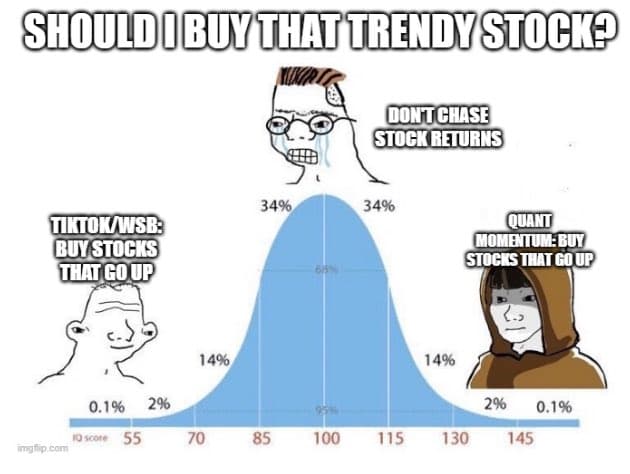
The bell curve meme captures the irony perfectly. At first glance, "buy stocks that go up" sounds like the worst possible investment advice. But it is also, mathematically, one of the most robust anomalies in finance.
Jegadeesh and Titman published the foundational momentum research in 1993. They ranked NYSE and AMEX stocks on trailing returns, bought the top decile, shorted the bottom decile, and held for a set number of months. The version they study in most detail ranks on the past six months and holds for six: it returned 0.95% per month (t = 3.07) from 1965 to 1989, which the authors report as a compounded 12.01% per year on a zero-cost position.[JT 1993] As they put it, a six-month ranking period "produces returns of about 1% per month regardless of the holding period." That is not a typo.
Three details that usually get lost. The 12.01% is a raw long-short spread rather than a risk-adjusted number; the market-model alpha is reported separately at 1.00% per month (t = 3.23). Half the profit comes from the short leg, so this is not a strategy you can run by buying winners alone. And the returns are gross: after 0.5% one-way trading costs on 85% semiannual turnover, the risk-adjusted figure falls to 9.29% per year. Jegadeesh and Titman also found that roughly half the first-year gain reverses over the following two years, though they are careful to note that the reversal itself is not statistically significant.
Note what the strategy does not do: skip a month. That convention, ranking on returns from twelve months ago to two months ago, came later with Fama-French and Carhart, and it is what the standard momentum factor uses today. Jegadeesh and Titman's headline strategy moves straight from the ranking period into the holding period. Their 2001 follow-up extended the sample through 1998 and found the effect had persisted, at 1.23% per month.
Mark Carhart formalized this in 1997 by adding a momentum factor (WML, Winners Minus Losers) to the Fama-French three-factor model. His key finding: mutual fund "persistence" (funds that kept outperforming) was almost entirely explained by momentum loading, not manager skill. The top-performing funds were not smart. They were just holding recent winners.
Asness, Moskowitz, and Pedersen extended this in 2013 with "Value and Momentum Everywhere," showing that momentum works not just in US stocks but across eight diverse markets and asset classes: international equities, government bonds, currencies, and commodities. The evidence is unusually broad.
Same Holdings, Different Reasons
The overlap between growth and momentum ETFs is not a coincidence. Companies that are growing fast (growth) tend to also be going up in price (momentum). But the reason for holding them is fundamentally different.
| Stock | In Growth ETF (VUG) Because... | In Momentum ETF (MTUM) Because... |
|---|---|---|
| AAPL | $400B revenue, consistent earnings growth, high ROE | Outperforming the market over the trailing 12 months |
| NVDA | Revenue up 125% YoY, AI-driven earnings explosion | Strongest trailing price performance of any large cap |
| MSFT | 15%+ earnings growth, cloud revenue acceleration | Consistent relative outperformance vs. S&P 500 |
| META | Strong revenue growth, improving margins post-2023 | Sharp price recovery creating strong trailing returns |
If you only look at the holdings, growth and momentum are the same trade. If you look at why they hold those stocks, they are completely different strategies. Growth asks: "Will this company earn more in the future?" Momentum asks: "Is this stock currently winning?"
When the Distinction Actually Matters
In a steady bull market, growth and momentum hold similar stocks and produce similar returns. The distinction becomes critical during reversals.
- Growth holds through downturns. A growth ETF keeps holding NVDA at 60x earnings even when the stock falls 30%, because the growth thesis (AI revenue) has not changed. The fundamentals still look strong.
- Momentum rotates out. A momentum ETF sells NVDA when its trailing 12-month performance turns negative. It does not care about fundamentals. The price signal flipped, so the stock leaves the portfolio.
This mechanical rotation is both momentum's strength and its weakness. It cuts losses in prolonged downtrends (2000-2002 dot-com unwind). But it also creates "momentum crashes" during sharp reversals. From March to May 2009, a decile winners-minus-losers portfolio lost 73.8% in three months. The damage came almost entirely from the short side: over those three months the loser decile gained 44.7%, 45.1% and 23.2% while the winner decile went essentially nowhere. Daniel and Moskowitz put the same period more starkly still, with the past-loser decile up 163% against 8% for past winners.[DM 2016] Only 1932 was worse. If you held a pure momentum strategy through the March 2009 reversal, the pain was extraordinary.
Crash figures are for a value-weighted top-decile-minus-bottom-decile portfolio formed on prior (12-2) returns, computed from the Kenneth R. French Data Library and reproducible with scripts/extract_momentum_betas.py. Decile spreads are far more extreme than the standard momentum factor, which uses 30th and 70th percentile breakpoints and lost 49.4% over the same three months.
Four Momentum ETFs Worth Knowing
| ETF | Name | Expense Ratio | AUM | Approach |
|---|---|---|---|---|
| MTUM | iShares MSCI USA Momentum | 0.15% | ~$22B | Passive index, quarterly rebalance, broad |
| VFMO | Vanguard US Momentum Factor | 0.13% | ~$1.4B | Rules-based, all market caps, diversified |
| QMOM | Alpha Architect US Quant Momentum | 0.28% | ~$440M | Concentrated, roughly 50 holdings, closest to academic research |
| IMOM | Alpha Architect Intl Quant Momentum | 0.38% | Smaller | International momentum, same methodology as QMOM |
MTUM is the default: lowest cost, largest, most liquid. QMOM is for investors who want the purest academic momentum exposure (50 stocks, high turnover, concentrated). VFMO is the Vanguard compromise: low cost, more diversified, less concentrated momentum signal. IMOM gives you momentum outside the US, which is valuable for global diversification since Asness et al. showed the factor works across markets.
The Academic Scorecard
| Factor | What It Buys | Academic Evidence | Key Risk |
|---|---|---|---|
| Growth (anti-HML) | Low book-to-market, high P/E | Negative premium 1926-2007; positive post-2007 | Regime-dependent; may not persist |
| Momentum (WML) | 12-month trailing winners | Positive across markets, decades, asset classes | Momentum crashes during sharp reversals |
The academic evidence for momentum is substantially stronger than for growth. Growth is a bet on valuation regimes. Momentum is a bet on human behavior: slow information diffusion, herding, and the tendency of trends to persist. The behavioral explanation is more durable because human psychology does not change with market regimes.
A key finding from Asness et al.: value and momentum are negatively correlated. When value underperforms, momentum tends to outperform, and vice versa. This makes momentum a genuine diversifier for value-tilted portfolios, not a replacement for growth.
Practical Takeaways
- If you hold VTI or VXUS, you already own growth stocks at market weight. Adding a momentum ETF (MTUM, VFMO) is a different factor exposure, not "more growth."
- Growth and momentum overlap in calm markets but diverge in reversals. Growth holds through downturns; momentum rotates out. Neither behavior is inherently better. It depends on the environment.
- Momentum crashes are real and can be severe (a decile long-short portfolio fell 73.8% over three months in 2009). If you tilt toward momentum, understand that you are accepting crash risk in exchange for a historically robust premium.
- The bell curve meme is surprisingly accurate. "Buy stocks that go up" is either the dumbest or the smartest investment strategy depending on whether you are doing it based on TikTok tips or a systematic, rebalanced, factor-based process.
- Check your actual factor exposure. Summitward's portfolio analysis runs a Carhart 4-factor regression that shows your portfolio's actual momentum loading (MOM beta). You might be surprised by how much or how little momentum exposure you have.
Key Takeaways
- Growth selects on fundamentals (earnings, P/E). Momentum selects on price trends (12-month return). They often hold the same stocks but for completely different reasons.
- The academic evidence for momentum is stronger than for growth. Momentum has a positive premium across markets and asset classes (Asness et al. 2013). Growth's premium is regime-dependent.
- Momentum and value are negatively correlated, making momentum a genuine diversifier for value-tilted portfolios.
- Momentum crashes during sharp reversals. A decile winners-minus-losers portfolio lost 73.8% over three months in 2009, almost all of it on the short side. This is the price of admission.
- MTUM, VFMO, QMOM, and IMOM offer different tradeoffs between cost, concentration, and fidelity to the academic research.
Related Guides
- Alpha Architect ETFs: the funds behind QMOM and IMOM, with measured momentum loadings against the Avantis and Dimensional alternatives
- Fama-French Factor Analysis covers the full framework including all five factors and the Carhart momentum extension.
- Concentration Risk covers what happens when a single stock dominates your portfolio (relevant for momentum’s concentrated bets).
- Equity Compensation Tax Strategy covers managing RSU exposure alongside factor tilts.
More in Investing & Portfolio
Browse all investing & portfolio guidesGet new guides by email
Evidence-based, no jargon. At most two emails a month. Unsubscribe any time.
Try it in Summitward
See portfolio factor analysis in action with your own financial data. Free to start, no credit card required.