

The Risk-Free Rate Is Your Hurdle Rate: How to Use Treasuries and TIPS as the Starting Point for Every Investment
At 5.03% nominal and 2.74% real on May 12 2026, Treasury and TIPS yields set the hurdle every risky asset has to clear. The framework, the common mistakes, and a Hurdle Rate Check calculator.
Treasury and TIPS yields update daily. Specific yields cited below are point-in-time snapshots from May 12 2026 and will move with the market. (Live numbers are on the markets dashboard.) The framework does not.
On May 12 2026, the 30-year nominal Treasury closed at 5.03% and the 30-year TIPS at 2.74% real. Pekka Tuomov (@ptuomov) summarized the implication in a PSA-style tweet: these are the yields a DIY investor is supposed to use as the starting point for any long-term discount rate or expected-return calculation, with the risk premium added on top.
The framing is right, and it is the most important framing in personal finance that gets the least airtime. After fifteen years of near-zero real yields, U.S. government bonds offer a positive real return again. That changes the bar every other asset class has to clear. The post that follows unpacks the framework: what the risk-free rate actually is, why it matters, how DIY investors should use it, and the most common mistakes around it.
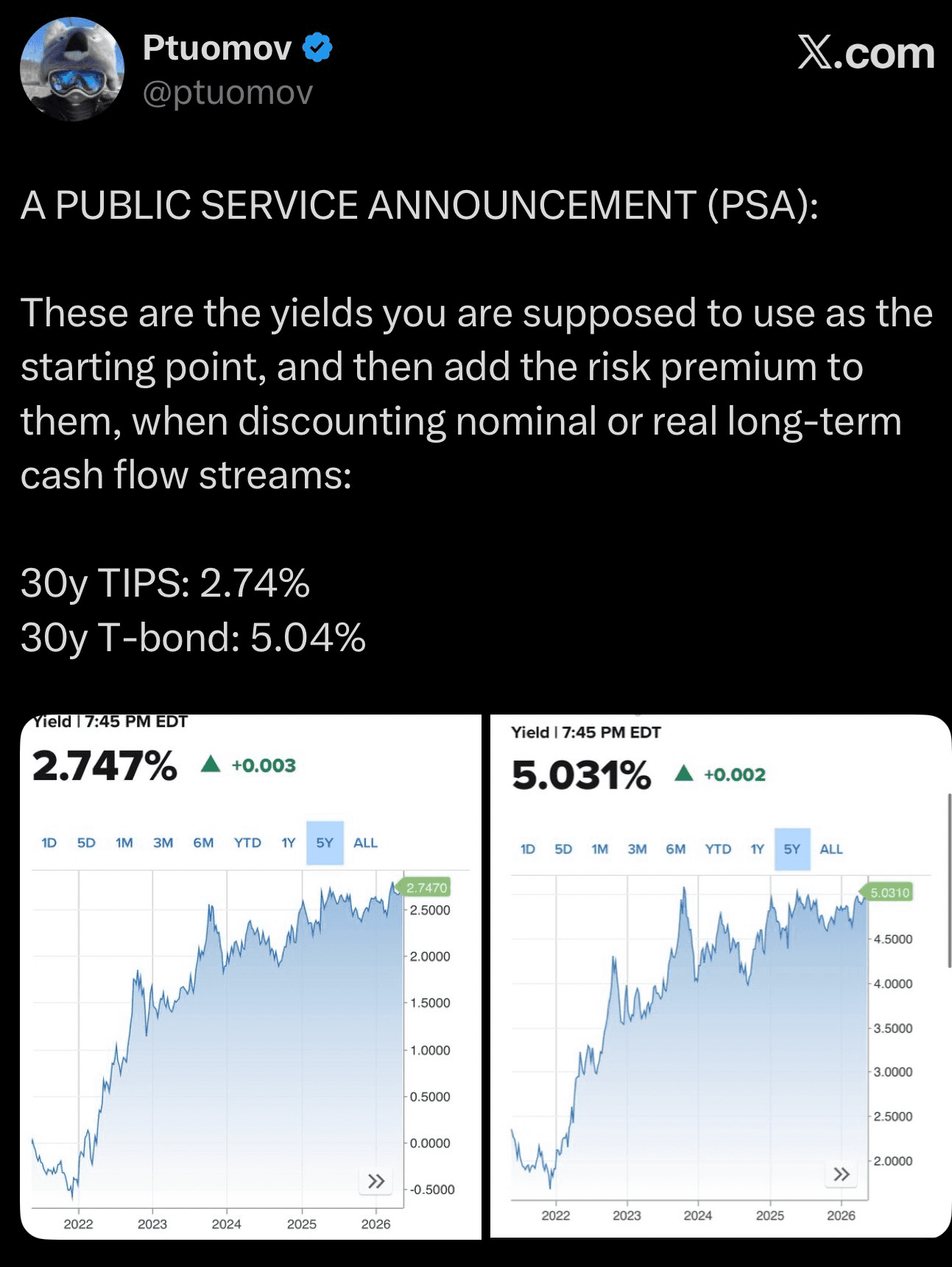
Source: @ptuomov on X, May 12 2026.
What the tweet is saying, in plain English
Every investment decision involves comparing an expected return to an alternative. The cleanest alternative for a long-dated cash flow is a U.S. Treasury security of the same maturity and the same cash-flow type:
- For nominal cash flows (debt repayment, fixed-dollar annuities, fixed pensions), the alternative is a nominal Treasury. Treasury reported the 30-year nominal par yield at 5.03% on May 12 2026. U.S. Treasury Daily Par Yield Curve Rates.
- For real cash flows (retirement spending, purchasing-power goals), the alternative is a TIPS bond. TIPS principal adjusts with CPI and interest is paid every six months on the adjusted principal, so the real return is locked in if held to maturity. Treasury reported the 30-year real par yield at 2.74% on the same date. TreasuryDirect: TIPS overview.
The tweet’s point: do not estimate what a stock, rental property, business equity stake, or factor tilt “should” return in a vacuum. Start with the matched Treasury or TIPS yield, then ask whether the risky asset offers enough extra return to justify the extra risk.
“Risk-free” is not one number
The phrase “the risk-free rate” gets used as if it refers to a single yield. It does not. The right number depends on the question being asked.
| Question | Correct baseline |
|---|---|
| Is the cash flow nominal or real? | Nominal Treasury vs. TIPS. |
| Is it 6 months or 30 years away? | Match the maturity to the horizon. |
| What currency is the cash flow in? | Match the currency (USD, EUR, GBP, JPY, etc.). |
| Will you need to sell before maturity? | Long bonds are not risk-free if sold early. Use short T-bills for short horizons. |
| Are you in a taxable account? | Compare after-tax yields, not headline yields. Treasury interest is state-exempt; TIPS have phantom income. |
Maturity mismatch is the most common error. FINRA’s primer on duration is clear: bond prices move inversely with rates, and longer maturities have larger price swings for a given rate change. A 30-year Treasury approximates a risk-free 30-year nominal cash flow held to maturity. For a 1-year house down payment, the same bond is anything but risk-free.
The hurdle rate, defined
A risky asset is attractive only if its expected excess return over the appropriate risk-free baseline is high enough to compensate for the extra risk, not merely because its expected return is positive. That baseline is the hurdle rate: the minimum return an investment needs to offer before the comparison is worth making.
Aswath Damodaran describes the risk-free rate as the building block for every expected return: the cost of equity and cost of capital are constructed by adding risk premia to the risk-free rate, and a higher risk-free rate mechanically lowers present values for any given cash flow stream. Damodaran: What is the riskfree rate? Fama and French summarize the textbook version in their CAPM review: expected return equals the risk-free rate plus a risk premium tied to the asset’s market beta. Fama & French (JEP, 2004).
Concretely, with today’s real 30-year TIPS at 2.74%, a long-horizon real investment has to clear a 2.74% real hurdle before any risk premium is earned. A diversified equity portfolio expected to return 7% real is paying you roughly 4.26 percentage points above the matched TIPS alternative for equity risk, before taxes, fees, and forecast error. That premium may still be attractive, but it is the right number to evaluate.
Why 2026 looks different from 2021
For most of the 2010s and into 2021, real Treasury yields ran near zero or even negative. The 30-year TIPS chart in the tweet bottoms out below 0% in 2022, then climbs to about 2.7% over the following four years. That is a roughly 270 basis-point increase in the long-run real hurdle rate in less than five years.
When the risk-free real rate is near zero, the only way to earn a real return is to take risk. That was the “there is no alternative” environment that pushed valuations on stocks, real estate, and private credit higher. When the risk-free real rate is 2.74%, safe assets are once again real competition for risky assets, and every expected-return forecast has to climb a higher mountain to justify the same equity allocation.
That does not automatically mean stocks are unattractive. Equities still compound at faster rates over long horizons in most historical samples, and a 4% to 5% expected real equity premium over TIPS would still be attractive for most long-term accumulators. The point is that the hurdle is no longer 0%, and plans that were built assuming a near-zero baseline need a sanity check.
Decomposing nominal vs. real: the breakeven
Subtracting the TIPS yield from the matched nominal Treasury yield gives a number commonly called the breakeven inflation rate. On May 12 2026, the 30-year breakeven was:
5.03% − 2.74% = 2.29% simple spread
More precisely, using the geometric relation between nominal and real returns:
(1.0503 / 1.0274) − 1 ≈ 2.23%
It is tempting to read the breakeven as the market’s expected inflation rate. The Federal Reserve’s own documentation of its TIPS yield-curve series is explicit that this read is too clean: “Rates of inflation compensation (‘breakeven’ rates) incorporate inflation risk premiums and the effects of the differential liquidity of TIPS and nominal securities. Consequently breakeven rates should not be interpreted as estimates of inflation expectations.” Federal Reserve: TIPS Yield Curve and Inflation Compensation (Gurkaynak, Sack & Wright).
Translated: 2.23% is the market-implied inflation compensation, which mixes expected inflation, an inflation risk premium that investors demand for bearing inflation surprises, and a liquidity premium that reflects how much more thinly TIPS trade compared to nominal Treasuries. Use the breakeven as a sanity check, not as a forecast.
Five DIY mistakes around the risk-free baseline
- Using cash or money-market rates as the baseline for 30-year goals. A 4% T-bill yield can vanish in a single Fed-cutting cycle. The 30-year Treasury locks in a 30-year nominal rate. For a retirement spending floor 20+ years out, the long bond is the matched baseline, not the cash rate.
- Comparing nominal investment returns to real spending goals. A 7% nominal stock return looks great until you subtract 2.3% inflation compensation. For a real-spending plan, the comparison is between a real expected return (around 4.6% in this example) and the real TIPS baseline (2.74%). The real premium is what matters.
- Ignoring taxes on Treasury and TIPS yields. Treasury interest is federally taxable but exempt from state and local income tax. TreasuryDirect: Tax Forms and Withholding. TIPS holders also face phantom income: inflation adjustments to principal can be taxed as ordinary income in the year accrued, even before the cash is received at maturity. Hold TIPS in tax-advantaged accounts where possible.
- Treating breakeven inflation as a clean forecast. As cited above, the Fed says breakevens include risk and liquidity premia. Treat the breakeven as a market-implied inflation compensation number, not as the market’s point forecast for CPI.
- Treating bond funds as duration-matched bond ladders. A 30-year Treasury held to maturity locks in 5.03% nominal. A long-duration Treasury bond fund does not. Funds roll maturities, so the yield investors actually earn drifts with rates and they bear interim price risk. The hurdle-rate framework works for individual bonds held to maturity; for funds, the realized yield is uncertain.
How to apply it: a four-step check
- Identify the cash flow type. Is the goal dollar-denominated and fixed (a mortgage, a fixed annuity), or inflation-adjusted (retirement spending, a college tuition target)? Pick nominal or real.
- Match the maturity to the horizon. Six months: T-bills. Ten years: 10-year Treasury or TIPS. Thirty years: 30-year Treasury or TIPS. For mid-horizon goals, blend maturities or interpolate.
- Pull the right baseline yield. Treasury publishes both the nominal and real par-yield curves daily. Bookmark Treasury.gov and the Fed’s H.15 release.
- Subtract to find the excess return the risky asset must clear. A risky asset offering less than about 1 percentage point of excess return is probably not paying for its risk. Three points is roughly the long-run equity risk premium. In between is judgment.
The Hurdle Rate Check
Use the calculator below to apply the framework to any expected return you are evaluating. Choose nominal or real, match the horizon, and read the excess return your risky asset is actually offering against the May 12 2026 Treasury or TIPS baseline.
Three common overclaims, and what to say instead
Three pieces of phrasing worth using verbatim when you talk or write about TIPS, Treasuries, and risk premia:
- A duration-matched TIPS held to maturity can approximate a government-backed real return before taxes, expenses, and personal inflation mismatch. (Not “TIPS guarantee a 2.74% real return.”)
- The nominal Treasury and TIPS spread is market-implied inflation compensation, not a clean inflation forecast, because it also reflects inflation risk premia and relative liquidity. (Not “The market expects 2.3% inflation for 30 years.”)
- Risk premia are estimates, not contractual yields. The Treasury or TIPS coupon is contractual. The 5% expected equity premium is a hypothesis.
Who this is for, and who it is not
This framework is most useful for DIY investors evaluating forward-looking return assumptions: retirees pricing a real spending floor, high earners comparing taxable bond options, accumulators sanity-checking equity allocations, anyone reading capital-market assumptions published by an asset manager.
It is less useful as a short-term trading lens. Treasury and TIPS yields move daily, and one-week or one-month moves are usually noise. The framework is for setting planning hurdle rates, not for timing markets. For short-horizon cash, see Where to Park Your Cash; for the retirement-income vehicle built directly on TIPS, see How to Build a TIPS Ladder.
What I recommend
Build every expected-return conversation around the hurdle rate. Before asking whether a stock fund, rental property, business equity stake, or factor tilt is “a good investment,” ask what the matched Treasury or TIPS yield is and how big the excess return is. If the gap is large enough to compensate for the risk, the asset deserves serious consideration. If the gap is thin, the spreadsheet that says otherwise is probably wrong.
Frequently Asked Questions
Is a 30-year Treasury actually risk-free?
For a 30-year nominal cash flow held to maturity, yes, in the sense that the U.S. Treasury has not defaulted on dollar obligations and can in principle issue more dollars to pay the coupon. The 30-year Treasury is not risk-free for shorter horizons or for real purchasing power: a 30-year Treasury sold after 5 years can lose substantial value if rates rise, and a 30-year nominal Treasury held to maturity can lose substantial purchasing power if realized inflation runs above the breakeven. For purchasing-power risk, use TIPS.
How are TIPS taxed?
TIPS interest is federally taxable but exempt from state and local income tax, the same as nominal Treasuries. The complication is the inflation adjustment to principal, which is also federally taxable in the year it accrues, even though the cash is not received until the bond matures or is sold. This is the “phantom income” problem. The cleanest fix is to hold TIPS in a tax-advantaged account (IRA, 401(k), HSA), where the inflation adjustments are not taxed annually.
What about I Bonds versus TIPS?
I Bonds offer CPI-linked principal protection with a fixed real rate set at issuance and capped purchase limits ($10,000 per person per year electronically, plus $5,000 via tax refund). TIPS have no purchase cap and are tradeable. For small amounts of household inflation protection, I Bonds are often the better wrapper. For sizing a real-spending floor in the hundreds of thousands or millions of dollars, TIPS are the only practical option. See The Best Inflation Hedges Are Boring for the full comparison.
Should I put everything in TIPS at 2.74% real?
No. A 2.74% real return is attractive against a 0% real baseline but still well below the long-run historical real return on a global equity portfolio. For most accumulators, equities still deserve the largest portfolio role; TIPS earn their place as the funded-floor layer for known real liabilities (retirement spending, future college costs, healthcare). The right question is not which asset class wins but how much of each to hold for which goal.
Bond funds or individual TIPS?
For a planning floor where the goal is to lock in a known real return, individual TIPS held to maturity are the cleaner tool. Bond funds are continuously rebalanced, so the yield realized depends on rate paths over the holding period, not the yield at purchase. For a household that wants broad diversified exposure without managing individual issues, a short or intermediate TIPS ETF is reasonable, with the caveat that the locked-in real return is an approximation rather than a guarantee.
What about international government bonds?
Match the currency to the cash flow. A US-based investor with dollar liabilities should evaluate dollar opportunities against US Treasury and TIPS yields. International government bonds introduce currency risk, sovereign risk, and tax-treatment complexity that the framework above does not capture. For most DIY investors with dollar-denominated retirement spending, US Treasuries and TIPS are the right baseline.
Related Guides
- The Ten-Year Rose 392 Basis Points Since 2021. The Real Yield Rose 395. for how that baseline got here: the whole move since 2021 was the real yield, with inflation compensation flat.
- Is Locking In Today’s TIPS Yields Market Timing? takes the same real yields and asks what they do to the cost of guaranteeing retirement spending.
- Do You Need a Paid-Off Home to Retire? applies the risk-free-return framing to paying off a mortgage versus keeping the liquidity.
- How to Build a TIPS Ladder covers the retirement-income application of the same TIPS yields: turning savings into guaranteed real cash flows.
- Where to Park Your Cash covers the short-horizon end of the curve: T-bills, SGOV, money-market funds, and after-tax yield comparisons.
- The Best Inflation Hedges Are Boring compares TIPS to I Bonds, stocks, gold, and fixed-rate debt as inflation-protection vehicles.
- What Real Return Should You Assume for Stocks? covers the other half of the hurdle-rate comparison: what real return is reasonable to expect from equities.
- Safe Withdrawal Rate translates expected returns and hurdle rates into a retirement spending plan.
- The Four Deep Risks of Investing covers what nominal Treasuries cannot hedge: inflation, confiscation, deflation, devastation.
- Does the Fed Really Set Interest Rates? covers the term-premium and r-star mechanics behind the yield curve.
Key Takeaways
- Every risky asset has to clear a matched Treasury or TIPS baseline. The hurdle rate is the minimum return needed before any risk premium is earned.
- Match the baseline to the cash flow type and horizon. Nominal Treasuries for dollar cash flows, TIPS for real purchasing power, and a maturity that lines up with when the money is needed.
- 2026 is not 2021. A 2.74% real 30-year TIPS and a 5.03% nominal 30-year Treasury raise the bar every other asset class has to clear. Plans built around a 0% real baseline need a sanity check.
- Breakeven inflation is market-implied compensation, not a forecast. The 2.23% to 2.29% spread includes inflation risk and TIPS liquidity premia.
- The right DIY question is what excess return the asset offers above the matched baseline, and whether that premium is large enough to compensate for the risk taken. Use the calculator above to make the comparison concrete.
More in Investing & Portfolio
Browse all investing & portfolio guidesGet new guides by email
Evidence-based, no jargon. At most two emails a month. Unsubscribe any time.
Try it in Summitward
See Monte Carlo retirement simulation in action with your own financial data. Free to start, no credit card required.