

The Problem With "Just Invest in Index Funds"
There are more US fund products (12,843) than companies. Indexing is the right default, but which index, how much risk, and for which goals is the real work. With a calculator.

“Just invest in index funds” is the most common piece of investing advice on the internet, and the core of it is right. Low-cost index funds beat most active managers over time. The trouble is that the phrase answers the easy question and skips the hard ones. An index fund is a way to build a fund. It is not a financial plan.
Quick answer
Indexing is the right default for most investors. It solves one hard problem: avoiding expensive, underperforming active managers. It does not tell you which index, how much risk, which asset classes, how many funds, what it costs, where to hold it for tax purposes, or how to match your money to when you will spend it. The label tells you how a fund is managed. Whether it belongs in your portfolio is a separate question that depends on your goals, horizon, and liabilities.
I made the same point on my Engineer Investor account: telling someone to buy index funds, with no further detail, is like telling them to buy a car without naming a make or model.
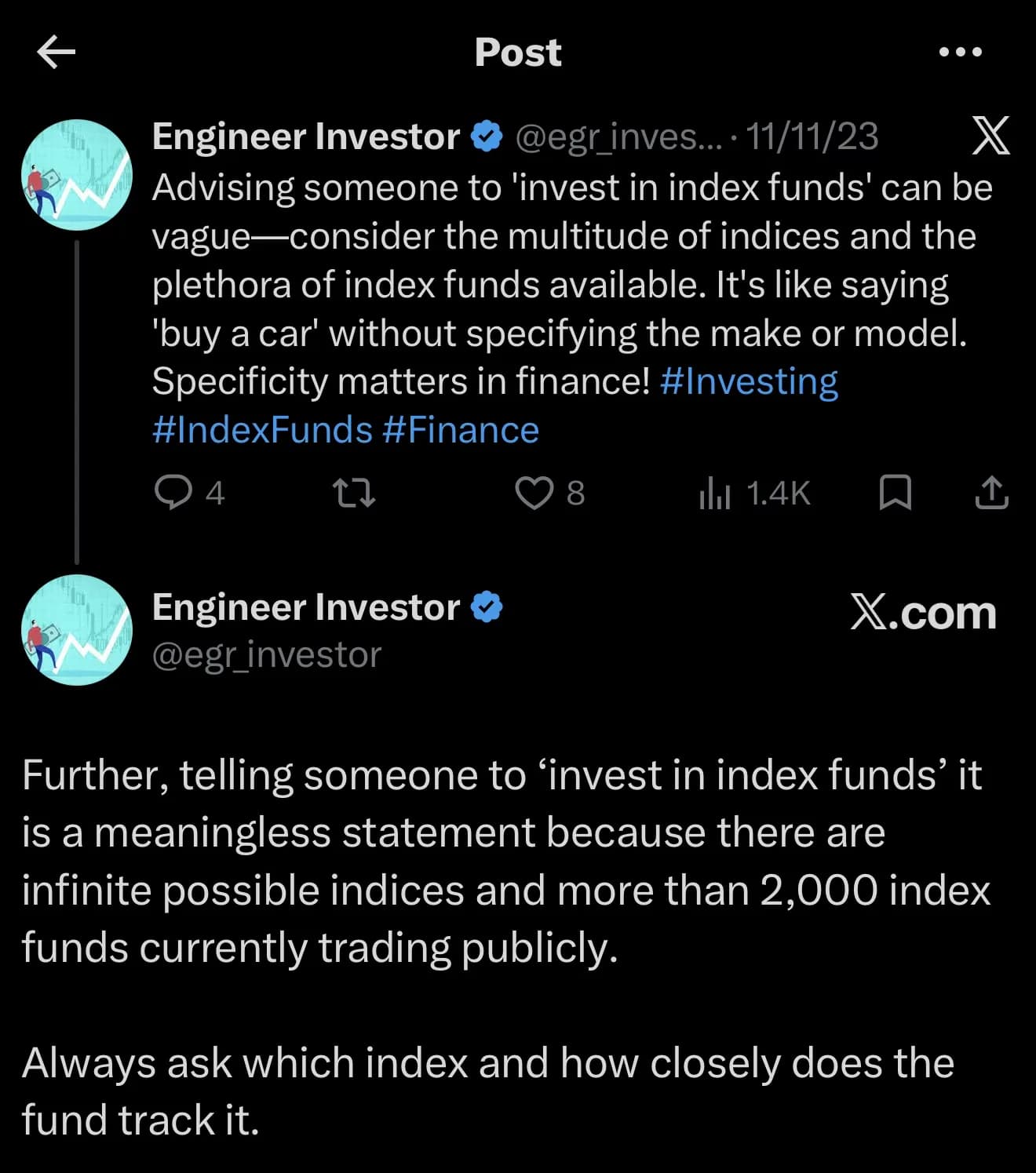
From my Engineer Investor account (@egr_investor) on X, Nov 11, 2023.
Disclosure: I write both Summitward and the Engineer Investor account.
Yes, there really are more funds than companies
The fund menu is now larger than the stock market it is built on. At the end of 2025 the Investment Company Institute counted 16,829 U.S. investment companies, including 8,030 mutual funds and 4,813 ETFs, so mutual funds and ETFs alone totaled 12,843 products.1 Jay Ritter’s data put the number of U.S. domestic operating companies listed on major exchanges at 3,657 at the end of 2025, after excluding REITs, closed-end funds, and ETFs.2 SIFMA’s broader count of all listed companies, which includes funds and other non-operating securities, was 5,492 in early 2026.3 On any reasonable definition, there are more fund products than there are American companies to put in them.
Indexing moved the hard choice rather than removing it. The decision used to be “which stock?” or “which manager?” Now it is which index, which wrapper, which asset allocation, which factor exposure, which duration, which tax treatment, and which sponsor. ICI counts 1,233 funds opened in 2025 alone, against 685 merged or liquidated.1 The fund shelf is a product marketplace full of launches that chase trends, and the options are far from equally sensible.
The case for indexing is strong
Start with what the advice gets right, because it gets a lot right. The arithmetic is hard to argue with: before costs, the aggregate of all active investors is the market; after costs, the average active dollar has to trail comparable low-cost passive exposure. Fama and French found that U.S. equity funds as a group looked much like the market before costs, and that very few funds earned enough to cover their fees once you separated skill from luck.4
The scorecards keep saying the same thing. Morningstar’s 2025 Active/Passive Barometer found that only about one in five active funds, 21%, both survived and beat their average passive peer over the prior decade, with U.S. large-cap among the weakest categories.5 S&P’s persistence work adds the behavioral kicker: even the winners rarely stay winners. Its year-end 2025 U.S. persistence scorecard described outperformance as “typically fleeting,” with only a sliver of top-quartile funds holding that rank a few years later.6 So the pro-indexing case is settled enough to build on. The rest of this post is about what indexing leaves for you to decide.
An index fund is a construction method
“Index fund” describes how a fund picks its holdings, while saying nothing about what those holdings are. The same label sits on wildly different exposures, and each one answers some questions while leaving others open.
| The index | What it gives you | What it leaves out |
|---|---|---|
| S&P 500 | Low-cost U.S. large-cap stocks | U.S. small caps, international, bonds, cash needs |
| Total U.S. market | Broad U.S. equity | Non-U.S. stocks, bonds, liabilities |
| Total world stock | Global equity diversification | Bonds, cash, liability matching |
| Aggregate bonds | Interest-rate and credit exposure | Inflation-linked needs, short-term cash |
| TIPS | Inflation-linked real bonds | Equity growth, nominal liabilities |
| Commodities | Possible inflation and shock diversification | Roll yield, tax drag, an inconsistent hedge |
| Factor (value, size, etc.) | Systematic tilts | Long stretches of underperformance, turnover |
Anything can be an index
The word “index” carries a quiet halo of discipline and breadth that it has not earned in every case. An index is just a rules-based basket. Define a theme, write screening rules, set weights and a rebalance schedule, license the methodology to a sponsor, and you have wrapped a marketing story in the language of passive investing. ICI counts more than three million indexes worldwide as of a 2020 industry survey, and index providers are not regulated as such in the U.S., where there is no single legal definition of what counts as an index.7 The SEC’s own bulletin is blunt: an index fund carries the same general risks as the securities in the index it tracks, and not all index funds are low cost.8
A broad total-market fund and a narrow thematic fund can both call themselves index funds. They are not remotely the same investment.
| Fund | Tracks | Expense ratio |
|---|---|---|
| BUZZ (VanEck Social Sentiment) | BUZZ NextGen AI US Sentiment Leaders Index (social-media sentiment) | 0.76% |
| PAWZ (ProShares Pet Care) | FactSet Pet Care Index | 0.50% |
| MILN (Global X Millennials Consumer) | Indxx Millennials Thematic Index | 0.50% |
| METV (Roundhill Ball Metaverse) | Ball Metaverse Index | 0.59% |
| UFO (Procure Space) | VettaFi Space Index | 0.75% |
| VEGN (US Vegan Climate) | Beyond Investing US Vegan Climate Index | 0.60% |
Index names and expense ratios from each issuer’s fund page, June 2026. Listed as cautionary examples only.
Plenty of these themes did not last. Janus Henderson launched an Organics ETF and an Obesity ETF tracking Solactive theme indexes in 2016, then liquidated both in March 2020.9 Direxion’s Moonshot Innovators ETF tracked the S&P Kensho Moonshots Index and liquidated in July 2024.10 The original Roundhill MEME ETF was a genuine index fund, tracking a meme-stock index built from social-media activity and high short interest, before it closed in December 2023. There really was an index fund for meme stocks.
This is not a fringe problem. Ben-David, Franzoni, Kim, and Moussawi studied specialized ETFs and found they tend to launch around attention-grabbing themes and then lose roughly 30% on a risk-adjusted basis over their first five years, because the underlying stocks are often overvalued at launch.11 For most DIY investors, narrow thematic funds are poor core holdings. They may earn a tiny satellite slot for someone who understands the risk. They do not replace a globally diversified portfolio.
“The market” is bigger than the S&P 500
Casual index advice often shrinks “the market” down to the S&P 500. That is fine shorthand for U.S. large-cap stocks, and it is not the global investable market. Research on the global multi-asset market portfolio treats the real benchmark as everything investors hold together: public and private equity, real estate, government and corporate bonds, inflation-linked and high-yield debt, emerging-market debt, and commodities. Doeswijk, Lam, and Swinkels estimated that this global market portfolio earned about 4.45% real per year from 1960 to 2017, with lower volatility than an all-equity portfolio.12 Owning the S&P 500 is a reasonable building block. It is not, by itself, a complete portfolio.
Allocation matters more than how many funds you own
A one-fund portfolio can be excellent. A twelve-fund portfolio can be a mess. The exposures are what matter, far more than the number of funds. The classic Brinson-style research is often mangled into “asset allocation explains 90% of returns.” The careful version is narrower: the stock, bond, and cash mix explains most of the variation in a portfolio’s returns over time, which still makes it a far bigger decision than whether your total-market ETF comes from Vanguard, iShares, Schwab, Fidelity, or State Street.13 Vanguard’s investing principles put it plainly: your capacity for risk depends on your cash-flow needs and time horizon, and the asset mix defines the likely range of outcomes.14
| Funds | Best for | Main weakness |
|---|---|---|
| 1 (target-date or global balanced) | Hands-off savers who want automation | Generic glide path, little tax-location control |
| 2 (global stocks + bonds) | Simplicity with one allocation lever | Less tax and location customization |
| 3 (U.S. + international + bonds) | Most DIY investors | Still requires the allocation decision |
| 4 to 7 | Tax-location, TIPS, munis, deliberate tilts | More to rebalance |
| 10+ | Only if every fund has a defined job | Overlap, tinkering, behavior risk |
A useful test: you should be able to explain every fund you own in one sentence. What exposure does it add, what risk does it reduce, or what goal does it fund? If a holding fails that test, it probably should not be there.
Stocks, bonds, cash, and the optional rest
Stocks are the long-term growth engine, right for money you will not touch through deep drawdowns and slow recoveries. “Stocks for the long run” does not mean stocks for every dollar. High-quality bonds help with volatility, liquidity, rebalancing, and liability matching, and the key variable is duration: a short-term need should not sit in a long-duration bond fund. Cash and Treasury bills are not return maximizers. They buy certainty for emergency funds, tuition, down payments, and near-term taxes, which is exactly what those dollars need.
Commodities and managed futures can diversify, with caveats. Gorton and Rouwenhorst found collateralized commodity futures had equity-like returns historically, with negative correlation to stocks and bonds and positive correlation to inflation; Erb and Harvey cautioned that the inflation-hedging works inconsistently and depends heavily on the weighting scheme.15 Trend-following has a long record of low correlation to stocks and bonds in the work of Hurst, Ooi, and Pedersen.16 These can earn a defined role for an investor who can tolerate the cost, complexity, and tracking-error regret. They earn a slot only when the role is clear and you can live with the cost.
Who the simple advice serves well
“Just index” works well, once translated into something precise, for:
- Long-term retirement savers who want broad diversification cheaply.
- People without the time, skill, or temperament to vet active managers.
- Anyone who benefits from automation and rebalancing.
- Investors who would otherwise lose ground through stock-picking, market timing, or chasing last year’s winners.
The precise version: use a low-cost, globally diversified index portfolio matched to your goals, risk capacity, taxes, and spending horizon.
Where it falls short
The slogan leaves real gaps for:
- People saving for a near-term home, tuition, tax, or business need.
- Retirees managing withdrawal sequencing and longevity risk.
- Anyone with concentrated employer stock or RSUs.
- High-income taxable investors who need tax-aware asset location and capital-gain planning.
- Anyone who panic sells, chases performance, or constantly switches funds.
- Anyone who reads “index funds” as “100% S&P 500 forever.”
In every one of these, the gap is the missing plan, and that is what to fix.
Low cost matters, and the label does not guarantee it
Cost is where indexing earns much of its edge, and the gap is large. In 2025 the asset-weighted expense ratio for index equity mutual funds was about 0.05%, against 0.64% for active equity funds; index bond funds ran about 0.05% against 0.44% for active bond funds.17 The averages also hide a wide spread. The simple-average equity mutual fund charged about 1.08% in 2025 while the asset-weighted average was 0.40%, because investors concentrate their money in the cheapest funds.17 So the upgrade to the advice is to buy broad, low-cost, transparent, tax-aware index exposure that fits your plan, and to check the actual expense ratio rather than trusting the word “index.”
A working order of operations
- Define the goal: retirement, a house, tuition, financial independence, income.
- Map your liabilities by timing: 0 to 3 years, 3 to 7, 7 to 15, and 15-plus.
- Fund the safety assets first: emergency reserve and known near-term spending.
- Choose the growth allocation: global stocks, with a deliberate U.S. and international split.
- Choose the stabilizers: high-quality bonds, TIPS, short Treasuries, cash.
- Minimize costs and taxes, including where each fund is held.
- Write down your rebalancing and behavior rules before you need them.
- Add commodities or other diversifiers only if they have a defined role you can tolerate.
Frequently Asked Questions
Are there really more funds than stocks?
Yes. At year-end 2025 there were 12,843 U.S. mutual funds and ETFs against roughly 3,657 U.S. domestic operating companies. The fund universe is larger than the market it tracks.
How many index funds should I own?
As few as one, often two or three, and rarely more than seven. The number is less important than whether each fund has a clear role. If you cannot explain in one sentence what a fund adds, you probably do not need it.
Is the S&P 500 a complete portfolio?
No. It is low-cost exposure to U.S. large-cap stocks, a strong building block, but it leaves out international stocks, bonds, cash for near-term needs, and any inflation-linked or liability-matching assets.
Are thematic index funds bad?
Most are poor core holdings. Tracking an index does not make a fund broad, cheap, or suitable. Specialized ETFs have historically lost about 30% risk-adjusted over their first five years. A narrow theme can be a small satellite for someone who understands the risk, well short of a portfolio core.
Does “index fund” mean “low cost”?
Not automatically. The SEC warns that not all index funds are low cost. Broad index funds are usually cheap; narrow thematic ones often charge 0.5% to 0.8%. Always check the expense ratio.
Key Takeaways
- Indexing is the right default. The evidence on costs and persistence makes a low-cost index core the sensible starting point for most investors.
- An index fund is a construction method. The label describes how a fund is managed. Which market, risk level, and asset class belong in your plan is a separate question.
- The choice did not disappear, it moved. With 12,843 fund products and millions of indexes, the work is now picking exposures, not stocks.
- Allocation outweighs fund count. Match your money to when you will spend it, fund near-term needs with cash, and be able to explain every holding in one sentence.
- The label is not a quality stamp. Meme-stock and pet-care index funds exist. Check the index, the cost, the concentration, and the role before you buy.
Related Guides
- An Index Fund Is Not a Financial Plan: the companion piece on the household plan, taxes, and estate handoff around the portfolio.
- The Case for Global Equity Diversification: why “the market” is bigger than the S&P 500.
- 60/40, Target-Date Funds, or 100% Stocks Forever?: the allocation decision that matters more than fund count.
- The Simplified Engineer Investor Portfolio: a concrete three-fund example where each holding has a job.
- Are Bonds Still Good Diversifiers?: duration, and why near-term money does not belong in long bonds.
- Should You Invest Like Yale?: when added complexity earns its keep, and when it does not.
- Do You Need Managed Futures?: how to judge whether a diversifier deserves a role.
Sources
- Investment Company Institute, 2026 Investment Company Fact Book(fund counts and 2025 openings/closures, year-end 2025). icifactbook.org.
- Jay R. Ritter, “The Number of Operating Companies Listed on Nasdaq and the NYSE,” University of Florida (3,657 domestic operating companies, year-end 2025). PDF.
- SIFMA, Research Quarterly: Equity and Related, 1Q 2026 (5,492 listed companies). sifma.org.
- Eugene F. Fama and Kenneth R. French, “Luck Versus Skill in the Cross-Section of Mutual Fund Returns,” Journal of Finance(2010). Journal of Finance.
- Morningstar, Active/Passive Barometer (year-end 2025): about 21% of active funds survived and beat the average passive peer over ten years. Morningstar.
- S&P Dow Jones Indices, U.S. Persistence Scorecard (year-end 2025). S&P SPIVA.
- Investment Company Institute, “Indexes and How Funds and Advisers Use Them: A Primer” (2021; the “3 million indexes” figure traces to a 2020 Index Industry Association survey). PDF.
- U.S. SEC Office of Investor Education and Advocacy, “Investor Bulletin: Index Funds.” investor.gov.
- Janus Henderson, “Changes to ETF Line-Up” (The Organics ETF and The Obesity ETF liquidated March 2020). Press release.
- S&P Dow Jones Indices, S&P Kensho Moonshots Index (tracked by the Direxion Moonshot Innovators ETF, liquidated July 2024). Index page.
- Itzhak Ben-David, Francesco Franzoni, Byungwook Kim, and Rabih Moussawi, “Competition for Attention in the ETF Space,” Review of Financial Studies (2023). RFS.
- Ronald Q. Doeswijk, Trevin W. Lam, and Laurens Swinkels, “Historical Returns of the Market Portfolio,” Review of Asset Pricing Studies (2020). RAPS.
- Gary P. Brinson, L. Randolph Hood, and Gilbert L. Beebower, “Determinants of Portfolio Performance” (1986), and Ibbotson & Kaplan (2000) on the correct interpretation. Financial Analysts Journal.
- Vanguard, “Principles for Investing Success.” PDF.
- Gary Gorton and K. Geert Rouwenhorst, “Facts and Fantasies about Commodity Futures” (NBER 10595), and Claude Erb and Campbell Harvey, “The Strategic and Tactical Value of Commodity Futures” (2006). NBER.
- Brian Hurst, Yao Hua Ooi, and Lasse H. Pedersen, “A Century of Evidence on Trend-Following Investing” (AQR / Journal of Portfolio Management, 2017). AQR.
- Investment Company Institute, “Trends in the Expenses and Fees of Funds, 2025” (ICI Research Perspective, March 2026). PDF.
This article is educational and is not investment advice. Fund names and expense ratios are cited as examples and can change; verify any fund against its current prospectus before investing.
More in Investing & Portfolio
Browse all investing & portfolio guidesGet new guides by email
Evidence-based, no jargon. At most two emails a month. Unsubscribe any time.
Try it in Summitward
See portfolio factor analysis in action with your own financial data. Free to start, no credit card required.