

Grow Income Faster Than Expenses: The Underrated Math Behind Wealth and Freedom
Your savings gap matters more than your lattes. The math of growing income faster than expenses, why it beats small-expense guilt, and how to spend more as you age while still building wealth.
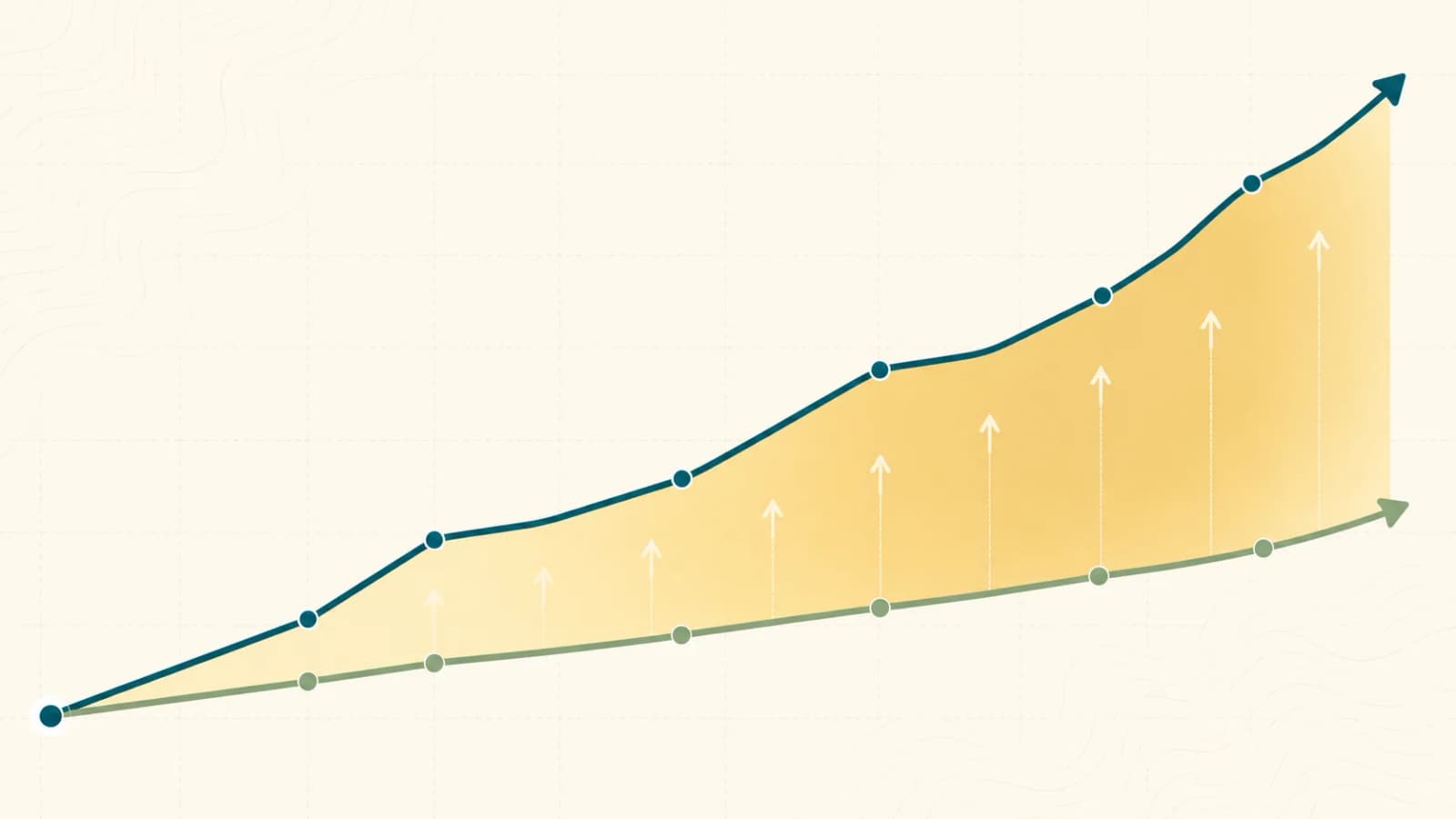
The most useful idea in personal finance rarely makes the headlines: keep your income growing faster than your spending. The gap between the two is what becomes savings, investments, optionality, and eventually freedom, and it compounds for decades. This guide works through the math, the evidence, and a less obvious payoff: you can spend more as you age and still build wealth faster, as long as income outruns expenses.
The short version
You do not need expenses to stay flat forever. You need income to grow faster than expenses. When it does, your savings rate climbs on its own while your lifestyle still improves, and the gap improves both sides of the freedom equation at once: more money invested each year, and a portfolio target that grows more slowly. A high savings rate built this way beats any amount of small-expense guilt.
Why the latte framing is too small
A cafe latte averaged $5.54 in 2026, so every weekday runs about $1,440 a year and every day about $2,022. That is real money, and it matters for someone with little surplus. For most people building wealth, the bigger levers sit elsewhere. The Bureau of Labor Statistics’ 2024 data puts average household spending at $78,535, of which housing is $26,266 (33.4%), transportation $13,318 (17.0%), and food $10,169, with only $3,945 of that spent on food away from home.1 Housing and transportation alone are about half of spending. David Bach popularized the “latte factor,” and Helaine Olen’s Pound Foolish is the well-known rebuttal: small daily purchases are a distraction from the decisions that actually move the needle. We run the numbers on that argument in The Latte Factor, Recalculated.2 The decisive question is how much of each raise, bonus, or RSU vest turns into permanent spending.
The math: the gap compounds twice
Let income and expenses each grow at their own rate from today’s values, where is income growth and is expense growth:
Savings is the gap between them, and the savings rate is the share of income you keep:
That formula is the whole article. When expenses grow slower than income, the ratio in the parentheses shrinks each year, so the savings rate rises. When the two grow at the same rate, the savings rate is stuck forever. When expenses grow faster, even a high earner drifts toward fragility. The gap helps twice over: a larger gap means more invested each year, and slower expense growth means the portfolio you need for independence (a multiple of spending) grows more slowly too.
Start a household at $100,000 of after-tax income and $80,000 of spending, with nothing invested, a 5% real return, and a 25x spending target for financial independence. Hold income growth at 3% real and vary only how fast expenses grow:
| Scenario | Income / expense growth | Savings rate at year 20 | Portfolio at year 20 | FI target | Progress to FI |
|---|---|---|---|---|---|
| Full lifestyle creep | 3% / 3% | 20% | ~$847k | ~$3.51M | ~24% |
| Income outruns expenses | 3% / 1% | 45% | ~$1.37M | ~$2.42M | ~57% |
| Expenses outrun income | 3% / 4% | 4% | ~$539k | ~$4.21M | ~13% |
Illustrative, at a 5% real return and a 25x (4% withdrawal) target. The middle household is not becoming miserly: its spending still rises from $80,000 to about $96,600 over the 20 years. Income simply rises faster, so the savings rate more than doubles while the FI target grows slowly.
The middle row is the point of the whole post. Spending goes up, life gets nicer, and the household still reaches more than half of its FI target in twenty years while the full-creep household sits near a quarter. The calculator below lets you run your own income and expense growth and watch the savings rate climb.
Watch the gap grow (or not)
Set how fast your income and your expenses grow. When income grows faster, your savings rate climbs even as you spend more in absolute terms. Set both equal to see full lifestyle creep.
Raises and promotions, after inflation. The whole point is keeping this above expense growth.
How fast your lifestyle inflates, after inflation. Below income growth, the savings rate climbs.
Portfolio needed per dollar of spending. 25x implies a 4% withdrawal rate.
Savings rate now
20%
$20k of $100k income.
Savings rate in 30 years
55%
While spending still rises to $107k.
Years to FI
27
Until the portfolio covers 25× that year’s spending.
Lifestyle-creep drag
+30 yr
Letting expenses grow as fast as income adds about 30 years.
Savings rate over 30 years
Educational tool, not advice or a forecast. Growth and return are in real (after-inflation) terms; the model ignores taxes, sequence-of- returns risk, and lumpy income, and a year with no surplus simply adds nothing rather than drawing down. The FI target rises with your spending each year.
What the evidence says
The idea sits on standard life-cycle finance. The life-cycle hypothesis holds that people smooth consumption over a lifetime, saving most during prime earning years, which produces a hump-shaped wealth path.3 Christopher Carroll’s buffer-stock model adds the practical wrinkle that households face real income uncertainty, so a sensible rule is to keep fixed costs from ratcheting up faster than income, especially when that income is lumpy.4
Saving capacity does rise with income, but it is not automatic. Dynan, Skinner, and Zeldes found a strong positive link between lifetime income and saving rates.5 The Federal Reserve’s 2022 Survey of Consumer Finances shows the same pattern in behavior: 82% of families in the top income decile saved, compared with 66% of the upper-middle group and 43% of the bottom half (the Fed measures whether any saving occurred, not how much). Stock ownership tracks income just as steeply, from 34% of the bottom half to 78% of the upper-middle group to 95% of the top decile.6 Saving is mechanically easier when income clears necessary expenses by a wide margin.
One sobering nuance: income growth is often front-loaded and modest. Guvenen and coauthors, using Social Security records, found that median lifetime earnings grow only about 38% from age 25 to 55, and nearly all of that happens by the mid-30s (a median-worker result; top earners diverge sharply).7 That makes the early-career raises the ones most worth capturing, and it is why deliberately seeking raises and moving between employers matters. The Atlanta Fed’s Wage Growth Tracker has historically shown job switchers out-earning stayers, a gap that narrowed in the soft 2025 labor market.8
Behavior decides whether the gap actually opens. Thaler and Benartzi’s Save More Tomorrow asks people to commit future raises to saving before they get used to spending them, and reported large savings increases (the Department of Labor rates the causal evidence as low, so treat it as a strong idea rather than a settled fact).9 Chetty and coauthors’ Danish data found roughly 85% of people are passive savers who respond to automatic contributions far more than to incentives, which argues for automating the raise capture rather than relying on intentions.10
Can you be less frugal as you age?
Yes, when spending grows on purpose and slower than income. There is a useful difference between deliberate upgrades, where spending rises while the savings rate holds or climbs, and automatic creep, where every raise turns into a new fixed obligation and the savings rate flatlines. The first is the “have your cake and save it too” version of personal finance, and the math above shows it is real.
Two cautions matter here. Spending is sticky: a bigger mortgage, a car payment, private school, or a recurring travel habit is far harder to unwind than a one-time purchase, so separate one-time upgrades from permanent fixed-cost ratchets. And the lasting happiness from lifestyle upgrades fades. Research on hedonic adaptation finds that people absorb about two-thirds of the well-being boost from higher income within a few years.11 Our guide on money and happiness covers where spending actually buys a better life, and Die With Zero vs FIRE covers the opposite risk of underspending a life away.
The raise-capture rule
A simple rule turns the math into a habit: capture at least half of every after-tax raise until you are clearly on track. If a raise adds $8,000 after tax, let spending rise by no more than $4,000 and route the rest to investing. For lumpy, employer-tied pay such as bonuses and RSUs, use a stricter version and invest 50% to 100% unless the money already has a planned use. A workable hierarchy:
- Stabilize. Emergency fund, insurance, and high-rate debt come first.
- Automate the capture. Raise your 401(k), HSA, IRA or backdoor Roth, mega-backdoor Roth where available, and taxable contributions before the money reaches checking. The tax-advantaged trifecta shows how much sheltered space a high earner can use.
- Delay upgrades. Wait three to six months after a raise before increasing fixed costs.
- Separate one-time from recurring. Celebrate with a trip or a purchase before committing to a bigger mortgage or car payment.
- Track the gap, not the lattes. Watch income minus spending and the savings rate, not individual categories.
For DIY investors, the gap is the fuel. Asset allocation, low fees, tax location, and rebalancing all matter, and none of them substitute for investable cash flow. Income growth creates capacity, expense discipline preserves it, and investing converts it into wealth. High earners with variable pay get the most leverage and the most temptation, so funding permanent fixed costs from base income and routing variable comp to assets keeps the lifestyle ratchet from locking in. This complements High Income Is Not Wealth, which covers the FI ratio and the leverage of spending at a fixed income; this guide adds what happens as income and expenses grow over a career.
Who this is for, and who it is not
This makes the most sense for people with realistic room to grow income: early-career professionals, dual-income households, high earners, business owners, anyone with bonuses or RSUs, and workers in fields where skills raise pay. It also helps middle-income households that expect raises. BLS data show median full-time weekly earnings rising with age, from $810 at ages 20 to 24, to $1,140 at 25 to 34, $1,384 at 35 to 44, and $1,435 at 45 to 54.12
It is weaker as standalone advice when income does not cover basic needs, or under severe medical costs, unstable housing, caregiving constraints, disability, job loss, or stagnant local wages. For those situations, “save more of your raises” is empty without income support, debt relief, benefits, training, or job mobility. The claim here is narrow: where income growth exists, the share you capture is one of the strongest determinants of how much wealth you build, not a promise that anyone can budget their way out of structural constraints.
Frequently asked questions
Is it better to earn more or to spend less?
The gap is what matters, and it has two sides. Spending less works immediately and is fully in your control. Earning more has a higher ceiling but takes time and is less certain. The strongest path grows income while holding expense growth below it, so the savings rate rises from both directions.
Does this mean I can stop being frugal?
Yes, and your lifestyle should keep improving as you earn more. The aim is to fund those upgrades from part of each raise rather than all of it. Increase your spending by, say, half of every raise, so life genuinely gets better while the savings gap still widens. A $10,000 raise might add $5,000 to your spending and $5,000 to your investing. Spending the whole raise freezes your savings rate in place.
How much of a raise should I save?
A reasonable default is at least half of every after-tax raise until you are clearly on track, and 50% to 100% of bonuses and RSU vests, which are lumpy and employer-tied. Automating the increase before the money lands in checking makes it stick.
Is the latte factor wrong?
It is directionally useful for someone with almost no surplus, where every dollar counts. For most people building wealth, it is dwarfed by housing, transportation, and how much of each raise becomes permanent spending. Cut the latte if you enjoy doing so, and pay far more attention to the big recurring costs and the raise-capture rate.
Will my income actually grow enough for this to work?
For the median worker, most earnings growth happens in the first decade of a career, so capturing early raises matters most. Beyond that, income growth often comes from deliberate moves: building rarer skills, taking on scope, and changing employers, which has historically paid more than staying put.
Key takeaways
- The gap between income and expenses is the engine. Grow income faster than spending and the savings rate climbs on its own.
- The gap compounds twice. A wider gap invests more each year, and slower expense growth keeps the FI target from running away.
- You can spend more as you age. Deliberate upgrades that rise slower than income let your lifestyle improve while your savings rate still grows.
- Capture at least half of every raise, more of bonuses and RSUs, and automate it so passive habits do the work.
- Watch the gap, not the lattes. Housing, transportation, and lifestyle ratchets dominate the small daily purchases.
Related guides
- The $408,000 Paycheck-to-Paycheck Illusion what happens when expenses are grown deliberately to meet a big income: an audit of the viral $1-a-month budget.
- How Much Should You Spend on Vacations? prices the discretionary side of this equation: which raises can become lifestyle, tested against cash flow, liquidity, and your FI target.
- Savings Rate vs Investment Returns covers when your savings rate stops being the main lever and returns take over, using the contribution-to-portfolio ratio.
- High Income Is Not Wealth covers the FI ratio and why a big salary takes years to become wealth.
- FIRE Calculator shows how a static savings rate maps to years until independence.
- Money and Happiness covers where lifestyle spending actually buys a better life.
- Die With Zero vs FIRE covers the opposite failure mode of saving too much and spending too little.
- Should Students Save Money? covers the early-career transition where the lifestyle ratchet starts.
- The Tax-Advantaged Trifecta is where to automate the captured raises first.
Sources
- U.S. Bureau of Labor Statistics. Consumer Expenditures, 2024. Average $78,535; housing $26,266; transportation $13,318; food $10,169 (food away $3,945).
- Olen, H. (2012). Pound Foolish: Exposing the Dark Side of the Personal Finance Industry. The critique of the latte factor and small-expense focus. David Bach popularized “The Latte Factor.”
- Federal Reserve Bank of Richmond. Jargon Alert: Life Cycle Hypothesis (Econ Focus, 2016). Modigliani-Brumberg consumption smoothing.
- Carroll, C.D. (1997). Buffer-Stock Saving and the Life Cycle/Permanent Income Hypothesis. Quarterly Journal of Economics, 112(1), 1-55.
- Dynan, K.E., Skinner, J., & Zeldes, S.P. (2004). Do the Rich Save More? Journal of Political Economy, 112(2), 397-444.
- Federal Reserve. Changes in U.S. Family Finances from 2019 to 2022 (SCF, 2023). Saving rates 82% / 66% / 43% and stock ownership 34% / 78% / 95% by income group.
- Guvenen, F., Karahan, F., Ozkan, S., & Song, J. (2021). What Do Data on Millions of U.S. Workers Reveal About Life-Cycle Earnings Dynamics? Econometrica, 89(5), 2303-2339. Median lifetime earnings grow ~38% from 25 to 55, mostly by the mid-30s.
- Federal Reserve Bank of Atlanta. Wage Growth Tracker. Job switchers have historically out-earned stayers, with a 2025 cyclical reversal.
- U.S. Department of Labor (CLEAR review). Save More Tomorrow (Thaler & Benartzi, 2004). Large reported savings increases; causal evidence rated low.
- Chetty, R., Friedman, J.N., Leth-Petersen, S., Nielsen, T.H., & Olsen, T. (2014). Active vs. Passive Decisions and Crowd-Out in Retirement Savings Accounts: Evidence from Denmark. Quarterly Journal of Economics, 129(3), 1141-1219. About 85% of savers are passive.
- Di Tella, R., Haisken-De New, J., & MacCulloch, R. (2010). Happiness adaptation to income and to status in an individual panel. Journal of Economic Behavior & Organization, 76(3), 834-852. Much of the well-being gain from higher income fades within a few years.
- U.S. Bureau of Labor Statistics. Usual Weekly Earnings, First Quarter 2026 (Table 3). Median full-time weekly earnings by age: $810 / $1,140 / $1,384 / $1,435.
More in Getting Started
Browse all getting started guidesGet new guides by email
Evidence-based, no jargon. At most two emails a month. Unsubscribe any time.
Try it in Summitward
See cash flow planning in action with your own financial data. Free to start, no credit card required.