

BOAT: Break Out Another Thousand, and the Number That Tells You If It's Worth It
Run five boats through the full cost math and the loan payment is 27% to 31% of the total on conventional financing. Plus the break-even, in days per year.
I grew up on boats. My family owned several, and some of the best days of my childhood happened on the water. I have never bought one.
That combination is why I wanted to work this out properly. The joke every boater knows is that BOAT stands for Break Out Another Thousand, and for a big enough yacht people swap in million. It is funny because it is true, and it is also useless as advice. It tells you boats are expensive without telling you whether one would be worth it to you.
There is a number that answers that, and it is not the sticker price.
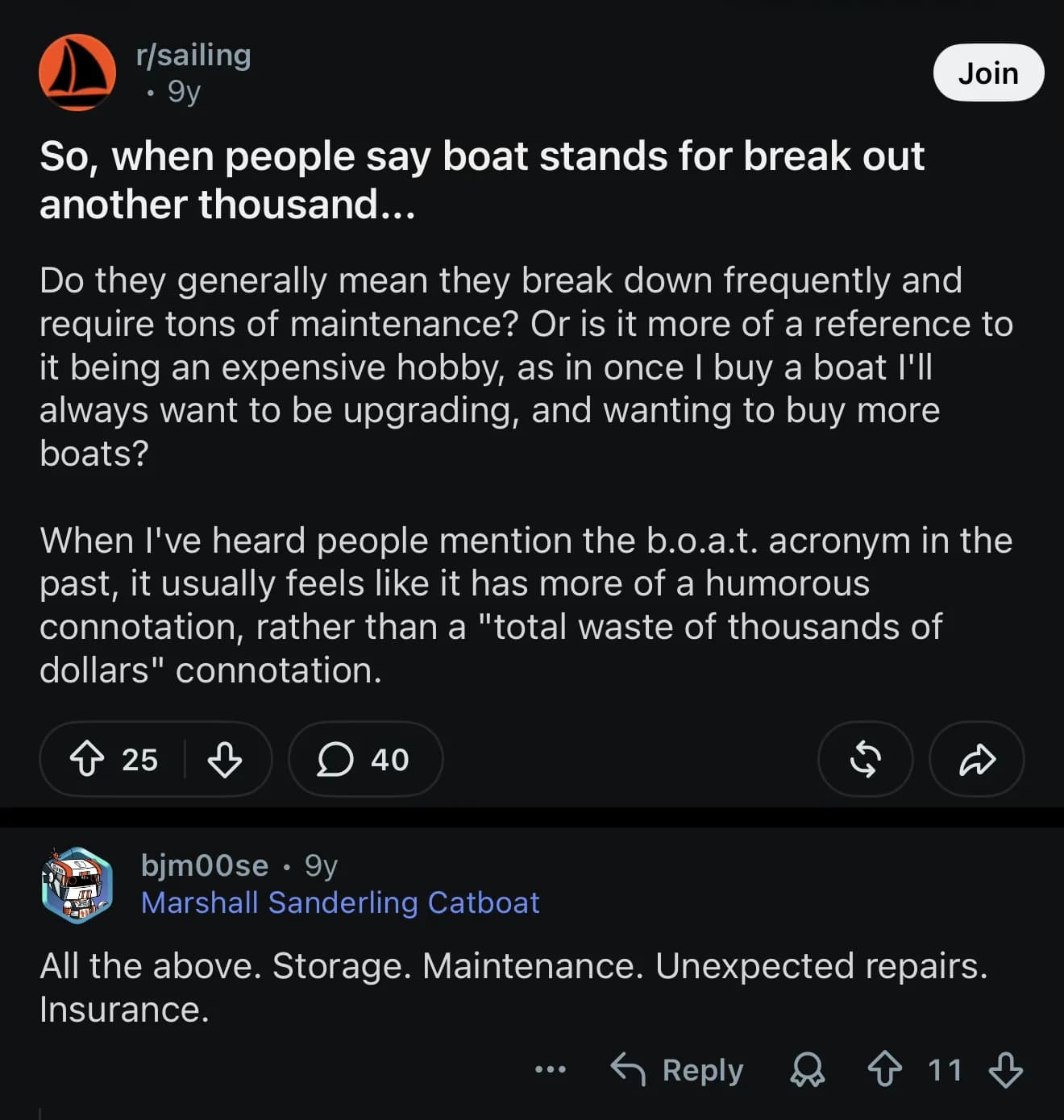
From r/sailing.
The person asking that question drew a better distinction than most finance writing does. Later in the thread he adds that storage, insurance, and to some extent maintenance can be calculated, and that he is fine with those. What worries him is the part that cannot be budgeted. That is the right thing to worry about, and it is only half the problem.
The short version
Work a $75,000 boat on conventional financing all the way through and the loan payment comes to about 27% of what ownership costs. Interest, depreciation, and the return given up on the money tied up in it make up another 44%, and none of those appear on a loan application. Across the five boats in the calculator below the same split holds, 27% to 31% payment and 39% to 47% invisible, and the rent-versus-own break-even lands between 42 and 82 days a year. Buying can still be the right call. The question it turns on is what a day on the water is worth to you, because at 15 days a year that $75,000 boat works out to about $1,725 for each one.
What the joke is about
Boat costs are unusually easy to underestimate, and it is worth being precise about why. Five things combine:
- The price is one number and the costs are forty. Slip fees, insurance, registration, bottom paint, anodes, impellers, winterization, spring commissioning, safety gear, electronics, canvas, upholstery, trailer bearings, and fuel all arrive separately.
- Costs scale with length and systems, not with price. A $60,000 twenty-year-old cabin cruiser with twin inboards, plumbing, and air conditioning costs far more to run than a $60,000 new outboard boat on a trailer. The market knows this, which is part of why the older boat is cheap.
- Salt water and sun are relentless. Corrosion, fouling, and UV damage do not pause because you did not go out.
- The bills are lumpy. One cruiser describes paying $750 to have his fuel tanks cleaned, on top of a diesel mechanic’s bill, on a trip he had planned around neither.1 Nothing about that is a monthly average.
- An unused boat still costs money. Storage, insurance, registration, and depreciation continue through a season you missed entirely.
The framework for separating cash cost from economic cost from exit value is worked through in the car cost of ownership guide, and it applies here unchanged. What follows uses it rather than rebuilding it.
The payment is a quarter of this boat’s cost
Take a $75,000 boat, 15% down, financed at 7.5% over fifteen years, which is a normal marine loan structure. Put it in a seasonal slip at $4,000, insure it for $1,200, register it for $400, budget $2,000 for routine service and $800 for winterizing and commissioning, set aside $2,500 a year against future repairs, and run it 60 engine hours at 12 gallons an hour with fuel at $5.00.
| Annual cost, first year | Cash view | Economic view |
|---|---|---|
| Loan payments ($591 a month) | $7,092 | interest only, $4,700 |
| Storage, insurance, registration | $5,600 | $5,600 |
| Maintenance, seasonal, repair reserve | $5,300 | $5,300 |
| Fuel | $3,600 | $3,600 |
| Depreciation | not a bill | $6,000 |
| Return given up on the down payment | not a bill | $675 |
| Total | $21,592 | $25,875 |
The loan payment is 27% of the economic cost. Interest, depreciation, and forgone return together are 44%, and a lender will never mention any of them, because a lender is assessing whether you will repay rather than whether this is a good idea.
Loan principal appears in the cash column and drops out of the economic one, because repaying principal converts cash into equity rather than consuming it. Both columns are real. The first is what leaves your account; the second is what the year cost you.
That 27% is the one figure here that moves a lot with your own terms, so it is worth knowing which way. Shorten the same loan to ten years and the payment becomes 35% of economic cost. Put half down instead of 15% and it falls to 16%. The share of cost you can see on a statement is largely a function of how you financed it, while the total barely notices.
Paying cash changes who you owe
A common response is to buy outright and skip the financing. It helps less than people expect.
Pay cash for the same boat and the $4,700 of first-year interest disappears, but opportunity cost rises from $675 to $4,500, because now the whole $75,000 sits in the boat instead of earning something. Economic cost falls from $25,875 to $25,000, a saving of about 3%. Paying cash improves your cash flow and your flexibility, and it barely touches the cost.
What nobody can tell you about depreciation
Depreciation is the largest single line in that table, so it is worth knowing how well anyone knows it. The answer is uncomfortable.
Boat articles routinely state that a new boat loses 10% to 15% in the first year, or that maintenance runs 10% of value annually. I went looking for where those numbers come from.
The marine industry has two designated valuation authorities. BUC International has published used-boat price guides since 1961. It publishes no depreciation curve, no rate, and no methodology specification. Its fullest public statement on method says dealer and broker sales reports feed formulas which “are then used to adjust the retail prices published in the previous BUC Used Boat Price Guide.”2 That describes values chained forward from the prior edition rather than repriced from closed transactions.
ABOS Marine Blue Book, now part of Price Digests, publishes no methodology at all and no depreciation content of any kind.3 The National Marine Manufacturers Association publishes no depreciation figure either, which is unsurprising given that its members sell new boats.
The one government economic depreciation rate covering recreational boats comes from the Bureau of Economic Analysis, which assigns 16.5% a year on a declining balance to the consumer durables category that contains them.4 Read the footnotes and that number is a default. BEA classifies it as a Hulten-Wykoff type C asset, defined as one for which the researchers “had no data” and an average rate estimated from other asset classes was substituted. The category lumps boats in with bicycles, sports equipment, cameras, and pleasure aircraft.
I could not find a peer-reviewed empirical depreciation curve for recreational boats. That may mean one exists somewhere I did not reach, but the search was not casual.
Two practical consequences. The 8% a year used above is an assumption, and the only government figure is roughly double it, so the example leans optimistic rather than pessimistic. And when a broker or an article tells you a particular boat holds its value well, ask what that rests on. The answer usually rests on experience, which is worth something and is a different thing from data.
What a day on the water costs
Cars are measured in cost per mile. Boats should be measured in cost per day, because the binding constraint is not distance but how many times you actually go.
| Days used in the year | Economic cost per day |
|---|---|
| 6 | $4,313 |
| 10 | $2,588 |
| 15 | $1,725 |
| 25 | $1,035 |
| 40 | $647 |
| 60 | $431 |
Two things follow. The first season is the most expensive one you will ever have, because depreciation is steepest early and the loan balance is largest. And the difference between a good outcome and a bad one is mostly not the boat. It is the number of days.
The number that decides it
Renting or chartering has no fixed cost. Owning is mostly fixed cost plus a little fuel. So the two cross at a specific level of use:
where is your annual fixed cost of ownership, is the daily rate for a comparable rental or charter, and is what a day out costs you as an owner, which is mostly fuel. Below days a year, renting is cheaper. Above it, owning is.
| Boat | Fixed cost a year | Comparable rental | Break-even days a year |
|---|---|---|---|
| $35,000 | $13,200 | $400/day | 82 |
| $75,000 | $22,300 | $650/day | 54 |
| $150,000 | $39,400 | $1,100/day | 46 |
| $300,000 | $73,500 | $2,000/day | 42 |
Even scaling the rental alternative up with the boat, the break-even sits between 42 and 82 days a year. Hold the rental rate at a generous $650 a day and ask instead what boat price breaks even at 19 days of use, and the answer is around $11,400. That is a used trailered fishing boat.
These are consequences of the assumptions rather than laws. The rental rate in your area, your storage quote, and how long an outing runs will all move the answer, which is what the tool below is for. Run its five presets, which use a different price ladder and their own cost structures, and they land in the same band, between 43 and 78 days.
Three caveats on the break-even, because it is easy to over-read. A comparable rental has to actually exist near you, and for many boat types it does not. Availability on a good Saturday in July is worth something the arithmetic cannot see. And a rental has to be planned, which quietly rules out the spontaneous two-hour evening run that is often the best part of owning.
Why the usage estimate is always high
Every buyer estimates their future usage, and the estimate has a direction. People predict optimistically because they build a plan-based scenario rather than consulting what actually happened last time, an effect Buehler, Griffin and Ross documented across a range of tasks and which weakened when subjects were prompted to recall their own past experience.5
There is a second effect specific to how boats get bought. Projection bias is the tendency to assume future preferences will resemble present ones, and Loewenstein, O’Donoghue and Rabin formalized it partly to explain the “excessive pursuit of a high material standard of living.”6 The cleanest measurement of it comes from catalog orders: when the temperature on the order date fell by 30 degrees, the probability that a cold-weather item was later returned rose by about four percentage points.7 The effect is modest and worth stating at its real size. The mechanism is exactly what a boat show in February is selling.
The arithmetic penalty for optimism is larger than the optimism itself. Cost per day moves inversely with days used, so overestimating usage by 40% raises your real cost per day by about 67%. Someone expecting 25 days who gets 15 does not pay 40% more than planned. They pay $1,725 a day against the $1,035 they had in mind.
The correction is to forecast from the last two years of your real calendar rather than an imagined one, and to run the numbers at both figures. Loewenstein and his coauthors suggested mandatory cooling-off periods for this class of decision. You can impose one on yourself for free.
When owning wins
Everything above is the cost side, and taken alone it would argue against buying anything enjoyable. That is the wrong conclusion, so here is the other half stated as strongly as it deserves.
Ownership genuinely wins when:
- You will use it a lot. Past 40 or 50 days a year the arithmetic flips and stays flipped, and cost per day falls into a range most families would find unremarkable for a day out.
- You live close to the water. Proximity is the best single predictor of whether a boat gets used, because it collapses the decision from a planned trip to an afternoon impulse.
- Spontaneity is the point. No rental supports leaving the dock at 6pm because the wind died and the light is good.
- The boat is set up your way. Your rods, your car seats, your charts, your gear left aboard. This is a real and underrated benefit, and it is exactly what a rental cannot provide.
- You want a boat nobody rents. Whole categories of sailboat and offshore fishing boat are simply unavailable to rent in most places.
- You like the work. If maintenance weekends are part of the hobby rather than a tax on it, a large cost item stops being a cost. Putting a number on your own time is worked through in the return on hassle guide, and the sign of that number is genuinely personal.
What the happiness research supports
The standard advice is to buy experiences rather than things. A boat is an awkward case for that slogan, because it is a thing bought to produce experiences, and the research is more specific than the slogan.
The category has a name. Guevarra and Howell studied “experiential products,” purchases falling between material items and life experiences, and found they delivered well-being similar to life experiences and higher than material items.8 That is a point in the boat’s favor, with two conditions that matter enormously here. Their strongest study was restricted to purchases “that turn out well,” which is the whole question. And they found experiential products produce more feelings of competence but less relatedness than shared life experiences.
That second finding is the useful one, because relatedness is where most of the experiential advantage comes from. The meta-analysis by Weingarten and Goodman put the overall advantage at a modest effect size near 0.38, estimated that roughly a third of observed effects may be publication bias, and found the advantage shrinks for negative experiences, for solitary experiences, and for consumers of lower socioeconomic status.9 Lee, Hall and Wood found it absent entirely for lower social class, whose “lesser resources engender concern with resource management and wise use of limited finances.”10
Put those together and the research says something more useful than the slogan. A boat used with family and friends sits close to the best case the literature describes, because it converts a material purchase into repeated shared experience, which is the channel carrying most of the benefit. A boat used alone, or bought by a household for whom the money is tight, sits close to the worst case. Same object, different answer.
One thing worth avoiding is the lottery-winners study that gets cited whenever anyone mentions adaptation. It surveyed 22 winners at about a 52% response rate, was cross-sectional with no before measure, covered under eighteen months, and carried a mean age gap of 23 years between groups. Its accident victims were significantly less happy than controls, which is the opposite of how the study is usually summarized.11 Adaptation is real, and the money and happiness guide covers the evidence that does support it.
Before you buy
The affordability framework for discretionary spending, including the sinking fund and what a permanent annual expense costs in portfolio terms, is worked through in the vacation spending guide, and boats are the same problem with a hull. A few things are specific to this purchase:
- Rent or charter first, for at least a season. Buying a boat to discover whether you like boating is the expensive way to run that experiment.
- Get a survey and a mechanical inspection. Treat both as part of the purchase price rather than optional extras.
- Price the storage before the boat. Slip availability and cost vary enormously by location, and in many markets the slip is the binding constraint rather than the purchase.
- Fund the repair reserve separately. A reserve is what keeps predictable maintenance from becoming an emergency.
- Prefer fewer systems. Every generator, watermaker, and second engine is another thing that fails. A simpler boat that launches easily often produces more actual days on the water than a larger one that requires planning.
- Keep it off the retirement side of the balance sheet. A boat has resale value and is still consumption. How to treat assets like this is covered in the four net worths guide.
- Log the season. Days used, hours out, people aboard, every dollar. At the end of the year you will have a real cost per day instead of an estimate, and next year’s decision becomes evidence-based.
How Summitward helps
Summitward has no opinion about boats. Two things it does bear on this decision.
The cash flow page is where a recurring lifestyle cost stops being abstract. The number that matters is not the purchase but the $20,000 or so a year that follows it, and whether that fits alongside everything else you are funding.
The retirement planner answers the version of the question that decides it: whether the ongoing cost changes your probability of funding the plan. If it does not, this is a discretionary purchase you can afford, and what remains is whether you want it. If it does, the boat is competing with something more important than a boat.
Frequently asked questions
Does BOAT really stand for Break Out Another Thousand?
It is a folk expansion rather than a real acronym, and there is no traceable inventor. Even people who use it describe it as something they have been told. Bust Out Another Thousand circulates as a variant, and owners of large yachts substitute million.
Is the 10% of value per year maintenance rule accurate?
It works as a warning label rather than a forecast, and I could not find an authoritative source behind it. Costs track a boat’s systems, length, age, water type, and storage rather than its market value. Two boats at the same price can differ by a factor of several, and the cheaper one is often cheaper precisely because the market has priced in its future bills.
How many days a year do I need to use a boat for owning to make sense?
On the assumptions in this guide, between 42 and 82 days a year depending on the boat and the rental alternative, with a $75,000 bowrider landing near 54. Change the rental rate, your storage quote, or the hours in a typical outing and that moves, which is what the calculator is for.
Does paying cash make a boat cheaper to own?
Barely. Paying cash for a $75,000 boat removes about $4,700 of first-year interest and adds about $3,800 of forgone return on the larger amount now tied up, so economic cost falls roughly 3%. It improves your cash flow and your flexibility. It does not make the boat cheap.
Is a boat ever an investment?
No. It is consumption that happens to have a resale value, which is a different thing. The framework for assets bought partly for enjoyment is in the collectibles guide, where ownership value is financial return plus emotional yield minus frictions. A boat is the extreme version: the financial return is reliably negative and the frictions run to a substantial share of value every year, so the enjoyment has to carry the whole thing. Often it does.
Key takeaways
- On conventional financing, the payment is 27% to 31% of the cost. Interest, depreciation, and forgone return make up 39% to 47% across the five worked boats, and appear on no loan application.
- Break-even runs 42 to 82 days a year in these examples. Hold the rental at $650 a day and pick 19 days as a modest season, and only a boat under about $11,400 beats renting on cost alone.
- Cost per day is the number that matters. At 15 days a year, the $75,000 example charges $1,725 for each day on the water.
- Optimism about usage costs more than the optimism. Overestimating days by 40% raises real cost per day by about 67%.
- Nobody publishes a boat depreciation curve. Both industry valuation authorities publish none, and the only government rate covering boats is a default borrowed from other asset classes.
- Who you boat with changes the answer. The experiential advantage runs mostly through shared experience, and it shrinks for solitary use and for households where the money is tight.
Related guides
- The True Cost of Owning a Car the cost framework this guide builds on, applied to an asset measured in miles rather than days.
- How Much Should You Spend on Vacations? the affordability framework for discretionary spending, including the sinking fund and what recurring costs do to a plan.
- Are Collectibles Investments? ownership value as financial return plus emotional yield minus frictions, which a boat pushes to its limit.
- Should You Buy or Lease a Car? the same access-versus-ownership question decided on holding period rather than frequency of use.
- Die With Zero vs. FIRE when spending the surplus is the right call, and what has to be funded first.
Sources
- SV Exit, “B.O.A.T. Break Out Another Thousand”, February 13, 2018. Source of the fuel-tank cleaning example and of the observation that the acronym is something owners “have been told many times.”
- BUC International, BUC Used Boat Price Guides, retrieved July 29, 2026. Source of the quoted methodology, including that the formulas “are then used to adjust the retail prices published in the previous BUC Used Boat Price Guide.”
- ABOS Marine Blue Book, now published as Price Digests Marine, retrieved July 29, 2026. No depreciation content or valuation methodology is published publicly.
- U.S. Bureau of Economic Analysis, BEA Rates of Depreciation, Service Lives, Declining-Balance Rates, and Hulten-Wykoff Categories. The 0.1650 rate on a 10-year service life applies to the consumer durables category including boats, and is classified type C, defined as assets for which the researchers “had no data” and an average rate from other asset types was substituted.
- Buehler, R., Griffin, D., & Ross, M. (1994). Exploring the “planning fallacy”: Why people underestimate their task completion times. Journal of Personality and Social Psychology, 67(3), 366–381.
- Loewenstein, G., O’Donoghue, T., & Rabin, M. (2003). Projection Bias in Predicting Future Utility. Quarterly Journal of Economics, 118(4), 1209–1248. Includes the authors’ suggestion of mandatory cooling-off periods for certain consumer decisions.
- Conlin, M., O’Donoghue, T., & Vogelsang, T. J. (2007). Projection Bias in Catalog Orders. American Economic Review, 97(4), 1217–1249. A 30 degree decline in order-date temperature raised the return probability by 3.95%.
- Guevarra, D. A., & Howell, R. T. (2015). To have in order to do: Exploring the effects of consuming experiential products on well-being. Journal of Consumer Psychology, 25(1), 28–41. Experiential products deliver well-being similar to life experiences and more than material items, with more competence and less relatedness. Study 3 is restricted to purchases that turn out well.
- Weingarten, E., & Goodman, J. K. (2021). Re-examining the Experiential Advantage in Consumption: A Meta-Analysis and Review. Journal of Consumer Research, 47(6), 855–877. 360 effect sizes from 141 studies, d = 0.383, with about a third potentially attributable to publication bias, and reduced effects for negative, solitary, and lower-socioeconomic-status cases.
- Lee, J. C., Hall, D. L., & Wood, W. (2018). Experiential or Material Purchases? Social Class Determines Purchase Happiness. Psychological Science, 29(7), 1031–1039.
- Brickman, P., Coates, D., & Janoff-Bulman, R. (1978). Lottery winners and accident victims: Is happiness relative? Journal of Personality and Social Psychology, 36(8), 917–927. Cited here for its limitations: 22 winners at a 52% response rate, cross-sectional, under eighteen months, a mean age gap of 23 years between groups, and accident victims significantly less happy than controls.
Editor’s note
Educational content, not financial advice. Every dollar figure follows from the stated assumptions rather than from a survey of real boats, and was computed independently in Python and in the TypeScript behind the calculator, which agree to the digits shown. Local storage, insurance, and rental quotes will beat any default here and should replace them. Claims I could not source are absent rather than softened: in particular there is no national average for how many days owners use their boats in this guide, and no figure for first-year depreciation, because the search described above did not turn up a published empirical basis for one.
More in Home & Big Purchases
Browse all home & big purchases guidesGet new guides by email
Evidence-based, no jargon. At most two emails a month. Unsubscribe any time.
Try it in Summitward
See cash flow planning in action with your own financial data. Free to start, no credit card required.