

How Much Should a Fantasy Football League Cost?
Across 56,000 leagues on one escrow platform in 2023, the most common entry fee was $50. What that does and does not tell you about your league's buy-in.
A question I put to my Engineer Investor account ahead of draft season:
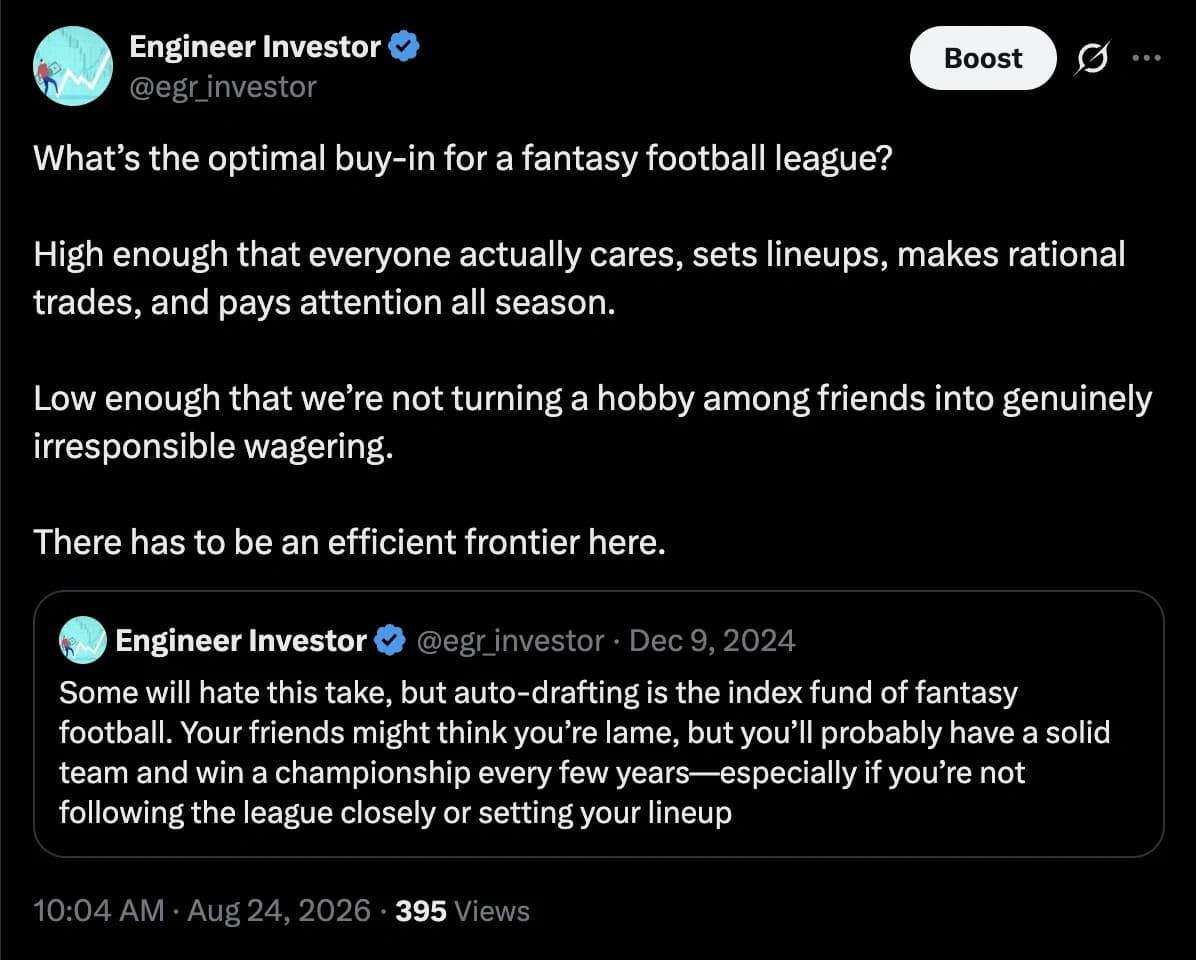
From my Engineer Investor account (@egr_investor) on X, August 24, 2026.
Disclosure: I write both Summitward and the Engineer Investor account.
Two constraints and one number. Nobody has estimated where that number sits. There is no study that assigns otherwise identical leagues to $0, $25, $50, $100 and $500 buy-ins and then measures lineup compliance, trade activity, abandonment and enjoyment. That experiment would settle the question and it has not been run.
What does exist is payment data from one platform, survey data on what people pay, motivation research on why they play, and tournament experiments on how prize structures change effort. Together they support a range, and they undercut the single most popular argument for setting the fee high.
My answer: $50 as a default, with $25 to $100 as the normal range. Treat that as a judgment call built on revealed preference and incentive theory, since the evidence underneath it does not identify an optimum. The lever most leagues reach for when engagement sags is the weakest one they have.
What leagues actually charge
Exactly one company has ever published what private leagues charge. LeagueSafe, an escrow service that holds league dues until the season ends, released figures for the 2023/24 NFL season through its then-parent SharpLink Gaming: more than $31.5 million in entry fees across more than 56,000 private fantasy football leagues.1
| Figure | 2023/24 season |
|---|---|
| Average fee per user | $55 |
| Average collected per league | $565 |
| Most common fee, $50, share of leagues | 34% |
| $25, share of leagues | 25% |
| $100, share of leagues | 20% |
| Users in a league costing $25 or more | 66.5% |
| Users in a league costing $500 or more | 0.4% |
SharpLink Gaming press release, October 10, 2023, covering more than 56,000 private LeagueSafe leagues for the 2023/24 NFL season. The $25, $50 and $100 rows are shares of leagues; the last two rows are shares of users, as published. No fuller distribution was released.
Three caveats travel with those numbers, and they all push the same direction.
The data describes the 2023/24 season. SharpLink sold LeagueSafe to RSports Interactive in January 2024 and nothing comparable has been published since. Articles presenting these figures as current are recycling a press release that is now three years old.
LeagueSafe users are a selected group. Escrow exists to solve one problem, which is a commissioner holding several hundred dollars of other people’s money for four months. Twelve friends who Venmo the guy who set up the Yahoo league have no reason to appear in this dataset. The modal $50 describes leagues that decided the pot was worth protecting, which skews above home leagues in general.
No other platform publishes anything. ESPN, Yahoo, Sleeper and Fantrax release no aggregate fee data. Every article on this topic, this one included, traces back to the same press release.
Survey data gives an independent read, and a higher one. The National Council on Problem Gambling’s 2021 national survey found 36% of traditional fantasy players reporting an average league cost of $50 or less, with 41% reporting more than $100. In the 2018 wave, half reported $50 or less and only 12% reported more than $100.2 That survey sampled 2,000 US adults, so the fantasy-playing subsample is small and the split is directional rather than precise. NCPG’s 2024 wave dropped the league-cost question, so 2021 is the most recent read available.3
For context on league size, RotoWire analyzed 36,599 NFL leagues imported into its tools and found 12-team leagues at 51.4% and 10- and 12-team formats together at 83.5%.4 That is a convenience sample of leagues belonging to people who use a fantasy research site, so it skews engaged, but it is the largest documented dataset on league settings and it contains no fee data at all.
The pot comes back out
A home league has no house. Whatever the twelve managers put in is what the twelve managers divide at the end. LeagueSafe states it takes 0% of the prize pool, charging only pass-through card processing on its paid option and nothing on e-check.5
That is a structural difference from the two activities a paid fantasy league gets grouped with. In 2025, regulated US commercial sportsbooks reported $16.96 billion of revenue on $166.94 billion of wagers, which implies books kept about 10.2 cents of every dollar wagered.6 Daily fantasy operators take a cut of each contest before prizes are paid. A home league takes nothing.
This changes what the buy-in question is asking. “How much can you afford to lose” is the right test for an activity with a house edge, where the group’s expected outcome is a loss to a third party. A twelve-team league at $50 collects $600 and pays out $600. The money moves toward the better managers and away from the worse ones, but it stays inside the friend group.
A larger buy-in buys a wider spread of outcomes among people who know each other, and higher stakes on every disputed trade. Those are the things worth pricing. For the machinery of sizing any discretionary category against the rest of a budget, see how much to spend on a vacation; the same three constraints apply here and are not worth repeating.
What a bigger buy-in buys
The case for a higher fee is that money makes people pay attention. It is intuitive, widely held, and has no evidence behind it.
No platform, survey or academic study measures league abandonment or inactive managers by stakes level. Yahoo and ESPN publish policies on abandoned teams; neither publishes rates. Nobody has compared $25 leagues to $250 leagues on lineup compliance, waiver activity or anything else. The claim that a higher fee reduces abandonment is a hypothesis awaiting its first test.
What has been studied is why people play, and money keeps landing low. A 2020 systematic review of 21 peer-reviewed studies concluded that rewards and prizes “were not necessarily a strong motivation for participating in season-long fantasy sports leagues,” and that entry fees do not appear to be a primary factor in participation.7 When Dwyer and Kim built and validated a fantasy football motivation scale in 2011, a gambling factor did emerge in their analysis and was dropped from the final scale because it correlated negatively with the criterion they validated against.8 Drayer, Dwyer and Shapiro surveyed 253 fantasy baseball players in 2013 and found that those who played for money were more strongly motivated by the social benefits of participation than by the chance to win money, which runs opposite to what the gambling literature finds elsewhere.9
There is also a selection problem hiding inside the intuition. Mills, Kwak, Lee and Lee ran an experiment in 2014 that varied the entry fee and payout advertised for a fantasy service. Higher advertised fees raised participants’ expectations that opponents would be more skilled, and participants preferred leagues where opponents sat near their own skill level. Expecting tougher opponents did not lower their estimates of their own chances.10 A high-stakes league is more engaged partly because it recruited people who wanted a high-stakes league. The fee sorted who showed up.
Broader incentive research points the same way. Camerer and Hogarth reviewed 74 experiments that varied incentive levels and reported that “the modal result is no effect on mean performance,” with variance usually reduced by higher payment.11 Ariely, Gneezy, Loewenstein and Mazar did find that very large stakes degraded performance, but their high-pay condition ran to roughly half a year of average local consumption in rural India, and in the same paper a purely physical task improved sharply under the same large stakes.12 Neither finding reaches a $50 league. Ordinary league stakes sit in the range where incentives reliably do very little in either direction.
Why the buy-in stops working in November
Whatever the fee was, it is spent by week 3. What remains is the prize money a manager can still reach. A team at 2 and 7 in week 10, in a league that pays the champion and nobody else, has an expected prize of zero. Their remaining reason to set a lineup is whatever social pressure the league generates. The entry fee appears nowhere in that calculation, and it appears nowhere whether it was $25 or $250.
People do respond to sunk costs anyway. Arkes and Blumer’s 1985 paper included a field study in which theater season-ticket buyers were randomly assigned to full price or a discount, and the full-price group attended more plays.13 Later evidence is more mixed than the classic paper suggests. An incentivized 2021 experiment found 23% of subjects sticking with an option they had earned even when a strictly better one was offered, with susceptibility predicted by cognitive reflection, and the time-based version of the effect is actively disputed.14 The bias is real, moderate and uneven. A league relying on members irrationally honoring a sunk fee is relying on a small effect that some of its members will not have.
Paying more than one place
Freeman and Gelber ran 468 subjects through a maze-solving tournament with $30 per group of six distributed three ways: equally, as a single $30 prize, or as five differentiated prizes of $15, $7, $5, $2 and $1. Output was lowest under equal pay, higher under the single prize, and highest under the differentiated prizes.15
The condition attached to that result matters, and it happens to favor fantasy. The ranking held when participants had been told how many mazes they and the others solved in a prior round. Without that information, the single-prize and multiple-prize groups performed about the same, 16.53 against 16.36 mazes. The gain came from the bottom half of the ability distribution: under full information, a single prize raised output by 6.31 mazes for the top half and an insignificant 0.93 for the bottom half, while multiple prizes raised both. People who know they are behind stop trying for a prize they cannot reach, and several prizes give them one they can. A fantasy league satisfies the information condition by construction, because standings and points are public from week 1 and everyone knows exactly where they stand.
The same study found the counterweight. Misreporting of scores also peaked under multiple differentiated prizes, and was statistically significant only in the full-information condition. Sharper incentives sharpen the incentive to game them. The fantasy analogues are convenient trades between friends whose seasons are going in opposite directions, and tanking once draft position becomes the most valuable thing still available. A league that pays several places should expect to need a trade-review rule more than a league that pays one.
Test your own payout table
The tool below holds the season structure fixed and lets you change the buy-in and the payout split. The figure worth watching is the money a team can still reach after it falls out of the playoff race, because that is the incentive that survives into November. Drag the buy-in from $10 to $500 under winner-take-all and it does not move.
The number I would set
For a conventional season-long league among friends, $50. For an office or extended-family league where getting everyone in matters more than competitiveness, $25. For a league where every member independently wants higher stakes, $100.
That rests on two facts and one test. The facts are that $50 was the modal fee among leagues willing to pay for escrow, and that no study has compared leagues above $100 with leagues at $100 on lineup compliance, trade activity, abandonment or anything else. The test is personal, and it is the same one that works for collectibles and every other hobby with a financial return of negative one hundred percent: would you pay the entry fee, before the draft, knowing with certainty that you would win exactly $0? If yes, you are buying a season of a group chat and the price is the price of a hobby. If the fee only justifies itself because you might win the pot, the stake is doing something other than buying entertainment.
One constraint applies to a group and not to an individual. Most of the value you get from a league is produced by the other eleven people showing up, which makes the buy-in a collective decision priced by the member for whom the number is real money. A $250 league among ten friends is not a $250 entertainment decision if two people agree because they do not want to leave the group. Those two set the ceiling, not the highest earner in the league.
Above roughly $100 the burden of proof flips. The question stops being whether everyone can afford it and becomes what problem a larger pot solves. If the answer is that one manager quits on his lineup in November, that is a payout-table problem and a league-rules problem, and quadrupling twelve people’s exposure is an expensive way to miss it.
I would not call $250 or $500 irresponsible in the abstract. For a homogeneous group of enthusiasts with plenty of discretionary income it may be trivial. It is worth knowing that in LeagueSafe’s 2023 data only 0.4% of users were in a league at $500 or above, so that level sits well outside the norm even among serious leagues.
Fix the maximum loss at the draft
A season-long league has one structural advantage over almost every other form of wagering: the maximum loss is known before the first game and cannot grow. That property is worth protecting, and it is easy to give away by accident.
Cash waiver fees, in-season side bets, cash penalties for finishing last, and any form of rebuy convert a fixed annual entertainment expense into a variable one that responds to how the season is going. That responsiveness is the mechanism behind chasing losses, and it is the difference between one prepaid stake and a betting habit. Use FAAB dollars rather than cash for waivers. Use a trophy, a forfeit, or a group-chat obligation for last place. Those carry the social consequence the money was supposed to supply, at no cost and no variance.
Where the responsible-gambling numbers bind
Canada’s Lower-Risk Gambling Guidelines are the most serious attempt to put numbers on this question. Young, Hodgins and colleagues derived them in 2021 from 11 population datasets across 8 countries, covering more than 60,000 people, by locating where harm curves start to bend.16 Three limits, meant to be followed together:
- Gamble no more than 1% of household income before tax per month.
- Gamble no more than 4 days per month.
- Avoid regularly gambling at more than 2 types of games.
The first is misread constantly. It is 1% of gross household income per month, not per year. On the Canadian median household income of about $70,000 the report puts it at roughly $60 a month, and on $50,000 it is about $42 a month. A reader who takes 1% of annual income lands twelve times too high.
Measured against that ceiling, a $50 season-long league is about $4 a month and does not come close to binding. Neither does $100. What binds for most people is the other two rules. A league plus a weekly parlay habit plus daily fantasy is three types of gambling across far more than four days a month, and the annual entry fee is the smallest component of it. Australia’s equivalent guidelines, derived separately, land in a similar place at 20 to 30 gambling occasions a year and two activity types.17
Two caveats the authors state and I will repeat. Lower risk is not safe: they write that people with a personal or family history of gambling or substance problems, or current anxiety or depression, should gamble less than the guidelines allow or not at all. And the published limits are the conservative end of the ranges the analysis produced, which ran from 1% to 3% on spending and 5 to 8 days on frequency; the tighter numbers were chosen partly on public-preference grounds.
Applying a gambling guideline to a season-long league is a borrowed benchmark. CCSA did not study fantasy football, and the systematic review cited earlier argues season-long play is not primarily gambling-motivated. It is useful here for the shape of the answer, which is that frequency and variety carry more risk than the size of one annual fee.
When this framework does not apply
For someone with a gambling problem or a family history of one, a paid friends league is still a wager on sports, and a free league is the version of this hobby that costs nothing to get wrong.
For anyone whose $50 is not discretionary money, none of the above applies either. The framework assumes the fee competes with restaurants and hobbies rather than with groceries.
And the number of paid leagues matters more than the price of any one. Wilkins and colleagues surveyed 635 fantasy football players in 2024 and compared those in zero, one, and two or more money leagues. The 2+ group reported higher anxiety, stress, negative mood and problematic behavior, and higher positive mood alongside it.18 Read that carefully before making anything of it: the effects are small at 2% to 3% of variance, depression and functional impairment showed no significant difference, the sample was UK Fantasy Premier League rather than US season-long NFL, and the design is cross-sectional, so it cannot say whether the leagues create the stress or whether people already invested and anxious enter more of them. It is worth what a small correlational difference is worth, which is enough to notice how many paid leagues you are in.
The same test outside fantasy
March Madness pools, home poker, golf skins games, prediction contests and office brackets sit in the same category, and the headline dollar amount tells you less about them than the structure does. $100 once a year and $20 five nights a week are different consumption patterns that happen to produce similar annual totals.
Three questions transfer. Is the maximum loss fixed before play starts and unable to grow? A poker game with rebuys fails this, which puts it in a different category from a bracket pool at the same buy-in. Is the money reachable by more than one participant? Would you pay the stake for a guaranteed zero return? A format that passes all three is an entertainment expense with a scoreboard attached.
Legality and taxes
Two things worth knowing, neither of which is legal or tax advice.
Federal law carves fantasy sports out of the definition of a bet or wager for payment-processing purposes, at 31 U.S.C. § 5362(1)(E)(ix). The carve-out has conditions, and the first is the interesting one: prizes must be “established and made known to the participants in advance of the game or contest” and their value must not be “determined by the number of participants or the amount of any fees paid by those participants.”19 A pot equal to the sum of the entry fees fails that condition by construction, which describes most home leagues. The same statute states at § 5361(b) that it does not change state law in either direction, so the carve-out was never a federal legalization of anything.
State law is where it lands, and it varies more than most players assume. Washington’s Gambling Commission lists fantasy sports, along with bracket pools and office sports pools, among the activities Washington law “has never allowed.”20 Other states license paid fantasy contests outright. Check your own state rather than a national summary.
On taxes, IRS Publication 525 says directly that “Winnings from fantasy sports leagues are gambling winnings.”21 A private league is not a payer in a trade or business, so no form will arrive; the income is reportable regardless. Platforms that do report use the section 6041 threshold, which rose from $600 to $2,000 for payments after December 31, 2025.22 The same law limited wagering-loss deductions to 90% of losses beginning in 2026, which reaches only filers who itemize. That change is worked through in sports betting versus investing.
Key takeaways
- Nobody has estimated an optimal buy-in. No study assigns identical leagues to different fees and measures what happens. Any specific dollar figure, including mine, is judgment resting on revealed preference and incentive theory.
- $50 is a defensible default and $25 to $100 a normal range. $50 was the most common fee in LeagueSafe’s 2023/24 data, at 34% of more than 56,000 leagues, though that platform’s users skew toward leagues with enough at stake to pay for escrow.
- A home league has no rake. Every dollar collected is paid back out, against roughly 10.2 cents per dollar kept by US sportsbooks in 2025. A bigger buy-in buys a wider spread of outcomes among friends, not a larger expected loss to a house.
- Raising the fee to fix late-season apathy has no evidence behind it. Nobody has measured abandonment by stakes level, prizes rank low in motivation research, and the engagement seen in high-stakes leagues is consistent with who joins them.
- Payout structure reaches the managers a bigger pot cannot. Freeman and Gelber found the highest output under several differentiated prizes, but only when participants could see where they ranked. Fantasy standings are public all season, so the condition holds.
- Keep the maximum loss fixed at the draft. Cash waiver fees, side bets and rebuys turn one prepaid entertainment expense into a variable one that tracks how the season is going.
- Frequency and variety carry more risk than one annual fee. Canada’s guidelines cap spending at 1% of gross household income per month, about $42 on a $50,000 income. A $50 league is roughly $4 a month. The four-days-a-month and two-game-types limits are the ones that bind.
How Summitward helps
Give the hobby a line item
Track a fixed entertainment budget next to savings and fixed costs, so a discretionary category stays visible instead of quietly competing with contributions.
Open the cash flow plannerFrequently asked questions
What is the average fantasy football buy-in?
The only published figure comes from LeagueSafe, which reported an average of $55 per user and $565 per league across more than 56,000 private leagues for the 2023/24 NFL season. The most common single fee was $50, at 34% of leagues. No platform has published comparable data since, and LeagueSafe’s users are leagues that chose to pay for escrow, so the figure likely sits above the average home league.
Is a $500 fantasy football league too much?
It is unusual. Only 0.4% of LeagueSafe users in 2023/24 were in a league at $500 or above. For a group of enthusiasts who all independently want that level and can pay it without thinking, it is a hobby expense. The question to answer first is what the larger pot is supposed to fix, because there is no evidence that a $500 league runs better than a $100 one.
How should we split the payouts?
Fund more than the championship, and fund at least one line that a team out of playoff contention can still reach, such as a weekly high-score pool or a consolation bracket. The experimental support for multiple differentiated prizes comes from a maze-solving tournament rather than a fantasy league, so treat specific percentages as a starting point for a league vote rather than an optimum. Expect to need a clearer trade-review rule once more than one place pays.
Will a higher buy-in stop people abandoning their teams?
No one has measured it. There is no published comparison of abandonment rates across stakes levels. What is clear is that the fee is sunk by mid-season, so it cannot motivate anyone in week 11 through the money. A prize an eliminated team can still win does that directly.
Are fantasy football winnings taxable?
Yes. IRS Publication 525 states that winnings from fantasy sports leagues are gambling winnings. A private league has no reporting obligation, so no tax form will arrive, but the income is reportable anyway. Commercial platforms report above the section 6041 threshold, which rose from $600 to $2,000 for payments made after December 31, 2025.
Is a paid fantasy football league gambling?
Legally it depends on the state. Federal law contains a fantasy sports carve-out for payment processing, but one of its conditions requires prize values to be fixed in advance and independent of the number of entrants and fees paid, which a pot equal to the entry fees does not satisfy. Washington’s Gambling Commission lists fantasy sports among activities state law has never allowed. Behaviorally, the research on season-long play finds entertainment, competition and social interaction ranking above prizes as motivations.
Should the commissioner hold the league money?
For a small, low-stakes league among people who see each other, trust settles this before arithmetic does. Escrow services exist because holding several hundred dollars of other people’s money for four months creates an awkward failure mode. If the pot is large enough that anyone would be uncomfortable, that discomfort is itself a signal about the buy-in.
Related guides
- Who Pays for the Probability? for the same consumption test applied to prediction market contracts.
- Sports Betting vs. Investing: Where the Expected Return Comes From: the house edge a home league does not have, and how the 2026 gambling-loss rules work.
- How Much Should You Spend on Vacations?: the cash-flow, liquidity and FI tests for sizing any discretionary category, which is the machinery behind the number.
- Are Collectibles Investments?: the same zero-resale-value test applied to a hobby people are more tempted to call an asset.
- What Money Can and Cannot Buy: why repeatable, shareable, anticipated spending holds up better than one-off purchases.
Sources
- SharpLink Gaming, SharpLink Gaming Announces Record Financial Performance for LeagueSafe for 2023/2024 NFL Season, October 10, 2023. The only publicly released distribution of private fantasy football entry fees. Note the published units: the $25 / $50 / $100 figures are shares of leagues, while the 66.5% and 0.4% figures are shares of users.
- Feeney, D. (2023). National Survey on Gambling Attitudes and Gambling Experiences 2.0, National Detailed Report. National Council on Problem Gambling. PDF. Ipsos panel, n = 2,000 US adults, fielded April 12 to 29, 2021. Section 6C covers fantasy sports league costs.
- National Council on Problem Gambling, NGAGE 3.0 Key Findings, 2025. n = 3,013, fielded January 26 to March 20, 2024. The league-cost question from NGAGE 2.0 does not appear in the public key findings.
- RotoWire, We Analyzed 35,000 Fantasy Football Leagues, updated June 24, 2026. n = 36,599 NFL leagues imported into RotoWire’s tools, a convenience sample of subscriber leagues with no entry-fee data.
- LeagueSafe, How to Collect Fantasy League Dues Online. States that LeagueSafe takes 0% of the prize pool, with card payments carrying pass-through processing costs.
- American Gaming Association, Commercial Gaming Revenue Hits $78.7 Billion in 2025, February 26, 2026. The AGA publishes revenue and handle; the ~10.2% ratio is our own arithmetic on those two figures and is not an AGA statistic.
- Martin, R., Kozel, K., Sewell, K., Coghill, J., & Lee, J. (2020). A Systematic Review of Motivations for Fantasy Sport Participation. Journal of Sport Behavior, 43(3). Nine databases, 21 included articles. Scoped to season-long leagues; the authors note daily fantasy needs separate work.
- Dwyer, B., & Kim, Y. (2011). For Love or Money: Developing and Validating a Motivational Scale for Fantasy Football Participation. Journal of Sport Management, 25(1), 70–83. A gambling factor emerged and was excluded from the final scale.
- Drayer, J., Dwyer, B., & Shapiro, S. L. (2013). Examining the impact of league entry fees on online fantasy sport participation and league consumption. European Sport Management Quarterly, 13(3), 339–357. n = 253 fantasy baseball participants. Cross-sectional survey, so the comparison between paid and free players is correlational.
- Mills, B. M., Kwak, D. H., Lee, J. S., & Lee, W.-Y. (2014). Competitive environments in fantasy sports gaming: effects of entry fees and rewards on opposition quality and league sorting. International Gambling Studies, 14(1), 161–180. An advertisement-stimulus experiment, not a study of real leagues.
- Camerer, C. F., & Hogarth, R. M. (1999). The Effects of Financial Incentives in Experiments: A Review and Capital-Labor-Production Framework. Journal of Risk and Uncertainty, 19(1–3), 7–42. Review of 74 experiments. Most of the comparisons are no pay against low pay rather than low against very high.
- Ariely, D., Gneezy, U., Loewenstein, G., & Mazar, N. (2009). Large Stakes and Big Mistakes. The Review of Economic Studies, 76(2), 451–469. n = 87 in rural India and n = 24 at MIT. The abstract carries the qualifier “with some important exceptions,” and the key-pressing task improved under high stakes.
- Arkes, H. R., & Blumer, C. (1985). The psychology of sunk cost. Organizational Behavior and Human Decision Processes, 35(1), 124–140. Ten experiments; the theater season-ticket study randomized the discount.
- Ronayne, D., Sgroi, D., & Tuckwell, A. (2021). Evaluating the sunk cost effect. Journal of Economic Behavior & Organization, 186, 318–327. 23% of subjects retained a dominated option they had earned. The sunk-time version of the effect remains contested in later work.
- Freeman, R. B., & Gelber, A. M. (2010). Prize Structure and Information in Tournaments: Experimental Evidence. American Economic Journal: Applied Economics, 2(1), 149–164. n = 468, six treatments of 78. The multiple-prize advantage and the misreporting result both appear only in the full-information condition; the working paper carries the treatment-level tables.
- Young, M. M., Hodgins, D. C., Brunelle, N., Currie, S., Dufour, M., Flores-Pajot, M.-C., Paradis, C., & Nadeau, L. (2021). Developing Lower-Risk Gambling Guidelines. Canadian Centre on Substance Use and Addiction, September 15, 2021. Derived from 11 population datasets across 8 countries and more than 260 risk curves. The guidelines are stated for gambling generally and were not developed for season-long fantasy leagues.
- Dowling, N., Youssef, G., Greenwood, C., Merkouris, S., Suomi, A., & Room, R. (2021). Guidelines for Screening, Assessment and Treatment Thresholds. Journal of Clinical Medicine, 10(2), 167, with the underlying 2018 Victorian Responsible Gambling Foundation report.
- Wilkins, L., Churchyard, J., Dowsett, R., & Britton, G. (2024). Exploring Fantasy Football Involvement and Mental Health. Simulation & Gaming, 55(6), 1032–1056. n = 635, UK Fantasy Premier League players. Effect sizes of η² = .02 to .03; depression and functional impairment were not significant; cross-sectional design.
- 31 U.S.C. § 5362(1)(E)(ix), Definitions, with § 5361(b) preserving state law. The statute governs payment processing rather than the legality of play.
- Washington State Gambling Commission, Sports wagering requirements and rules, accessed August 24, 2026. The page carries no revision date, so this is an access date rather than a publication date.
- Internal Revenue Service, Publication 525, Taxable and Nontaxable Income, 2025 edition, Gambling winnings.
- Public Law 119-21 (July 4, 2025), sections 70114 and 70433. Section 70433 raises the section 6041 information-reporting threshold from $600 to $2,000 for payments after December 31, 2025; section 70114 limits wagering-loss deductions to 90% of losses for tax years beginning after December 31, 2025.
Author disclosure
Educational content, not investment, tax, or legal advice. I write both Summitward and the Engineer Investor account on X, and this piece grew out of a question posted there. I play in season-long leagues.
More in Getting Started
Browse all getting started guidesGet new guides by email
Evidence-based, no jargon. At most two emails a month. Unsubscribe any time.
Try it in Summitward
See cash flow planning in action with your own financial data. Free to start, no credit card required.