

The HSA Investing Strategy: Triple Tax Advantage for High Earners
Only 15% of HSA holders invest their funds. The rest are leaving the most tax-advantaged account in America sitting in cash. Here is the receipt hoarding strategy, the math, and who it is (and is not) for.
The Most Tax-Advantaged Account in America
The Health Savings Account (HSA) is the only account in the U.S. tax code with a triple tax advantage: contributions are tax-deductible, investment growth is tax-free, and withdrawals for qualified medical expenses are tax-free. No other account offers all three. Not 401(k)s (taxed on withdrawal). Not Roth IRAs (no deduction). Not taxable brokerages (taxed on everything).
Yet only 15% of HSA holders invest their funds beyond cash (EBRI 2023 data). The other 85% are using the only triple-tax-advantaged account available as a checking account for copays. If you are a high earner on a qualifying high-deductible health plan, this is one of the biggest missed opportunities in personal finance.
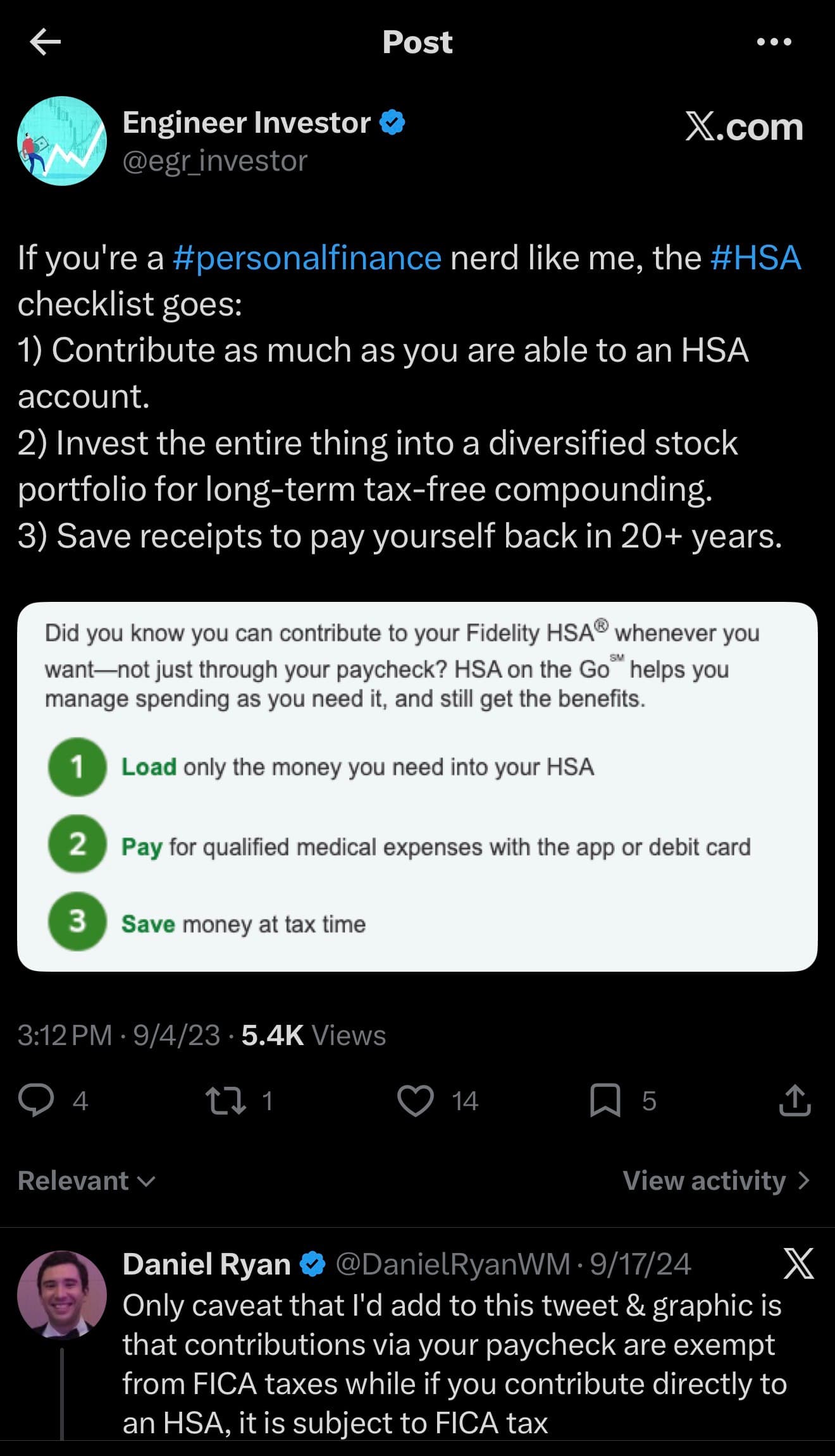
Source: @egr_investor
The Triple Tax Advantage, Explained
- Tax 1: Contributions are deductible. HSA contributions reduce your taxable income. At a 32% federal rate, a $4,400 individual contribution saves $1,408 in federal taxes alone.
- Tax 2: Growth is tax-free. Dividends, capital gains, and interest inside the HSA are never taxed. Unlike a taxable brokerage, there is no annual tax drag from dividends or realized gains.
- Tax 3: Withdrawals are tax-free. When you withdraw for qualified medical expenses (deductibles, copays, prescriptions, dental, vision, Medicare premiums), no tax is owed. Not even on the gains.
Bonus: FICA exemption. Contributions made via payroll deduction through a Section 125 cafeteria plan are also exempt from FICA taxes (7.65%). This is a benefit that direct contributions do not receive. If your employer offers payroll HSA contributions, use them.
2026 HSA Limits
| Category | 2026 Limit |
|---|---|
| Individual contribution | $4,400 |
| Family contribution | $8,750 |
| Catch-up (age 55+) | +$1,000 |
| HDHP minimum deductible (individual) | $1,700 |
| HDHP minimum deductible (family) | $3,400 |
| Max out-of-pocket (individual) | $8,500 |
| Max out-of-pocket (family) | $17,000 |
Source: IRS Revenue Procedure 2025-19.
Calculate Your HSA Tax Savings
Use the calculator below to see your immediate tax savings this year and the long-term growth advantage of investing your HSA versus a taxable brokerage account.
HSA Tax Savings Calculator
2026 max: $4,400 individual / $8,750 family
Immediate Tax Savings This Year
$1,408
Federal (32%)
$220
State (5%)
$337
Payroll tax*
$1,965
Total saved this year
*Assumes full 7.65% payroll tax savings (6.2% Social Security + 1.45% Medicare) via Section 125 cafeteria plan. For earners above the 2026 SS wage base ($184,500), only the 1.45% Medicare portion applies on marginal dollars, reducing the savings rate to 1.45% (or 2.35% above $200,000 with Additional Medicare Tax). Direct contributions are not FICA-exempt.
Long-Term Investment Growth: HSA vs. Taxable
$297.8K
HSA value at year 25
$151.8K
Taxable equivalent
$145.9K
HSA tax advantage
$187.8K
Tax-free investment gains
The growing gap between the solid (HSA) and dashed (taxable) lines is the cumulative tax advantage. After 25 years, the HSA is worth $145.9K more than the taxable equivalent.
See how HSA fits into your full retirement projection with Summitward's cash flow tool.
How the Calculator Works
The HSA future value uses the annuity-due formula (contributions at the beginning of each year):
where is the annual contribution, is the expected annual return, and is the number of years invested.
The taxable equivalent reduces the contribution by current taxes and applies an annual tax drag on returns:
where and are the federal and state marginal rates, and is the annual tax drag on a taxable portfolio (derived from the LTCG rate applied to the federal bracket). The gap between and captures both the upfront deduction benefit and the advantage of tax-free compounding.
The Receipt Hoarding Strategy
This approach is legal and underused. Per IRS Publication 969, there is no time limit on when you can reimburse yourself for qualified medical expenses from your HSA. The only requirement is that the expense was incurred after the HSA was established.
The strategy:
- Contribute the maximum to your HSA each year.
- Invest everything in a diversified stock portfolio (total market index funds). Do not leave it in cash.
- Pay medical expenses out of pocket using taxable funds. Do not use the HSA debit card.
- Save every receipt. Doctor visits, dental work, prescriptions, glasses, copays. Scan them, store them digitally.
- Reimburse yourself decades later. After 20-30 years of tax-free compounding, submit your accumulated receipts and withdraw the total, tax-free.
The result: you get the full benefit of tax-free compound growth for decades, then withdraw the money tax-free using receipts you have been accumulating. It is essentially a Roth IRA with no income limits, no age restrictions on contributions (as long as you have HDHP coverage), and an additional upfront deduction.
After Age 65: The Stealth Retirement Account
After age 65, the HSA becomes even more flexible:
- Medical withdrawals remain tax-free, including Medicare Part B and Part D premiums, long-term care premiums, and all the usual qualified expenses.
- Non-medical withdrawals are penalty-free and taxed as ordinary income, exactly like a traditional IRA. Before 65, non-medical withdrawals carry a 20% penalty.
- No required minimum distributions. Unlike 401(k)s and traditional IRAs, HSAs have no RMDs at any age. You can let the money compound indefinitely.
This makes the HSA a uniquely flexible retirement tool. You can use it for medical expenses tax-free at any age, or use it as a traditional IRA substitute after 65, or let it compound with no RMDs as a legacy account.
Who This Strategy Is For
- High earners on qualifying HDHPs. The tax savings scale with your marginal rate. At 32%+ federal, the deduction alone is worth $1,400+ per year for individual coverage.
- Investors with a long time horizon. The receipt hoarding strategy works best with 15-30 years of compounding. Younger workers benefit most.
- People who can afford to pay medical expenses out of pocket. The strategy requires using taxable funds for current medical costs while letting the HSA invest. If you cannot cover a $3,000 deductible from cash flow, this approach does not work.
- Disciplined receipt-keepers. You need to save and organize medical receipts for potential audit. Digital scans stored in cloud storage work fine.
Who This Strategy Is NOT For
- People who need the HSA for current medical costs. If you are using the HSA to pay this year's prescriptions and copays, investing it is not practical. The HSA serves its primary purpose as a medical spending tool.
- People not on an HDHP. You must be enrolled in a qualifying high-deductible health plan to contribute. HMO and PPO plans with low deductibles do not qualify.
- Risk-averse investors. Investing your HSA in stocks means it can lose value in the short term. If you need the funds for an upcoming surgery, keep that portion in cash.
Common Mistakes
- Leaving the HSA in cash. The average HSA balance for ages 35-44 is $4,438 (EBRI). Sitting in cash with no investment growth is the biggest opportunity cost.
- Using the HSA debit card for small expenses. Every $50 copay paid with the HSA card is $50 that could have been invested and compounded tax-free for decades.
- Contributing directly instead of via payroll. Direct contributions miss the FICA exemption (7.65%). On a $4,400 contribution, that is $337 in additional savings you leave on the table.
- Not tracking receipts. Without receipts, you cannot reimburse yourself later. The IRS has no time limit on reimbursement, but they can audit at any time. Save everything digitally.
Frequently Asked Questions
Can I invest my HSA in stocks?
Yes, if your HSA provider offers an investment option. Fidelity, Lively, and HSA Bank all offer brokerage-style investment accounts within the HSA. Some employer-provided HSAs have limited investment options; you can transfer to a provider with better options.
Is there really no time limit on reimbursement?
Correct. IRS Publication 969 states that distributions from an HSA used to pay for qualified medical expenses are not included in gross income, with no deadline specified. The only requirement is that the expense was incurred after the HSA was established.
What happens to my HSA if I leave my employer?
The HSA is yours regardless of employment. It is portable. You keep the account, the balance, and the investments even if you change jobs or lose HDHP coverage. You just cannot make new contributions without HDHP enrollment.
What if I need the money for a non-medical expense before 65?
Non-medical withdrawals before 65 are subject to income tax plus a 20% penalty. After 65, the penalty is removed and withdrawals are taxed as ordinary income (like a traditional IRA). This makes the HSA a flexible retirement account after 65.
Should I max out my HSA before my 401(k)?
Generally, the priority is: (1) 401(k) up to employer match, (2) max HSA, (3) max 401(k)/Roth IRA. The HSA's triple tax advantage makes it more tax-efficient than a 401(k) for most high earners. But always capture the full employer match first.
Key Takeaways
- The HSA is the only triple-tax-advantaged account in the U.S. tax code: deductible contributions, tax-free growth, tax-free medical withdrawals.
- Only 15% of HSA holders invest their funds. The other 85% are using the only triple-tax-advantaged account as a checking account.
- The receipt hoarding strategy is legal and powerful. Pay medical costs out of pocket, invest the HSA, save receipts, reimburse yourself decades later with tax-free withdrawals.
- After 65, the HSA becomes a penalty-free retirement account with no RMDs. Non-medical withdrawals are taxed like a traditional IRA.
- Payroll contributions save an extra 7.65% in FICA. Direct contributions miss this benefit.
- This strategy requires the ability to pay medical expenses out of pocket. If you need the HSA for current costs, invest what you can and use the rest as intended.
Related Guides
- Which Account Should Pay? for when paying out of pocket wins, why saved receipts lose value to inflation, and why an HSA left to a non-spouse heir is fully taxable.
- The ACA Subsidy Cliff Is Back for the 2026 change that makes bronze marketplace plans HSA-eligible.
- The Mega Backdoor Roth: the other high-leverage tax-advantaged strategy for high-earner households whose plan supports it
- The Order of Investing Operations: the savings waterfall that places the HSA third, after cash buffer and employer match
- Roth vs. Traditional: how HSA fits into the broader tax-advantaged account hierarchy
- Tax-Aware Decumulation: how HSA fits into the early retirement withdrawal plan
- FIRE Calculator: compute your FIRE number including HSA as part of your portfolio
- Equity Compensation Tax Strategy: for tech workers, HSA + RSU tax planning work together
More in Tax Strategy
Browse all tax strategy guidesGet new guides by email
Evidence-based, no jargon. At most two emails a month. Unsubscribe any time.
Try it in Summitward
See multi-year tax projection in action with your own financial data. Free to start, no credit card required.