

College Savings Plan: What 20 Years of Tuition Data Reveals About 529 Strategy
College costs have doubled in 20 years, growing 1.6x faster than inflation. See the data from 12 elite schools, learn how 529 plans work, and use three family case studies to find your savings number.
College Costs Have Doubled. Your Savings Plan Probably Has Not.
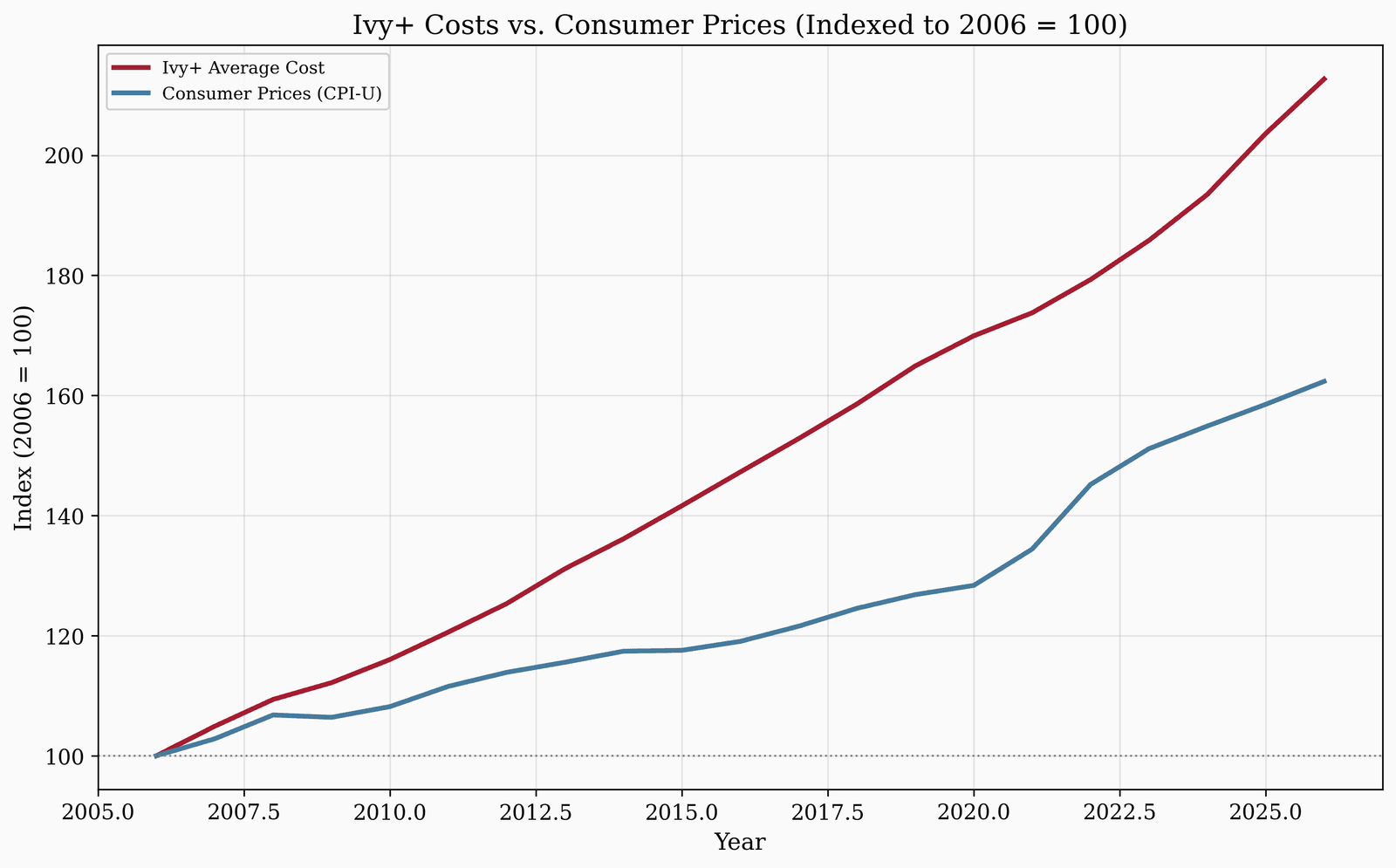
In 2006, the average total cost of attendance at an Ivy+ school was $44,069. By 2026, that number reached $93,735, an increase of 113% in twenty years. Over the same period, the Consumer Price Index rose just 63%. College costs grew 1.6 times faster than general inflation.
That gap matters because most savings calculators use CPI (around 2.5%) as their default growth rate. If you plug that number in for college costs, you will underestimate the bill by tens of thousands of dollars. The actual compound annual growth rate across these twelve schools was 3.84%, more than a full percentage point above CPI.
A quick note on sticker price versus net price: most students at elite schools pay 40% to 60% less than the published cost thanks to institutional financial aid. But upper-middle-income families earning $200,000 to $400,000 often receive little or no aid. If you are in that bracket, sticker price is the right planning baseline. This guide uses sticker prices throughout.
The Data: 12 Schools, 20 Years, Every One Beat Inflation
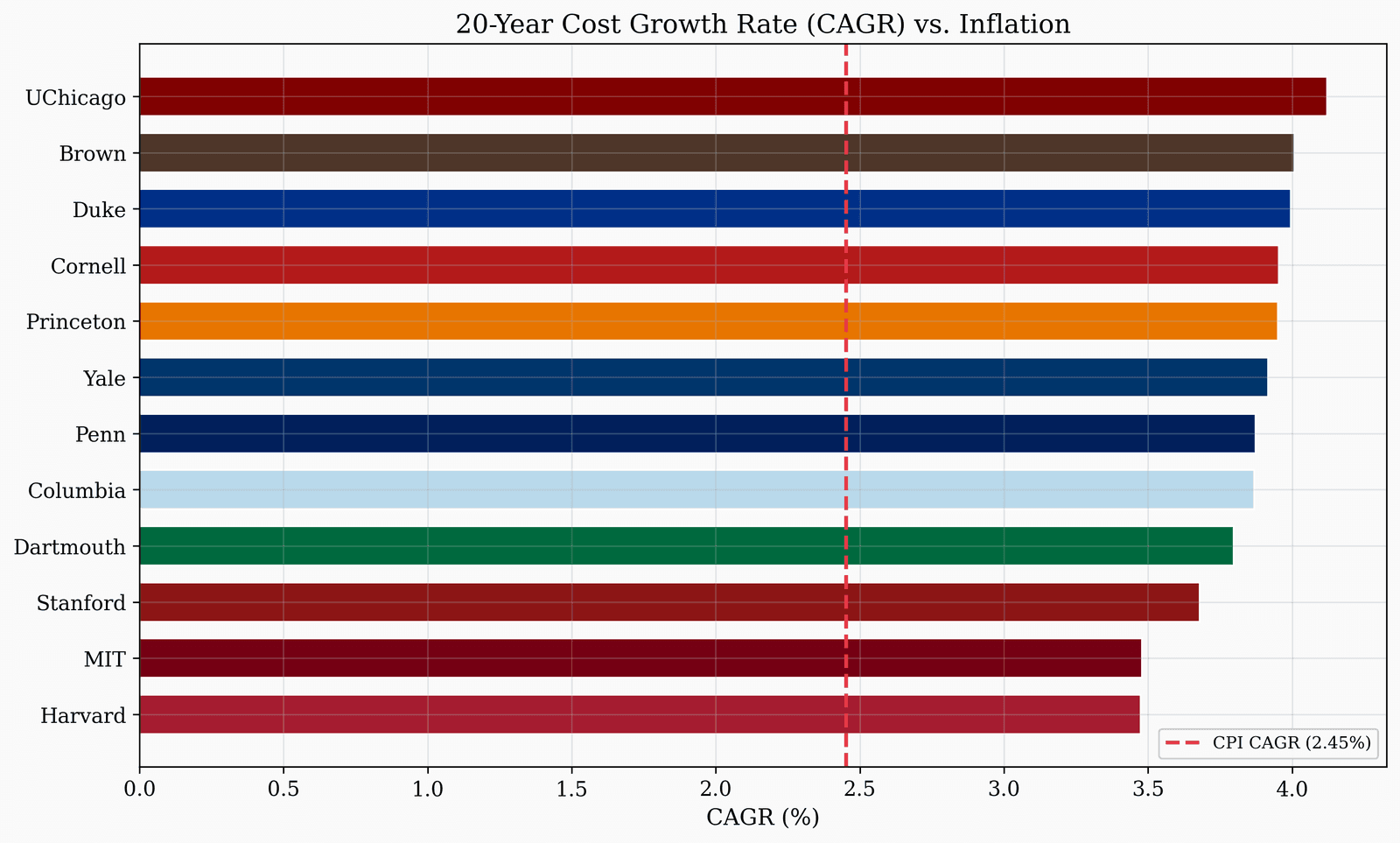
The chart above shows the 20-year CAGR for each school alongside the CPI baseline. Every single school beat inflation. Here are the summary statistics:
| Metric | Value |
|---|---|
| Average 2006 cost | $44,069 |
| Average 2026 cost | $93,735 |
| Group CAGR | 3.84% |
| CPI CAGR | 2.45% |
| Highest CAGR | UChicago (4.12%) |
| Lowest CAGR | Harvard/MIT (3.48%) |
Why do costs outpace inflation? Several structural forces are at work. Higher education is labor-intensive, which means it is subject to Baumol's cost disease: you cannot automate a seminar the way you automate a factory. Schools also compete on facilities, student services, and financial aid budgets. Administrative headcount has grown faster than faculty headcount at most universities. And demand remains inelastic: families continue to pay because the perceived return on a degree remains high.
Where Costs Are Heading: Three Scenarios to 2046
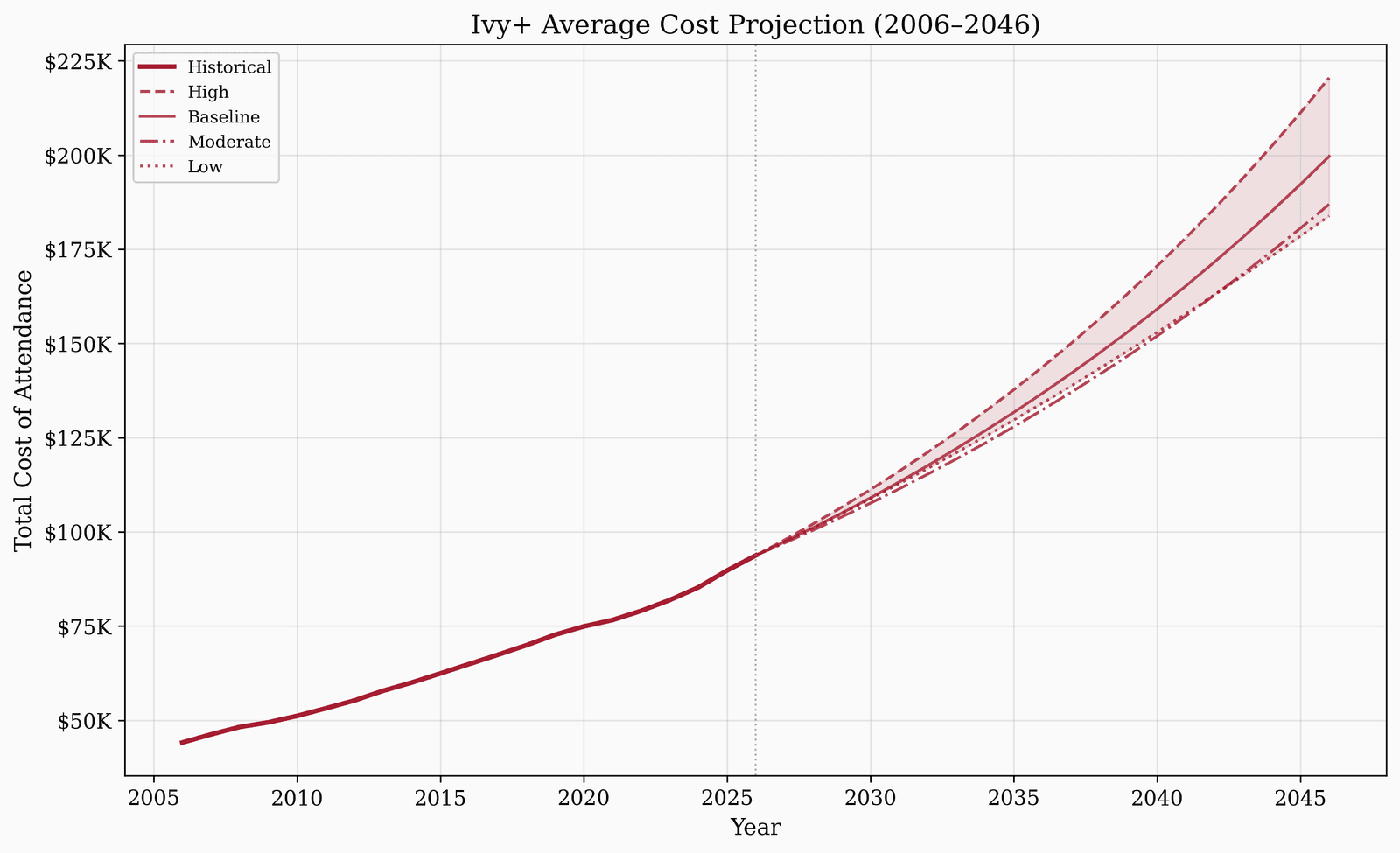
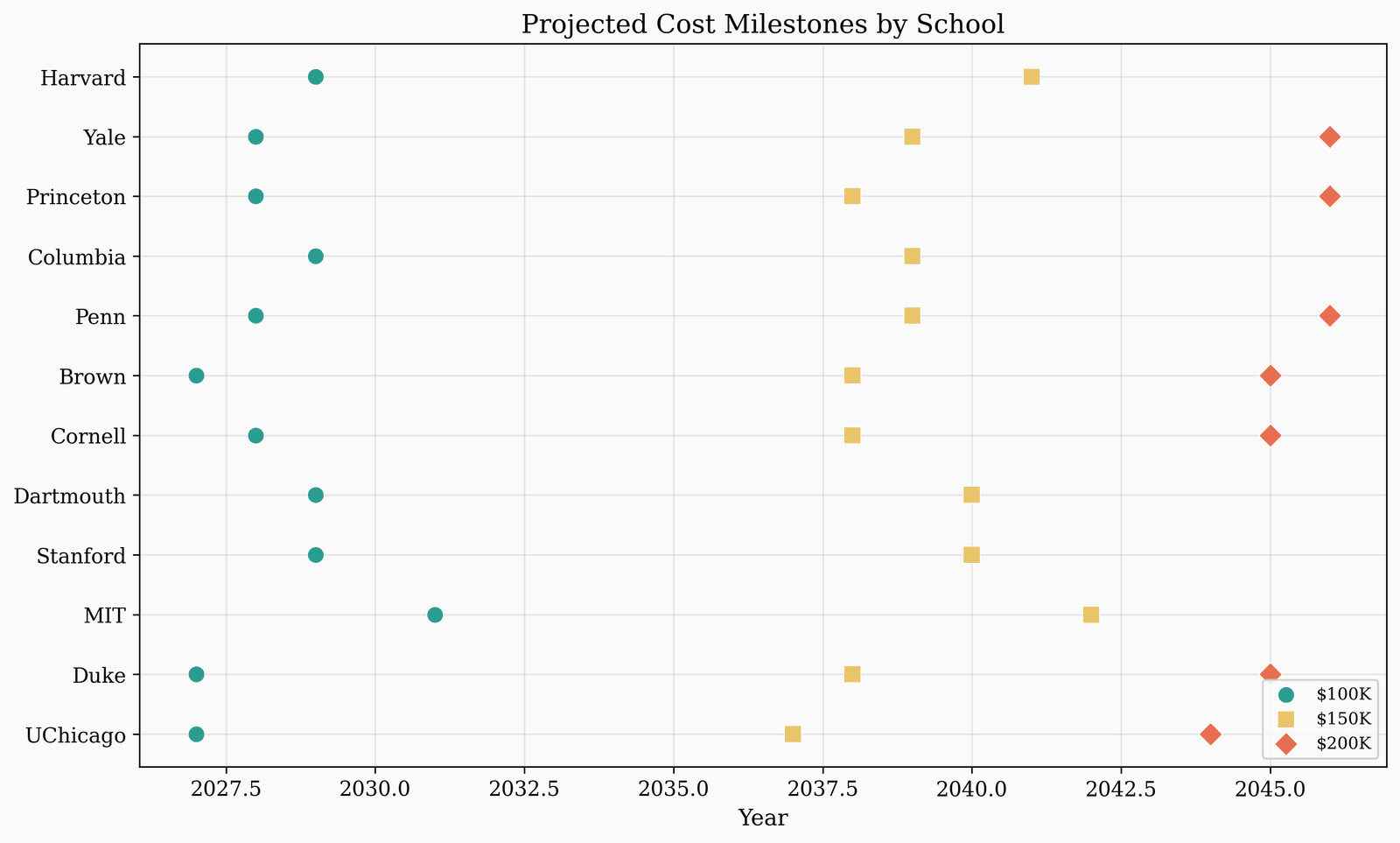
Projecting the 20-year trend forward gives three scenarios. The baseline uses the historical 3.84% CAGR. The high scenario assumes costs accelerate slightly (matching the upper quartile of school-level growth rates). The low scenario assumes some moderation from policy pressure and online competition.
| Scenario | 2035 Cost | 2046 Cost |
|---|---|---|
| High | ~$145k | ~$220k |
| Baseline | ~$131k | ~$200k |
| Low (moderation) | ~$118k | ~$165k |
These are extrapolations, not predictions. Nobody can forecast tuition with precision twenty years out. But the directional message is clear: even in the moderation scenario, costs roughly double again by 2046.
The Real Number: Cumulative 4-Year Cost
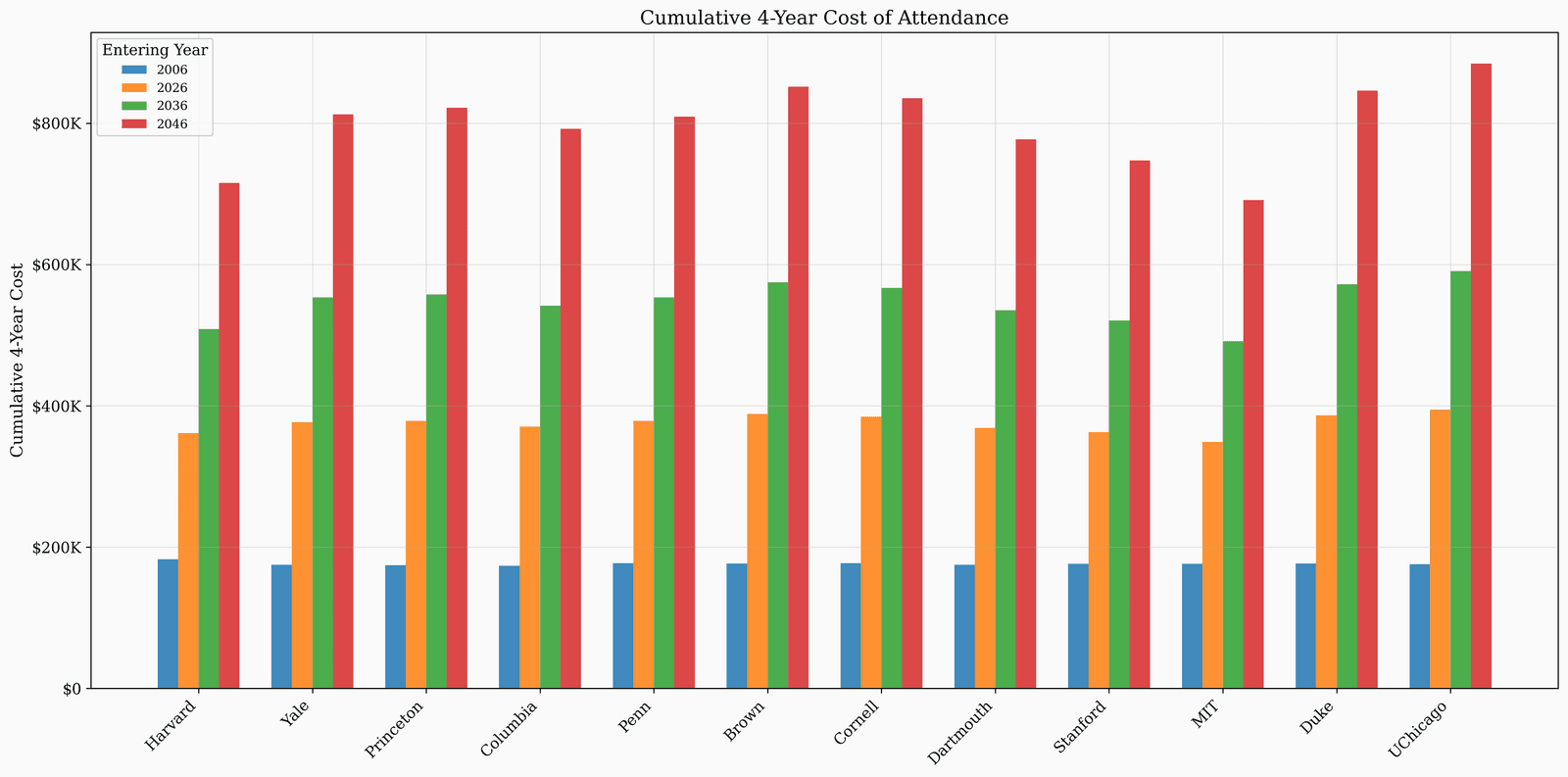
Annual cost is only part of the picture. What matters for savings is the total bill across four years. Because costs rise each year a student is enrolled, the cumulative number is always higher than four times the entry-year cost.
| Entry Year | Average 4-Year Cost | High Scenario |
|---|---|---|
| 2006 | ~$176k | — |
| 2026 | ~$375k | ~$390k |
| 2036 | ~$540k | ~$580k |
| 2046 | ~$800k | ~$910k |
These are the targets your savings plan needs to aim at. The gap between “I assumed 2.5% inflation” and “costs actually grew at 3.84%” compounds into a six-figure shortfall over an 18-year savings horizon.
How 529 Plans Work
A 529 plan is a tax-advantaged savings account designed specifically for education expenses. They are offered by every state and the District of Columbia, though you are not limited to your home state's plan.
Tax-free growth and withdrawals
Contributions grow tax-free at the federal level, and withdrawals for qualified education expenses are also tax-free. This is the same tax treatment as a Roth IRA, but with no income limits and much higher contribution caps.
State tax deductions
Many states offer a deduction or credit on 529 contributions, typically $5,000 to $10,000 or more per year. This is an immediate return on your contribution that no other education savings vehicle offers.
High contribution limits
Lifetime limits range from $300,000 to over $500,000 depending on the state. Annual contributions up to $19,000 per beneficiary (2026) qualify for the gift tax exclusion. Married couples can contribute $38,000 without filing a gift tax return.
Superfunding
The 5-year gift tax election lets you front-load up to $95,000 ($190,000 for married couples) into a 529 in a single year by spreading the gift across five tax years. This gets a large sum compounding immediately, which is especially powerful for newborns.
Investment options
Most plans offer age-based portfolios that automatically shift from equities to bonds as the child approaches college, similar to a target-date retirement fund. Static options (index funds, bond funds) are also available for families who want more control.
SECURE 2.0: unused 529 to Roth IRA
Starting in 2024, unused 529 funds can be rolled over into a Roth IRA for the beneficiary, up to $35,000 lifetime. The 529 must have been open for at least 15 years, and rollovers are subject to annual Roth IRA contribution limits. This significantly reduces the risk of overfunding.
What qualifies
Qualified expenses include tuition, room and board, books, supplies, computers, and required equipment. K-12 tuition is also eligible, capped at $10,000 per year. Student loan repayment qualifies up to $10,000 lifetime per beneficiary.
Future value formula
The core savings equation for a 529 with regular monthly contributions:
Where is the current balance, is the monthly contribution, is the monthly rate of return, and is the number of months until enrollment.
Three Families, Three Plans
Abstract numbers become real when you attach them to a family. Here are three scenarios that cover the most common planning situations.
Case Study 1: The Early Starters (newborn, public university)
Goal: Public in-state university, currently about $28,000 per year, growing at roughly 3.5% annually.
Projected 4-year cost at age 18: approximately $180,000.
The plan: $500 per month for 18 years at a 6% average annual return produces roughly $193,000. That fully funds four years of public university with a small buffer.
The insight: Starting at birth with $500 per month is enough for public school, because 18 years of compounding multiplies it. If grandparents superfund $90,000 at birth, the required monthly contribution drops to under $100.
You can model this scenario in Summitward's College Savings Planner.
Case Study 2: The Late Starters (child age 10, private university)
Goal: Private university, currently about $65,000 per year, growing at roughly 4% annually.
Projected 4-year cost: approximately $356,000.
The plan: $25,000 existing balance plus $2,500 per month for 8 years at 6% produces roughly $277,000. That covers 78% of the projected cost, leaving a $79,000 shortfall.
Options to close the gap: increase contributions to roughly $3,200 per month, target merit scholarships, or broaden the school list to include strong public universities.
The insight: Waiting until age 10 roughly doubles the required monthly savings compared to starting at birth. Each year of delay costs more than the contribution itself.
The “Find Required Savings” button in the College Savings Planner solves for the exact monthly contribution needed to hit any target.
Case Study 3: Two Children, Competing Priorities (ages 3 and 6, also saving for FI)
Goals: One child targeting private school ($65,000 per year), one targeting public out-of-state ($45,000 per year). Combined projected 4-year costs: approximately $650,000.
The plan: $1,200 per month total across two 529 accounts, split by timeline. At 6% returns, this funds about 68% of the combined target, leaving a shortfall of roughly $208,000.
The tradeoff: Every dollar directed to college savings is a dollar not going to retirement accounts. This is the central tension for families pursuing financial independence while saving for education. The standard advice holds: you can borrow for college, but you cannot borrow for retirement. Prioritize your employer match and core retirement contributions first, then allocate to 529s.
For more on balancing these priorities, see the FI Number guide and the Coast FIRE guide. If you have already reached Coast FIRE, redirecting some retirement contributions to college funding makes mathematical sense.
529 Mistakes to Avoid
- Using general CPI (2.5%) instead of college-specific growth (3.5%-4%). This single error can produce a six-figure shortfall over an 18-year horizon.
- Starting too late. Each year of delay costs more than the contribution itself because you lose a year of compounding and face a higher target.
- Overfunding a single child. Non-qualified withdrawals incur income tax plus a 10% penalty on earnings. The SECURE 2.0 Roth IRA rollover helps, but it is capped at $35,000 and requires the 529 to be open for 15 years.
- Ignoring state tax benefits. A $10,000 annual deduction in a state with a 5% income tax rate is a $500 guaranteed return every year.
- Choosing high-fee broker-sold plans over low-cost index funds. Expense ratios compound just like returns. A 0.50% fee difference over 18 years can cost $20,000 or more on a $200,000 portfolio.
- Not adjusting asset allocation as enrollment approaches. Age-based portfolios handle this automatically. If you are using static allocations, shift from equities to bonds starting 3 to 5 years before the first tuition bill.
Key Takeaways
College costs grow faster than inflation (3.84% vs. 2.45% over 20 years). Using general CPI in your savings model will leave you short. Use college-specific growth rates of 3.5% to 4% depending on school type.
Time is the most powerful variable. Starting at birth versus age 10 is the difference between $500 per month and $2,500 per month for the same target. Years of compounding matter more than contribution size.
529 plans offer unmatched tax efficiency for education. Tax-free growth, tax-free withdrawals, state deductions, high contribution limits, and the new Roth IRA rollover make 529s the default vehicle for college savings.
Sticker price is not net price, but plan for sticker if your income exceeds $200,000. Families in the $200,000 to $400,000 income range often fall in the gap between need-based aid and comfortable self-funding.
College savings and retirement savings compete for the same dollars. Prioritize your employer match and core retirement contributions first. You can borrow for college; you cannot borrow for retirement.
Model your specific situation. The numbers in this guide are averages across elite private schools. Your target school type, timeline, and existing savings will produce different results. Use the College Savings Planner to run your own scenario.
Related Guides
- Give Your Children a Floor, Not a Throne sizing a 529 as one layer of a wider inheritance policy rather than a goal in itself.
- Your FI Number: balancing college savings with retirement
- Coast FIRE: if you have reached Coast FIRE, redirect to college funding
- Rent vs. Buy: the other big financial decision with long time horizons
- The Complete Guide to Financial Independence: comprehensive plan including education funding
- 529 vs. Taxable Brokerage: after-tax math comparing 529 plans to taxable accounts
- Grandparent 529 Contributions: state tax benefits, FAFSA rules, and account ownership for multi-state families
More in Risk & Protection
Browse all risk & protection guidesGet new guides by email
Evidence-based, no jargon. At most two emails a month. Unsubscribe any time.
Try it in Summitward
See college savings planner in action with your own financial data. Free to start, no credit card required.